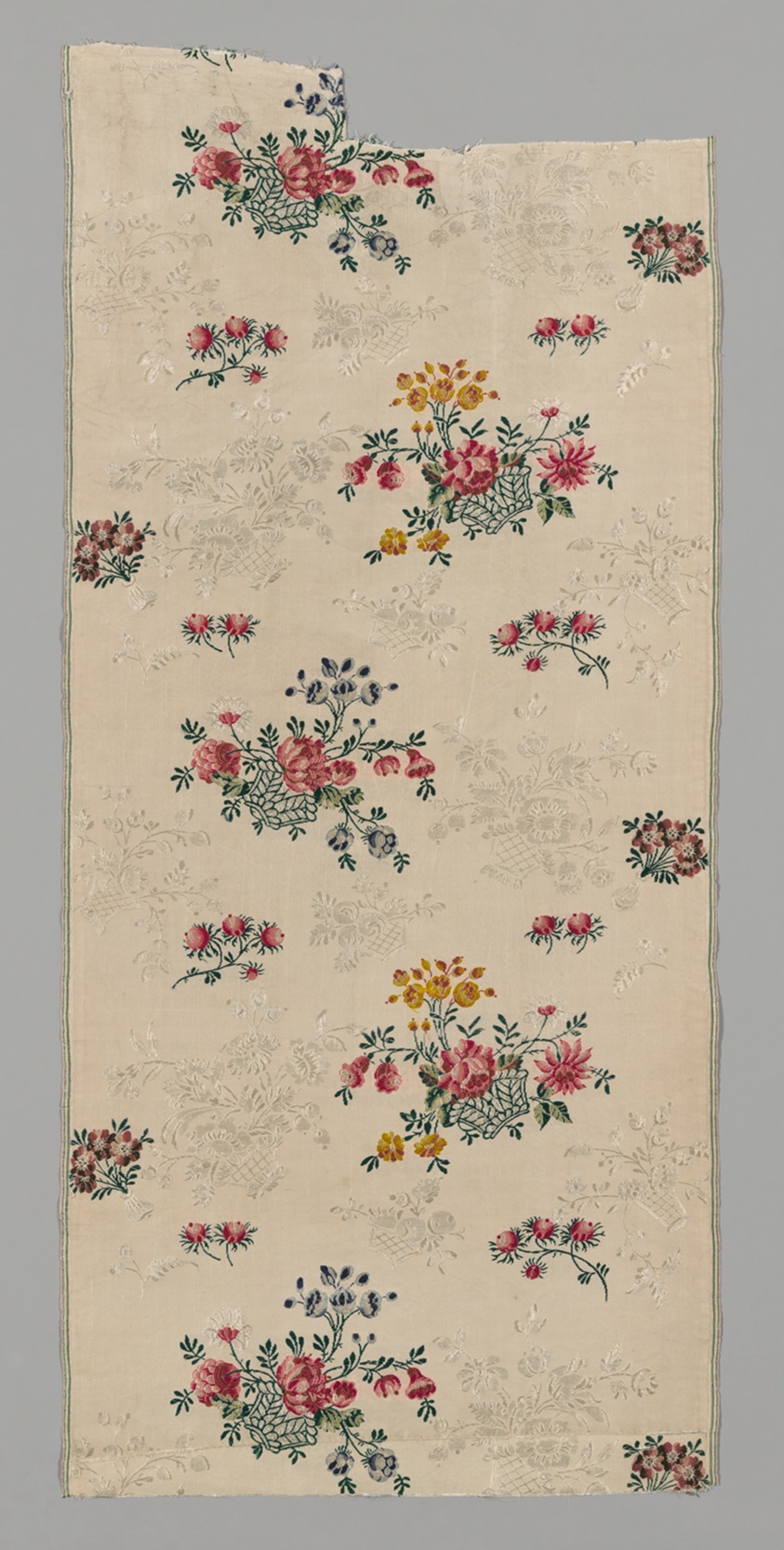
The Panel: A Study in Materiality and the Unseen Narrative of Craft
In the hushed, wood-paneled ateliers of London’s Savile Row, where the air is thick with the scent of beeswax and fine wool, we speak not merely of garments but of artifacts. The object before us—a single panel, excised from a dress—is a fragment of a larger story, a whisper of a silhouette now lost to time. Yet, within its 24 inches by 18 inches of silk, there resides a universe of technical mastery. This is not a remnant; it is a heritage research artifact that demands rigorous analysis. We shall deconstruct its materiality, its provenance, and its silent testimony to the fluid elegance that defines the highest echelons of textile art.
Materiality: The Architecture of Silk and Weave
The panel is constructed from silk, a protein fiber derived from the cocoon of the Bombyx mori silkworm. Its inherent luster, tensile strength, and hygroscopic nature make it the quintessential medium for luxury. The weave structure is a plain weave—the simplest, most fundamental interlacing of warp and weft threads. In a plain weave, each weft thread passes alternately over and under each warp thread, creating a balanced, durable fabric. However, this panel transcends the ordinary through the application of patterning and brocading wefts.
The ground weave, a fine, almost translucent silk organza, provides a diaphanous canvas. Upon this, the artisan introduced supplementary wefts—brocading threads—that float across the surface to create a raised, decorative motif. This is not a printed pattern; it is a structural intervention. The brocading wefts, likely of a heavier, more lustrous silk or possibly a metallic thread (though no metal content is detected in this sample), are woven in discontinuous sections. They are not carried across the entire width of the fabric but are inserted only where the pattern demands, a technique known as “brocading” (from the Italian broccato, meaning “to figure”). This method allows for precise, three-dimensional ornamentation without compromising the drape of the ground weave.
The pattern itself is a study in organic geometry: a sinuous, undulating vine with stylized leaves and blossoms, rendered in a matte-finish silk against the glossy ground. The contrast in texture—the smooth, reflective plain weave versus the matte, slightly napped brocade—creates a subtle, almost optical illusion of depth. This is not a fabric that shouts; it whispers of hours of hand-loom work, of a weaver’s eye calibrated to the millimeter.
Provenance and Context: The Savile Row Ethos
While the panel’s exact origin is undocumented, its materiality aligns with the golden age of couture silk weaving in Europe, circa 1890–1920. The fluid elegance of the drape, combined with the restrained opulence of the brocade, suggests it was destined for a tea gown or an evening dress of the Belle Époque or early Art Deco period. In the context of Savile Row—a district synonymous with bespoke tailoring—this panel represents a fascinating intersection of disciplines. Savile Row is traditionally the domain of wool and tweed, of structured jackets and trousers. Yet, the Row’s houses have long collaborated with silk weavers in Lyon, France, and Spitalfields, London, to source fabrics for the most refined of women’s garments.
The panel’s cut edges are telling. They are not raw or frayed; they are meticulously bound with a silk thread, suggesting it was part of a larger piece that was carefully dismantled. This is a common practice in heritage conservation: a garment is deconstructed to study its construction, to repair damage, or to archive a representative sample. The panel’s survival is a testament to the value placed on craft—even a fragment is preserved as a reference for future generations of tailors and designers.
Technical Analysis: The Weave and the Hand
Under magnification (10x–30x), the panel reveals its secrets. The warp threads are set at a density of approximately 120 threads per inch, a count that ensures a fine, stable ground. The weft threads of the plain weave are slightly less dense, at 80 picks per inch, creating a fabric that is balanced but supple. The brocading wefts, however, are inserted at irregular intervals—only where the pattern requires. These supplementary threads are not interwoven with the ground but are floated across the back of the fabric, creating a “floating” structure that is characteristic of true brocade. The reverse side of the panel reveals these floats, a chaotic yet deliberate tangle of threads that the wearer would never see but that the artisan knew intimately.
The pattern’s repeat measures 6 inches vertically and 4 inches horizontally, a scale that suggests it was designed for a garment with generous panels—a skirt or a bodice front. The motif’s asymmetry is notable: the vine does not mirror itself but flows continuously, a hallmark of hand-drawn or hand-punched Jacquard cards. This is not a machine-perfect repetition; it is an organic, human rhythm. The brocading wefts are secured at the edges of the pattern by a “tie-down” weave, a small supplementary binding that prevents the floats from snagging. This detail, invisible to the untrained eye, is a mark of technical sophistication.
Fluid Elegance: The Silent Language of Drape
The term “fluid elegance” is often overused in fashion discourse, but here it is a precise descriptor. The panel, when held, responds to gravity with a liquid fall. The plain weave ground provides a neutral base that allows the silk to cascade without stiffness, while the brocaded areas add localized weight, creating a subtle tension. When draped over a mannequin form, the panel forms gentle, organic folds—not sharp pleats, but soft, rounded curves. This is the hallmark of a fabric designed for movement, for the body in motion. The brocade does not disrupt the drape; it enhances it, acting as a counterpoint of density against the airy ground.
In the context of a dress, this panel would have been positioned to catch the light, the matte brocade absorbing shadows while the glossy ground reflected them. The effect is one of controlled opulence—a fabric that commands attention without demanding it. This is the Savile Row philosophy distilled into textile: understatement as the ultimate expression of luxury.
Conservation and Legacy: The Artifact’s Future
As a heritage artifact, this panel requires meticulous care. Silk is vulnerable to light, humidity, and mechanical stress. The panel is stored flat in an acid-free, lignin-free box, interleaved with unbuffered tissue. It is kept in a climate-controlled environment at 18–20°C and 50% relative humidity. The brocading wefts are particularly fragile; the floats can snag or abrade if handled improperly. Conservation-grade gloves are used for any examination, and the panel is never folded.
This artifact is not merely a decorative sample; it is a pedagogical tool. It teaches us about the economics of luxury (the cost of hand-looming), the geography of trade (silk from China, weaving in Lyon, tailoring in London), and the sociology of dress (the fluid elegance of the fin de siècle woman). It is a primary source for historians, designers, and conservators. In the Lauren Fashion Heritage Lab, we do not simply preserve such objects; we interpret them, extracting the knowledge embedded in every thread.
Conclusion: The Unspoken Mastery
This panel, in its silent, fragmentary state, speaks volumes. It tells of a weaver who understood the alchemy of silk and light, of a tailor who selected this fabric for its ability to transform a body into a silhouette, and of a woman who wore it, perhaps, to a soirée in Mayfair or a garden party in the Cotswolds. The panel is a witness to craft—a craft that is not dead but dormant, waiting for the next generation to reawaken it. In the hallowed tradition of Savile Row, we do not discard the past; we build upon it. This artifact is not an end; it is a beginning, a foundation for the future of heritage and design.