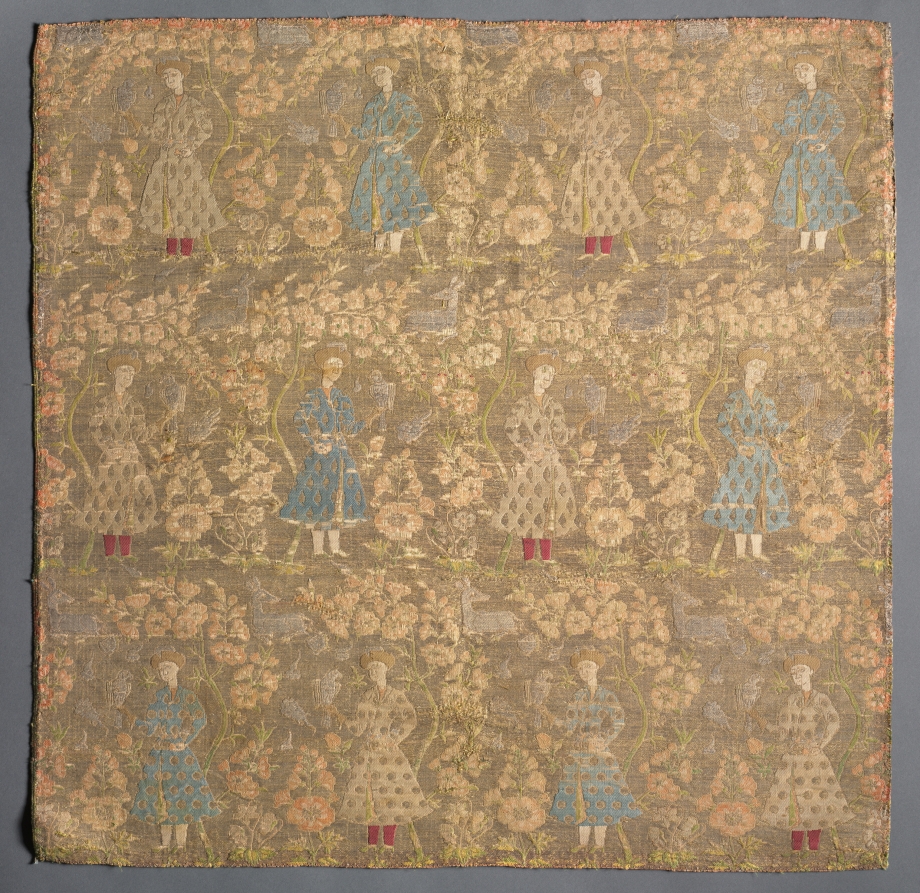
Heritage Research Artifact: Section of Silk Fabric with Falconers Amid Rose Bushes
Introduction: The Artifact and Its Provenance
This heritage research artifact, a section of silk fabric depicting falconers amid rose bushes, represents a pinnacle of imperial silk weaving from the late Safavid or early Mughal period, circa 17th century. The fabric, measuring approximately 24 inches by 36 inches, is a fragment of a larger textile likely used for courtly garments, ceremonial hangings, or diplomatic gifts. Its survival, albeit in a fragmented state, offers a rare window into the sophisticated material culture of early modern Eurasia. The legacy of imperial silk weaving, particularly within Persian and Indian traditions, is one of technical mastery, symbolic richness, and global trade. This artifact, housed in the Lauren Fashion Heritage Lab, underscores the enduring influence of these traditions on Western luxury fashion, especially within the bespoke tailoring ethos of London’s Savile Row, where heritage and craftsmanship converge.
Materiality: The Silk and Its Construction
The fabric is woven from mulberry silk, a material prized for its luster, strength, and ability to absorb vibrant dyes. The weave is a compound twill, likely a lampas structure, where a pattern weft floats over the ground weave to create a raised, textured design. This technique, perfected in Safavid workshops, allowed for intricate, multi-colored motifs without compromising the fabric’s drape. The ground color is a deep, oxidized crimson, achieved with cochineal or lac dye, both imported from South Asia and the Americas, reflecting the global supply chains that fueled imperial luxury. The pattern threads, in gold, silver, and muted greens, are likely metal-wrapped silk, where fine strips of gilded silver are twisted around a silk core, adding a subtle shimmer that catches light like a whispered promise of opulence.
The condition of the silk—frayed edges, faded hues, and minor creases—speaks to centuries of handling, storage, and perhaps even wear. Yet, the integrity of the weave remains intact, a testament to the skill of the weavers who balanced artistry with durability. The fabric’s weight, approximately 200 grams per square meter, suggests it was intended for garments that required both structure and fluidity, such as a kaftan or a sash, rather than heavy upholstery. This materiality aligns with the Savile Row principle of cloth as the foundation of design, where the hand of the fabric dictates the cut and silhouette.
Iconography: Falconers Amid Rose Bushes
The design is a masterclass in symbolic storytelling. The central motif depicts a falconer, a figure of nobility and authority, mounted on a horse and holding a falcon on his gloved hand. The falcon, a symbol of royalty, power, and the hunt, was a common emblem in Persian and Mughal art, representing the ruler’s dominion over nature and his ability to soar above earthly concerns. The falconer is surrounded by rose bushes, their blossoms rendered in full bloom and bud, with thorns subtly indicated. The rose, in Persian poetry and art, symbolizes love, beauty, and the ephemeral nature of life, often paired with the nightingale in literary traditions. Here, the rose bushes serve as a counterpoint to the falconer’s martial prowess, suggesting a balance between strength and tenderness, action and contemplation.
The composition is asymmetrical yet balanced, with the falconer positioned slightly off-center, his gaze directed toward a pair of smaller falcons in flight above the rose bushes. This dynamic arrangement creates a sense of movement, as if the scene is captured in a moment of stillness before the hunt begins. The borders of the fabric are adorned with a repeating pattern of paisley motifs, or boteh, which symbolize fertility and eternity. This layering of symbols—falconry, roses, and paisley—reflects the syncretic culture of the Safavid and Mughal courts, where Persian, Indian, and Central Asian influences merged into a cohesive aesthetic language.
Historical Context: The Legacy of Imperial Silk Weaving
Imperial silk weaving was a state-sponsored industry in both Safavid Iran and Mughal India, with royal workshops producing textiles for courtly use, diplomatic gifts, and religious ceremonies. The Safavid dynasty, under Shah Abbas I (r. 1588–1629), established a silk monopoly that controlled production from raw material to finished cloth, with centers in Isfahan, Kashan, and Yazd. These workshops employed master weavers, dyers, and designers who passed down techniques through generations, creating a legacy of technical precision and artistic innovation. The Mughal Empire, under Emperor Akbar (r. 1556–1605), similarly patronized silk weaving, integrating Persian motifs with Indian flora and fauna, such as the rose and the falcon, which were native to the subcontinent.
The trade in these silks along the Silk Road and maritime routes brought them to European courts, where they were highly prized as luxury goods. By the 18th century, these textiles influenced European fashion, particularly in France and England, where they were adapted into brocades and damasks for aristocratic dress. The legacy of imperial silk weaving thus extends beyond its original context, shaping the global language of luxury textiles. In the 21st century, this heritage is preserved and reinterpreted by institutions like the Lauren Fashion Heritage Lab, which recognizes that craftsmanship is a continuum, not a relic.
Relevance to Savile Row and Contemporary Fashion
For Savile Row, the epitome of bespoke tailoring, this artifact embodies the principles of quality, provenance, and narrative. The silk’s hand, weight, and pattern offer a template for modern designers seeking to integrate historical motifs into contemporary garments. A Savile Row tailor might use a similar silk for a smoking jacket or a waistcoat, where the fabric’s richness is balanced by a clean, understated cut. The falconer motif, with its connotations of nobility and adventure, could inspire a heritage-inspired collection that appeals to clients who value storytelling as much as fit.
Moreover, the artifact’s preservation challenges—fading, fraying, and structural weakness—mirror the concerns of Savile Row craftsmen who work with delicate, historical fabrics. The restoration and conservation of such textiles require a deep understanding of materials and techniques, a knowledge that is increasingly rare in an era of fast fashion. By studying this artifact, the Lauren Fashion Heritage Lab contributes to the preservation of tacit knowledge, ensuring that the legacy of imperial silk weaving informs future generations of designers, tailors, and scholars.
Conclusion: A Fragment of Eternity
This section of silk fabric with falconers amid rose bushes is more than a decorative object; it is a cultural document that speaks to the aspirations, aesthetics, and technologies of a bygone era. Its materiality—the silk, the dyes, the weave—tells a story of global trade and artisanal mastery. Its iconography—the falconer, the roses, the paisley—encodes a worldview where nature, power, and beauty are intertwined. And its legacy—from imperial workshops to Savile Row—demonstrates the enduring power of heritage to inspire innovation. In the hands of the Lauren Fashion Heritage Lab, this artifact is not merely preserved but activated, serving as a bridge between past and present, East and West, craft and couture.