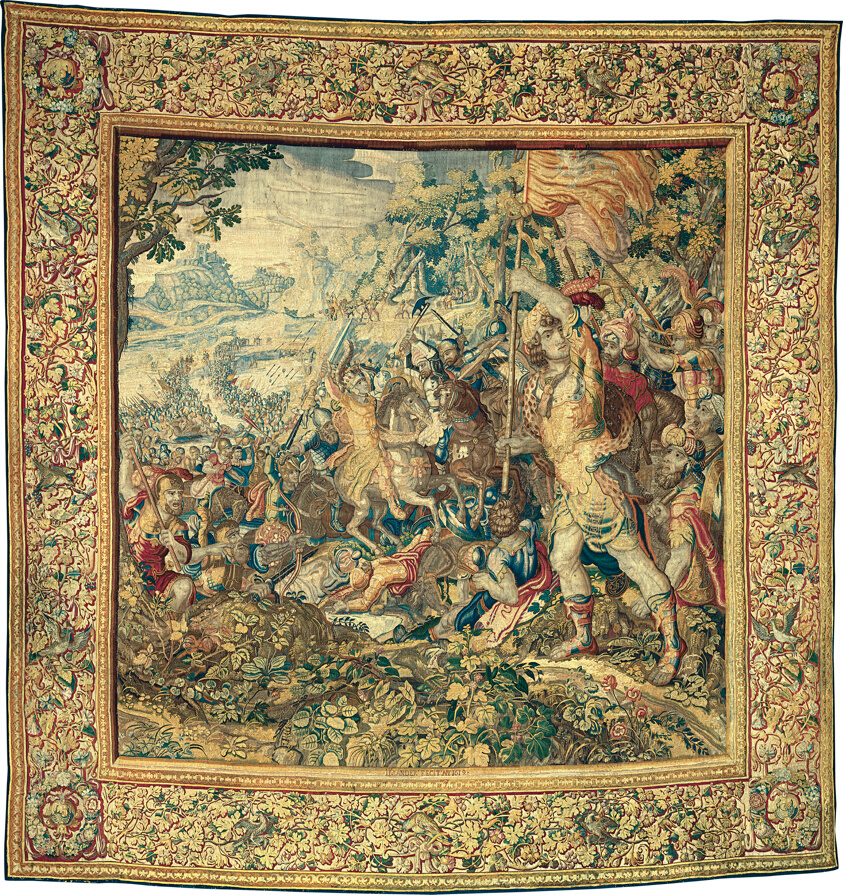
The Crossing of the Granicus: An Exegesis in Wool and Silk
To comprehend the artefact before us—a narrative tapestry depicting The Crossing of the Granicus—one must first appreciate the profound dialogue between its subject and its substance. This is not mere decoration; it is a sartorial thesis on power, fluidity, and the audacity of destiny, rendered through the most exacting of textile lexicons: the slit and double interlocking tapestry weave in wool and silk. The commission, drawing from The Story of Alexander the Great, demands a material intelligence equal to the strategic brilliance of the young king himself. Here, we find it.
Material Strategy: The Campaign of the Weave
The selection of a slit and double interlocking tapestry weave is a deliberate tactical choice, akin to Alexander’s deployment of the Companion Cavalry. This ancient technique, requiring a precision that borders on the obsessive, allows for the creation of sharply defined vertical colour fields—ideal for the rendering of spear shafts, architectural elements, and the stark, defining lines of armour. The ‘slit’ introduces a deliberate, minute void between colour transitions, a negative space that articulates form with a crispness no painted line could achieve. Yet, a campaign fought with rigidity alone would fail. Hence, the double interlock—a more fluid, intermeshing technique deployed for the organic, turbulent forms: the churning waters of the Granicus, the billowing of cloaks in the Anatolian wind, the musculature of Bucephalus. This interlocking prevents the slit, ensuring structural integrity while allowing for subtle, curvilinear modulation. The weave, thus, becomes a metaphor for the battle itself: a rigid, disciplined phalanx of form, seamlessly integrated with the fluid, opportunistic cavalry manoeuvres of colour and texture.
The Sovereign Fibres: Wool and Silk in Concert
The fibre alliance is paramount. Wool, the staple of Macedonian military dress—durable, resilient, possessing a noble matte texture and a depth of colourfast hue—bears the weight of the narrative. It defines the earthy riverbank, the heavy drapes of the Persian infantry’s trousers, the rugged texture of horse trappings. It is the foundation, the *terra firma* of the composition.
Against this, silk is the agent of luminescence and transcendence. Its role is that of the heroic highlight, the divine favour made manifest. Deployed through the tapestry weave, silk captures the specific, fleeting quality of light on water, the gleam on a bronze greave at the moment of impact, the otherworldly sheen of Alexander’s linen cuirass. The inherent fluidity and refractive index of silk thread introduce a kinetic energy, a sense of movement that is frozen yet palpably alive. This is not the blunt instrument of opulence, but a calculated use of sheen to guide the eye and elevate key narrative moments—the aristeta, or excellence, of the hero, literally woven in light.
Context & Craftsmanship: Fluid Elegance as a Philosophical Position
The context of classic silk craftsmanship and fluid elegance informs the artefact’s very philosophy. “Fluid elegance” here is neither decorative nor merely aesthetic; it is the visual articulation of Alexander’s central tactical and existential advantage: velocity. The composition must convey not a static tableau, but a decisive, violent transition—the shock of a river crossing becoming an immediate, rolling engagement.
The craftsmanship required to execute this is of the Savile Row order: a bespoke creation where every element is considered, measured, and interlocked with purpose. The weaver operates as a master tailor, understanding the drape and fall of visual elements as one understands the drape of a frescoed wool-silk cavalry cloak. The fluidity is engineered through gradations of colour within the silk wefts, through the deliberate direction of the weave to suggest current and momentum. The elegance is born of severe restraint—a limited, strategic colour palette where each hue is made to work indefatigably, and of a technical execution so flawless that the immense complexity beneath the surface reveals itself only upon the closest, most discerning inspection.
The Narrative Unfurled: A Reading of the Artefact
In the artefact itself, we observe the synthesis. The Granicus River, a diagonal tumult of interlocking wool and silk, dominates the lower register, its silk-highlighted crests breaking against the determined advance of the Macedonian line. Alexander, slightly off-centre as per the classical accounts, is a focal point of structured brilliance. His form is built with the slit weave’s clarity, yet his cloak is a masterpiece of interlocking fluidity, a swirl of Tyrian purple wool shot through with crimson silk, echoing the chaos and energy of the river he masters. The Persian commanders, their silks perhaps more lavish but less strategically deployed, appear static, their finery a trap rather than an advantage. The dying moment of Spithridates, his axe raised yet his fate sealed, is rendered in a brutal juxtaposition of slit-sharp metal and the blossoming, interlocked stain of wool on his tunic.
This heritage research artefact, therefore, stands as a testament to the principle that true luxury lies in the perfect marriage of appropriate material, narrative intent, and peerless execution. It demonstrates that the story of a king who moved with the speed and adaptability of water could only be told in a medium capable of capturing both structure and flow. The Crossing of the Granicus, in wool and silk, is more than a depiction of history. It is a woven argument for the timelessness of strategic elegance, a fabric where every thread is a soldier in the service of an immortal idea.