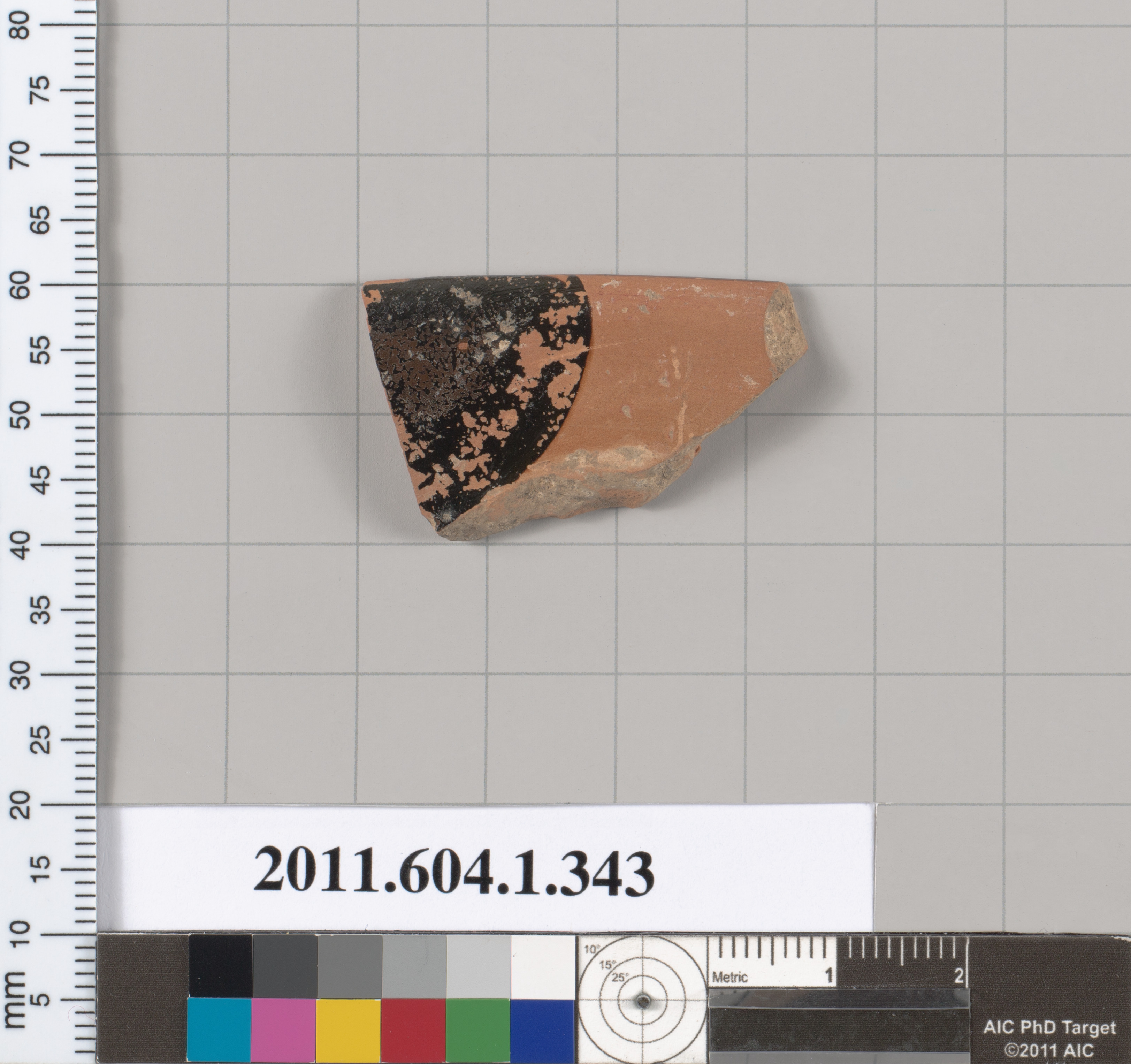
The Terracotta Fragment and the Architecture of Restraint: Reimagining Old Money Silhouettes for 2026
In the Lauren Fashion Heritage Lab, we engage in a continuous dialogue between the artifacts of antiquity and the living language of contemporary dress. The museum artifact under examination—a terracotta rim fragment of an Attic kylix, a Greek drinking cup from the 5th century BCE—offers a deceptively simple form. Yet within its broken curve and fired clay lies a profound aesthetic philosophy that directly informs the 2026 Old Money silhouette. This fragment is not merely a relic of conviviality; it is a testament to a civilization’s mastery of proportion, balance, and the quiet authority of the incomplete. These principles, when translated into the lexicon of luxury tailoring, yield a silhouette defined not by ostentation, but by an almost architectural sense of restrained permanence.
From Symposion to Silhouette: The Fragment as Formal Prototype
The kylix was a vessel for the symposion—a ritualized gathering of elite men engaged in philosophical discourse, poetry, and measured consumption. Its form was engineered for a specific social function: a shallow bowl on a stem, with two horizontal handles, designed to be held while reclining. The rim fragment we possess, with its cleanly turned edge and subtle curvature, embodies the Greek pursuit of arete—excellence through harmony. The potter’s wheel left no trace of ego; the form is pure, resolved, and subservient to its purpose. For the 2026 Old Money silhouette, this translates into a rejection of superfluous volume. The new silhouette is not about the dramatic flare or the exaggerated shoulder; it is about the precision of the line. Think of a double-breasted jacket in a dense, dark wool—its lapel width calibrated to the millimeter, its waist suppression echoing the kylix’s subtle inward curve. The garment, like the fragment, asserts its presence through the economy of its means. It does not shout; it commands attention through its refusal to be anything other than exactly what it needs to be. This is the aesthetic of the “terracotta rim”: a fragment that implies a whole, a garment that suggests a complete, ordered life.
Materiality and the Aesthetics of the Incomplete: The “Heritage-Black” Imperative
The terracotta fragment is, by its nature, incomplete. Its broken edge is not a flaw but a signature of time. This introduces a crucial concept for the 2026 silhouette: the aesthetics of the incomplete. In the context of Old Money style, this does not mean frayed hems or deconstruction. Rather, it means a deliberate withholding of finality. The garment’s finish is impeccable, but its statement is not exhaustive. A cashmere overcoat in Heritage-Black—a color that absorbs light rather than reflects it—is cut with a severity that suggests it has been passed down, that its shape has been perfected over decades. The fabric itself, like the fired clay, has a tactile density. It is not shiny, not new, but possesses a matte, almost mineral weight. The “incompleteness” is felt in the absence of logos, of overt branding, of any detail that would fix the garment in a specific season. It is a fragment of a larger, unwritten wardrobe—a piece that implies a history and a future, but refuses to narrate its own story too loudly. This is the Heritage-Black imperative: to clothe the body in a silent, enduring material that, like the kylix rim, bears the patina of intention rather than the gloss of commerce.
The Symposion’s Legacy: Proportion, Posture, and the New Geometry of Power
The kylix was designed for the hand, for the gesture of lifting and drinking. Its proportions were anthropometric, scaled to the human body in a state of reclined ease. This primacy of the body’s relationship to the object is the deepest lesson for the 2026 silhouette. The Old Money silhouette is not a shape imposed upon the body; it is a structure that emerges from the body’s own architecture. The terracotta fragment teaches us that the most powerful forms are those that respect the natural lines of tension and repose. For 2026, this manifests in a silhouette that is long, lean, and grounded. Trousers are cut with a gentle taper, falling to the shoe with a single, clean break. Jackets are slightly elongated, their shoulders soft but defined, their vents minimal. The overall geometry is one of verticality and stability, echoing the kylix’s stem and base. The garment becomes a second architecture for the body, a frame that elevates posture without constricting movement. This is the power of the fragment: it does not need to be whole to be perfect. It only needs to be true to its own internal logic.
Conclusion: The Eternal Fragment in a World of Fast Fashion
The terracotta rim fragment of an Attic kylix, broken and humble, holds a mirror to the 2026 Old Money silhouette. It reminds us that true luxury is not about accumulation but about essence. The fragment’s beauty lies in its resistance to completion—it is a permanent suggestion, an invitation to imagine the whole. The Heritage-Black silhouette of 2026, informed by this ancient artifact, will be defined by the same principle: garments that are complete in their incompleteness, that speak through their silence, that derive authority from their restraint. In a culture obsessed with the new, the loud, and the finished, the fragment offers a radical alternative: the quiet, enduring power of the partial. This is the aesthetic inheritance of the kylix—a lesson in how to build a silhouette that, like the finest fragments of antiquity, gains meaning with every passing season.