← BACK TO ARCHIVES
Silk
Heritage Synthesis: Roundel from a Tunic with Palmette Tree
Curated on May 17, 2026 // Node: LDN-01
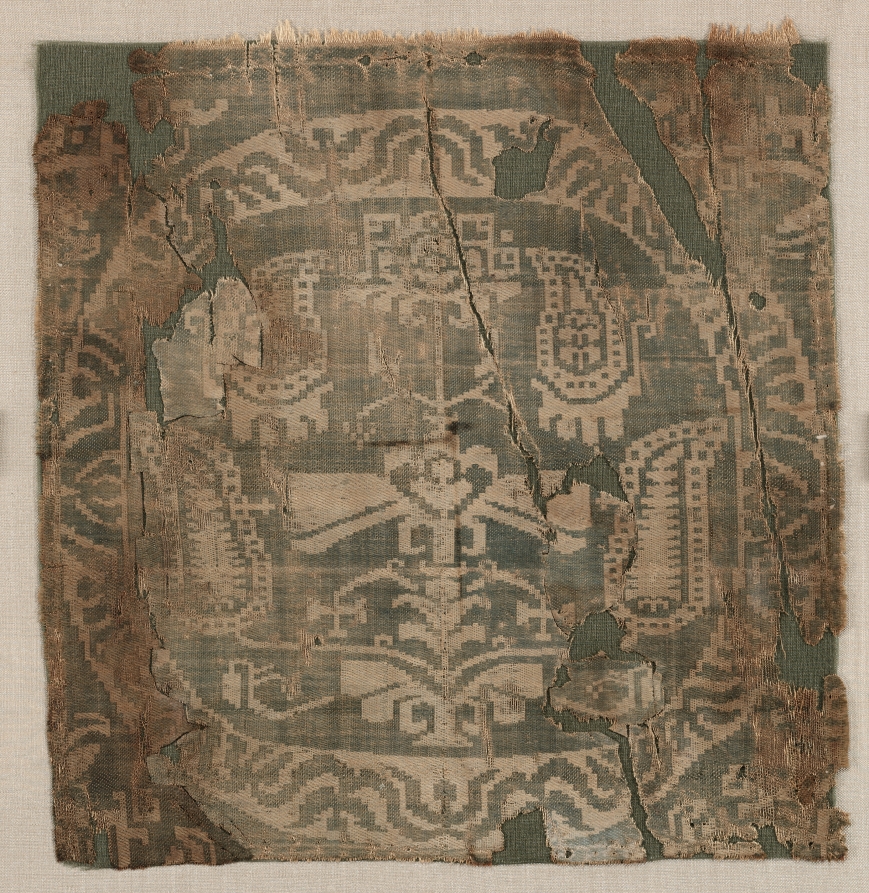
The Roundel from a Tunic with Palmette Tree: A Study in Imperial Silk Weaving and the Enduring Legacy of Craft
As a Senior Heritage Specialist at the Lauren Fashion Heritage Lab, I am frequently drawn to artifacts that transcend mere ornamentation to embody the very principles of craftsmanship, power, and continuity. The subject of this heritage research artifact—a roundel from a tunic featuring a palmette tree, woven in silk—is a profound testament to the legacy of imperial silk weaving. This piece, likely originating from the late antique or early medieval period, perhaps from the Sasanian or Byzantine empires, is not simply a fragment of fabric; it is a condensed narrative of trade, technology, and the unyielding human pursuit of beauty. In the language of London’s Savile Row, where precision, heritage, and material integrity are paramount, we must approach this roundel as a masterclass in textile engineering and design philosophy.
Materiality and the Silk Thread
The primary material, silk, is the foundational element that dictates the roundel’s significance. Silk, in the context of imperial weaving, was not a commodity; it was a currency of status, a diplomatic tool, and a medium for artistic expression. The sericulture and weaving techniques required to produce this roundel were closely guarded secrets, often monopolized by imperial workshops. The silk itself—likely a compound weave such as a samite or a twill—demonstrates a sophisticated understanding of fiber properties. The warp and weft threads are not merely structural; they are the vehicles for light, color, and texture. The sheen of the silk, even in its current fragmentary state, speaks to the quality of the raw material and the skill of the dyer. The palette, often comprising deep indigos, madder reds, and ochre yellows, was derived from natural sources, each requiring precise chemical knowledge. This is the Savile Row equivalent of selecting a super 150s wool from a specific flock in Yorkshire—the material is not chosen; it is curated.
Design and the Palmette Tree Motif
The roundel format itself is a deliberate design choice. Circular medallions were a hallmark of imperial textiles, serving as a framing device that both contained and elevated the central motif. The palmette tree, a stylized representation of a palm or a sacred tree, is a recurring symbol in Near Eastern and Mediterranean art. It is not a literal botanical illustration but an abstraction of life, fertility, and cosmic order. The tree’s symmetrical branches, often flanked by smaller palmettes or leaves, create a rhythmic, almost architectural composition. In Savile Row tailoring, we speak of the “balance of the cloth”—how a pattern sits on the shoulder or falls along the lapel. This roundel achieves a similar balance through its radial symmetry and the careful distribution of negative space. The weaver has used the warp and weft to create a visual hierarchy: the central trunk commands attention, while the surrounding palmettes guide the eye outward, creating a sense of expansion and containment simultaneously.
Technical Mastery: The Weave Structure
To truly appreciate this artifact, we must examine its technical execution. Imperial silk weaving often employed a compound weave structure, where multiple sets of warps and wefts interlace to create a pattern. The roundel likely used a weft-faced technique, where the weft threads dominate the surface, allowing for intricate color changes and fine detail. This is analogous to the “floating weft” technique used in high-end necktie manufacturing on Savile Row—a method that requires immense skill to maintain tension and prevent distortion. The weaver would have worked on a drawloom, a complex apparatus that allowed for the repetition of patterns across the fabric. The precision required to execute the palmette tree motif, with its curved lines and symmetrical elements, is staggering. Each thread had to be lifted in the correct sequence, often guided by a pattern of punched cards or a system of cords. This is the pre-industrial equivalent of a bespoke pattern draft—a bespoke algorithm for beauty.
Context: The Legacy of Imperial Silk Weaving
The legacy of imperial silk weaving is not merely a historical footnote; it is a living tradition that informs modern luxury and craftsmanship. The roundel from a tunic with a palmette tree is a direct ancestor of the patterned silks used in Savile Row for evening wear, waistcoats, and linings. The principles of design—symmetry, hierarchy, and the interplay of light and texture—are timeless. The imperial workshops of Byzantium, Sasanian Persia, and later the Islamic caliphates established standards of quality that continue to resonate. The roundel’s journey from a tunic, likely worn by a courtier or a religious figure, to a museum or private collection is a narrative of survival. It has endured centuries of wear, climate, and neglect, yet its design remains legible. This resilience is a testament to the integrity of the materials and the skill of the weaver.
Conservation and the Savile Row Ethos
In the Lauren Fashion Heritage Lab, we approach such artifacts with a conservator’s care and a tailor’s eye. The roundel’s silk fibers are fragile, prone to light damage and desiccation. Our conservation protocols mirror the meticulousness of a Savile Row cutter: we use archival materials, controlled environments, and minimal intervention. The roundel is not merely a specimen to be studied; it is a teacher. It reminds us that true luxury is not about opulence but about intention. Every thread, every dye, every weave structure was chosen with purpose. This is the same ethos that drives a Savile Row tailor to hand-stitch a lapel or to select a horn button over a plastic one. The roundel from a tunic with a palmette tree is a call to return to that standard.
Conclusion: A Fragment of Eternity
This roundel is more than a heritage research artifact; it is a fragment of eternity. It connects us to a lineage of artisans who understood that cloth could carry meaning, that a pattern could encode a worldview, and that silk could be a medium for the divine. In the context of imperial silk weaving, it represents the apex of technical and aesthetic achievement. For the modern practitioner, whether on Savile Row or in a heritage lab, it is a benchmark. It challenges us to ask: Are we upholding this legacy? Are we weaving with the same integrity? The answer, if we are honest, is that we must try. The roundel with the palmette tree is not a relic; it is a standard. And in the world of fine tailoring and textile heritage, standards are everything.
Heritage Lab Insight
Lab Insight: CMA Silk Archive Node integration.