A Disquisition on a Fragment: The Chasuble and the Loom of Empire
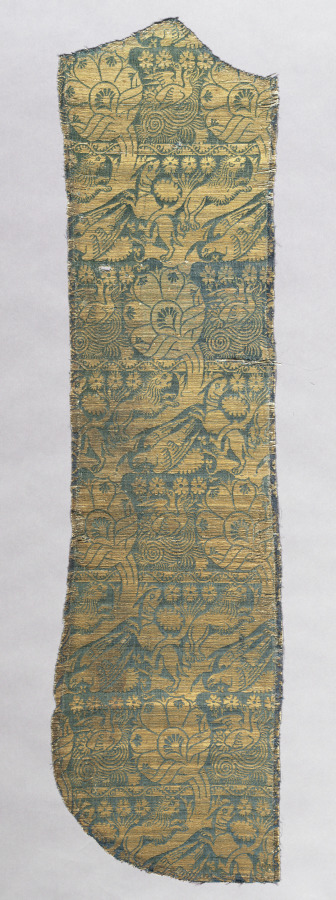
One must, in the course of a professional life dedicated to the curation of sartorial heritage, develop a certain reverence for the fragment. The complete garment, for all its narrative splendour, can often speak too loudly, its message entire and thus somewhat simplified. It is the fragment—the curated swatch, the preserved panel, the deliberate excision—that demands a more nuanced conversation. It presents not the full oration, but the most compelling paragraph, inviting the connoisseur to reconstruct the entire volume from a single page of exemplary prose. Such is the case with the subject of this disquisition: a fragment of a chasuble, executed in silk, depicting with startling vitality a menagerie of realistic animals.
The Foundation: Silk as the Substrate of Power
To appreciate the fragment, one must first understand its fundamental materiality. Silk is never merely a fabric; it is a geopolitical statement woven in filament. Its very presence in the ecclesiastical vestments of the West speaks of ancient, arduous trade routes, of Byzantine secrecy, and later, of imperial ambition. By the period to which this fragment alludes—likely the High Medieval or early Renaissance—silk was the ultimate luxury fibre, a tangible manifestation of both spiritual and temporal wealth. The loom upon which this piece was created was not merely a tool of craft; it was an instrument of state, often housed in imperial or royal workshops where technique was guarded as assiduously as crown jewels. The legacy of imperial silk weaving is, therefore, woven into every warp and weft of this artifact. It is a legacy of monopoly, of sublime technical achievement, and of the use of material splendour to articulate divine and earthly hierarchy.
A Menagerie in Microcosm: The Rhetoric of Realism
The fragment’s iconography—realistic animals—is where its narrative deepens considerably. This is not the realm of stylised heraldic beasts or symbolic lamb-and-lion allegories, though those traditions linger. Here, we observe a turn towards naturalism: a hare rendered with a pelt that seems to ripple, a hound captured mid-stride with anatomical precision, a bird whose plumage is differentiated stitch by stitch. This realism is a deliberate intellectual choice, a signal of a shifting worldview.
In the context of an ecclesiastical chasuble, this naturalism serves a profound purpose. It represents the concept of the Creation as a divine text. Each realistically depicted creature is a testament to the intricate artistry of God, a worthy subject for contemplation. The vestment, worn by the priest during the celebration of the Eucharist, thus becomes a microcosm of the created world, brought to the altar in an act of offering and transubstantiation. The silk ground, a product of human ingenuity mastering a natural filament, provides the perfect, lustrous field for this celebration of nature—a bridge between human art and divine artistry.
Craft as Command: The Technical Imperative
The Savile Row mind inevitably turns to the cut, the construction—the how of the thing. The execution of such detailed realism in silk demands a technique of the highest order: lampas or fine compound twill weave, likely executed on a draw-loom. This technology allowed for complex pattern repeats and the subtle colour gradations necessary to suggest volume and life. The designer’s cartoon, the loom’s configuration, the selection of dyestuffs—each step was a bottleneck of expertise. The rich, enduring colours speak of costly dyes—kermes for scarlet, woad for blue, perhaps even whispers of ultramarine from ground lapis lazuli, a pigment worth its weight in gold.
This level of investment—in materials, in technology, in skilled labour—was only possible under the aegis of imperial or extremely wealthy patronage. The fragment, therefore, is a direct product of economic and political power. It is a demonstration that the state or the princely church could command not only armies and taxes, but also the most refined expressions of artistic talent, directing them towards the glorification of its spiritual authority. The weave is tight, the design disciplined; there is a martial precision to this luxury, a sense of ordered splendour that is the very hallmark of imperial aesthetics.
The Fragment’s Silent Testimony
Today, divorced from the sweeping lines of the chasuble’s bell-shaped form, the fragment stands as an autonomous object. Its cut edges are not a tragedy, but a revelation. They allow us to focus on the essential: the dialogue between the demanding, unforgiving medium of silk and the artistic ambition to capture life within its threads. It whispers of the atelier’s pride, the patron’s piety, and the weaver’s silent, extraordinary skill.
In our modern pursuit of heritage, this fragment instructs. It reminds us that true luxury is born from the marriage of profound material understanding and elevated artistic vision, both supported by structures that enable excellence. The legacy it carries is not one of mere opulence, but of authoritative craftsmanship—a legacy where every stitch is intentional, every colour symbolic, and every realistic hare or hound is a deliberate act of devotion and display. It is a standard against which all subsequent endeavours in textile artistry may, quietly and respectfully, be measured.