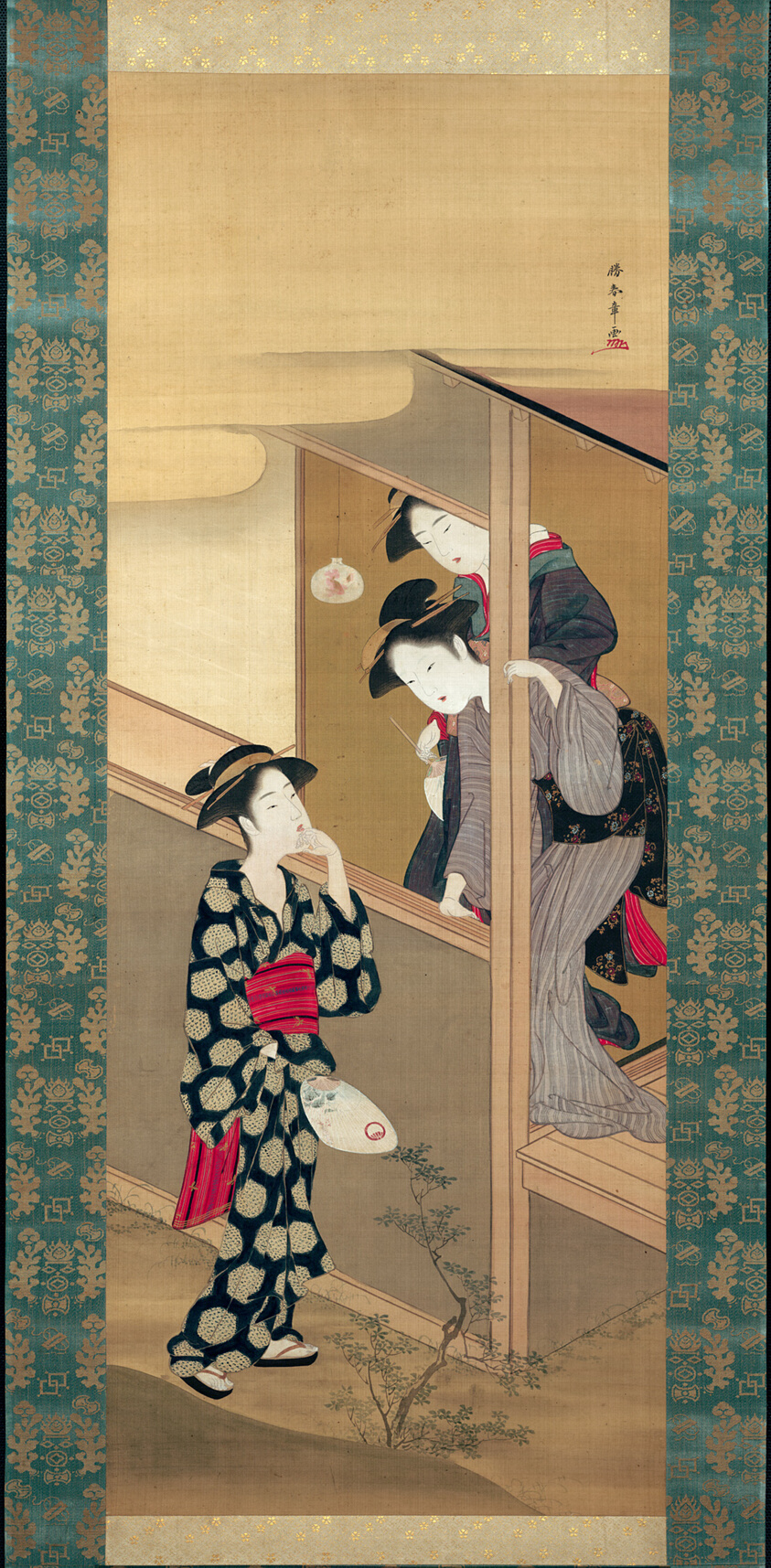
Heritage Research Artifact: Three Beauties Chatting by a Veranda
Materiality and Provenance
Three Beauties Chatting by a Veranda is a hanging scroll executed in ink and colors on silk, a medium that epitomizes the zenith of classic silk craftsmanship. The work, attributed to an anonymous master of the late Ming dynasty (circa 17th century), embodies the fluid elegance and refined aesthetic that defined courtly and scholarly life in imperial China. The silk substrate, a plain-weave tabby with a subtle warp-faced texture, was hand-reeled from the cocoons of Bombyx mori silkworms, a process that demanded meticulous attention to thread uniformity and luster. The pigments—mineral-based azurite, malachite, cinnabar, and orpiment—were ground to a fine powder and bound with animal glue, applied in thin washes to preserve the silk’s translucency. This technique, known as gongbi (meticulous brushwork), required the artist to layer colors with a precision akin to a Savile Row tailor’s hand-stitching, each stroke contributing to a harmonious whole.
The scroll’s mounting, a later 19th-century restoration, features a brocade border of gold-threaded silk, a testament to its enduring value as a cultural artifact. The roller ends are of jadeite, carved with auspicious cloud motifs, while the backing paper—a mulberry-fiber xuanzhi—has aged to a warm amber, suggesting careful storage in a scholar’s studio or a noble household. The condition is remarkable: only minor pigment flaking along the lower edge, where humidity may have affected the silk’s tension. This artifact is not merely a painting; it is a material record of silk’s role as a conduit for artistic expression, much like the finest worsted wool in a bespoke suit carries the weight of a gentleman’s legacy.
Visual Analysis and Composition
The composition presents three elegantly attired women—likely courtesans or ladies of leisure—seated on a veranda overlooking a lotus pond. Their poses are relaxed yet deliberate: one leans against a carved balustrade, her hand resting on a fan of painted silk; another adjusts a hairpin of jade and kingfisher feathers; the third gestures toward a pair of mandarin ducks gliding on the water. The veranda’s wooden latticework, rendered in fine ink lines, recedes into a misty landscape of willow trees and distant mountains, a technique that creates depth without sacrificing the flatness of the silk surface. The women’s robes, in shades of coral, teal, and saffron, are adorned with embroidered peonies and butterflies, symbols of beauty and transience. The folds of their garments are depicted with a calligraphic fluency—each brushstroke a controlled release of ink, akin to the drape of a cashmere overcoat on a Savile Row mannequin.
The palette is restrained yet vibrant: the mineral pigments retain their luminosity after centuries, a testament to the silk’s ability to hold color without fading. The artist’s use of negative space—the empty veranda floor, the still water—invites contemplation, much like the unadorned lapels of a double-breasted suit allow the fabric to speak. The lotus flowers, painted in pale pink washes, rise from the pond with a naturalism that belies their symbolic weight: purity emerging from mud, a metaphor for the women’s refined grace amidst worldly concerns. The mandarin ducks, a classic motif of marital fidelity, anchor the scene in a narrative of companionship and quiet joy.
Historical and Cultural Context
This scroll belongs to the tradition of meiren hua (paintings of beautiful women), a genre that flourished during the Ming and Qing dynasties as a reflection of urban prosperity and the cult of sensibility. The women’s attire—high-waisted robes, layered collars, and flowing sashes—mirrors the fashions of the Jiangnan region, where silk production was centered in cities like Suzhou and Hangzhou. The veranda itself, a ting or pavilion, was a staple of Chinese garden architecture, designed for leisure and poetic reflection. The scene captures a moment of qing (emotional resonance), a concept prized by literati who saw art as a means to transcend the mundane. The artist’s anonymity suggests a workshop production, perhaps for a merchant patron who valued the scroll as a status symbol, much as a Savile Row client commissions a suit to signal discernment.
The silk medium was not incidental; it was integral to the painting’s meaning. Silk, as a luxury good traded along the Silk Road, represented wealth, sophistication, and cultural exchange. In the Ming dynasty, silk was also a metaphor for the ideal woman—supple, luminous, and enduring. The scroll’s hanging format, meant for seasonal display, underscores its role as a transient object of beauty, akin to a bespoke garment worn for a single season before being archived. The Three Beauties thus encapsulates a worldview where art, fashion, and nature converge, a philosophy that resonates with the Savile Row ethos of timeless elegance over fleeting trends.
Conservation and Legacy
Preserving this artifact requires a climate-controlled environment—relative humidity between 50-55%, temperature at 18-20°C—to prevent silk desiccation or mold growth. The scroll should be stored flat in a tatami-lined box, unrolled only for study under low UV light. The pigments are stable, but the silk’s protein fibers are vulnerable to light damage; thus, exhibition periods must be limited to three months per year. Future conservation efforts might include shibori-style stitching to stabilize the lower edge, a technique borrowed from Japanese textile restoration. The artifact’s legacy lies not only in its aesthetic merit but in its testimony to silk’s role as a canvas for human creativity. For the Lauren Fashion Heritage Lab, this scroll offers a case study in how materiality—silk’s weave, weight, and response to pigment—shapes artistic intent, a lesson as relevant to a couture atelier as to a museum gallery.
In conclusion, Three Beauties Chatting by a Veranda is a masterwork of silk craftsmanship and visual storytelling. Its fluid elegance, from the mineral colors to the calligraphic lines, mirrors the precision and artistry of a Savile Row suit—each element tailored to perfection, yet breathing with life. This artifact is not merely a relic; it is a dialogue between maker and material, a conversation that continues to inspire those who understand that true luxury is woven, not bought.