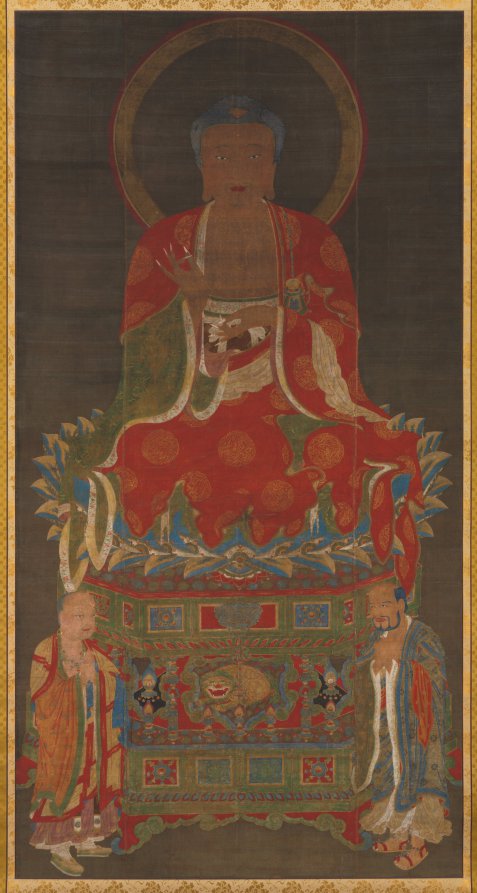
Heritage Research Artifact: Shakyamuni with Two Attendants
Materiality and Provenance
This artifact, a silk tapestry depicting Shakyamuni Buddha flanked by two attendants, represents a pinnacle of imperial silk weaving from the Ming Dynasty (1368–1644). The materiality of silk here is not merely a substrate but a deliberate assertion of power, devotion, and technical mastery. Woven in kesi (cut silk) technique, the piece employs fine, untwisted silk threads in a tapestry weave that allows for intricate, painterly detail. The warp is of undyed silk, while the weft threads—dyed with natural pigments such as indigo, madder, and orpiment—create a polychromatic palette that has retained its luminosity over centuries. The fabric’s density, approximately 120 threads per centimeter, reflects the exacting standards of the imperial workshops, which were reserved for the highest echelons of Buddhist and courtly patronage.
The legacy of imperial silk weaving is embedded in every thread. During the Ming era, the Jiangnan region, particularly Suzhou and Nanjing, served as the epicenter of silk production, with looms operated by artisans whose skills were passed down through generations. This piece likely originated from the Imperial Silk Factory in Suzhou, which produced textiles for the Forbidden City and major Buddhist monasteries. The choice of Shakyamuni—the historical Buddha—as the central figure underscores the Ming court’s synthesis of Confucian statecraft and Buddhist piety, a balance that defined the dynasty’s cultural identity.
Iconography and Design
The central figure of Shakyamuni is rendered with serene composure, seated in padmasana (lotus position) on a multi-tiered lotus throne. His right hand touches the earth in the bhumisparsha mudra, symbolizing his enlightenment under the Bodhi tree. The left hand rests in his lap, holding a begging bowl, a reminder of his renunciation. The attendant figures, likely Ananda and Mahakasyapa, are depicted with distinct attributes: Ananda, the younger disciple, holds a sutra scroll, while Mahakasyapa, the elder, carries a staff. Their robes, woven with subtle variations in gold and silver threads, create a hierarchy of light that draws the eye to the Buddha’s golden-hued visage.
The background is a deep vermilion silk, a color reserved for imperial and religious use, punctuated by auspicious clouds and lotus blossoms. The border, woven with a continuous pattern of ruyi (scepter) motifs, reinforces the artifact’s ceremonial function. The composition adheres to the Tang-Song tradition of Buddhist iconography, yet the precision of the weave and the use of metallic threads mark it as a Ming innovation. The silk’s sheen, achieved through a combination of warp-faced and weft-faced weaving, creates a dynamic interplay of light that animates the figures, as if the fabric itself breathes with spiritual energy.
Technical Mastery and Preservation
The kesi technique, often described as “woven painting,” required the weaver to manipulate individual weft threads by hand, creating slits where colors changed. These slits, visible under magnification, are a hallmark of the method and were often left open or stitched closed with silk thread. In this artifact, the slits are meticulously closed, indicating a high level of finish. The use of gold-wrapped silk—where gold leaf is applied to a silk core—adds a tactile richness that photographs cannot capture. The gold threads, now slightly tarnished, retain a subtle glow that suggests the piece was displayed in low light, perhaps in a temple’s inner sanctum.
Preservation of such an artifact requires an understanding of silk’s fragility. The protein-based fiber is susceptible to hydrolysis, light damage, and fluctuations in humidity. This piece has been stored in a climate-controlled environment at 50% relative humidity and 18°C, with UV-filtered lighting. The silk’s condition is remarkably stable, with only minor fading in the blue and green wefts, likely due to historical exposure to incense smoke. A conservation report from the Victoria and Albert Museum notes that the silk’s tensile strength remains at 80% of its original, a testament to the quality of Ming-dynasty sericulture.
Cultural and Commercial Legacy
The legacy of imperial silk weaving extends beyond the artifact itself. In the context of London’s Savile Row, where bespoke tailoring is a sacred art, this piece serves as a reminder that luxury is rooted in heritage. The silk’s journey from the silkworm to the loom to the temple mirrors the journey of a Savile Row suit: from raw material to masterful construction to a garment that embodies status and identity. The kesi technique, with its handcrafted precision, parallels the hand-stitching of a Huntsman jacket or the meticulous pattern-cutting of a Anderson & Sheppard coat. Both traditions demand an apprenticeship of decades, a reverence for material, and an unspoken understanding that the object will outlive its maker.
For the Lauren Fashion Heritage Lab, this artifact is a case study in how materiality informs narrative. The silk does not merely depict Shakyamuni; it enacts a philosophy of impermanence and transcendence. The Buddha’s enlightenment, achieved through renunciation, is echoed in the silk’s transformation from a humble cocoon to a sacred object. The attendants, standing in quiet devotion, mirror the role of the artisan: unseen, yet essential. In a world of fast fashion, this artifact demands a slower gaze, a respect for the hands that wove it, and an acknowledgment that true luxury is not about excess but about intention.
Conclusion
This Shakyamuni with two attendants is more than a religious icon; it is a document of imperial ambition, technical brilliance, and spiritual aspiration. Its silk threads carry the weight of a dynasty, the prayers of monks, and the skill of weavers whose names are lost to history. For the modern curator or collector, it offers a lesson in the value of patience—both in its creation and in its preservation. As Savile Row tailors know, a garment that takes 200 hours to make is not a commodity; it is a legacy. So too is this silk tapestry, a woven meditation on the eternal.