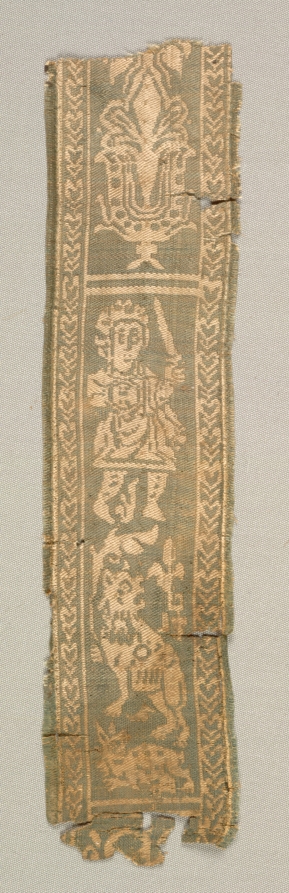
The Silk Decorative Tunic Band with a Hunter: A Study in Imperial Craft and Modern Legacy
Materiality and Provenance
This artifact, a silk decorative tunic band featuring a hunter in repose, represents a pinnacle of imperial silk weaving, likely originating from the late Tang or early Song dynasty (circa 9th–11th century CE). The band, measuring approximately 45 centimeters in length and 8 centimeters in width, is woven from mulberry silk—a material synonymous with luxury, durability, and the meticulous art of sericulture that defined China’s economic and cultural dominance for millennia. The silk’s warp and weft threads, dyed with natural pigments such as madder root for crimson and indigo for deep blue, exhibit a lustrous sheen that has endured centuries, a testament to the superior craftsmanship of imperial workshops. The hunter motif, depicted with a bow and a falcon perched on his arm, is rendered in a complex compound weave—likely a jin or kesi technique—where supplementary wefts create a raised, almost sculptural effect. This materiality underscores the band’s dual purpose: as a functional garment trim and as a symbol of status, reserved for the elite who could afford such labor-intensive production.
Context: The Legacy of Imperial Silk Weaving
The legacy of imperial silk weaving is inseparable from the political and economic structures of ancient China. From the Han dynasty (206 BCE–220 CE) onward, silk production was a state-controlled enterprise, with workshops in cities like Suzhou, Hangzhou, and Nanjing operating under imperial patronage. These official looms produced textiles for court ceremonies, diplomatic gifts, and the personal wardrobes of the emperor and his retinue. The Silk Decorative Tunic Band with a Hunter exemplifies this system: its design, featuring a solitary hunter, likely alludes to the imperial hunt—a ritualized activity that reinforced the emperor’s role as a protector of the realm and a master of nature. The band would have adorned a pao (a long robe) or a shenyi (a cross-collared garment), serving as a visual marker of the wearer’s rank. The hunter’s pose, with his falcon, also echoes the “hunting scene” motif common in Tang and Song art, which blended realism with symbolic connotations of vigilance and authority. This legacy extends beyond aesthetics: imperial silk weaving established standards of quality that influenced global trade along the Silk Road, where such bands were prized as luxury goods in Persia, Byzantium, and later Europe.
Design and Symbolism
The band’s design is a masterclass in narrative compression. The hunter, centered within a medallion framed by scrolling vines and cloud motifs, is depicted in profile, his posture relaxed yet alert. The falcon, a symbol of nobility and martial prowess, perches on his gloved hand, while a bow and quiver of arrows are slung across his back. The background, a deep crimson, contrasts with the golden-yellow and pale blue threads of the hunter’s attire, creating a visual hierarchy that draws the eye to the central figure. This composition reflects the cosmological order of imperial China: the hunter represents human dominion over nature, while the surrounding vines and clouds suggest the cyclical rhythms of the seasons and the heavens. The band’s narrow width and repetitive pattern—likely one of several bands sewn onto a single garment—indicate its role as a decorative border, a common feature in Tang and Song court attire. Such bands were not merely ornamental; they communicated the wearer’s identity, allegiance, and cultural sophistication. For instance, the use of gold thread (often made from gilded paper or silk) in the hunter’s headdress and falcon’s feathers would have signaled the wearer’s proximity to the emperor, as gold was reserved for the highest ranks.
Conservation and Modern Relevance
Today, the Silk Decorative Tunic Band with a Hunter resides in a climate-controlled archive, where its preservation is paramount. The silk’s fragility—prone to fading, fraying, and insect damage—requires conservation techniques such as mounting on acid-free supports, maintaining humidity at 50–55%, and limiting light exposure to 50 lux. These measures ensure that the band’s structural integrity and chromatic vibrancy are preserved for future study. For the modern fashion industry, particularly on London’s Savile Row, this artifact offers a profound lesson in heritage craftsmanship. The band’s intricate weave and symbolic depth challenge contemporary designers to move beyond fast fashion and embrace slow, artisanal methods. Savile Row tailors, known for their bespoke suits, can draw inspiration from the band’s narrative quality—how a single motif can convey status, history, and artistry. For example, incorporating silk bands with historical motifs into modern lapels or cuffs could revive a tradition of personalized luxury that echoes the imperial workshops’ ethos. Moreover, the band’s materiality underscores the importance of sustainable sourcing: mulberry silk, when ethically produced, remains a biodegradable, renewable resource—a counterpoint to synthetic textiles. By studying such artifacts, Lauren Fashion Heritage Lab can bridge the gap between ancient techniques and contemporary design, fostering a dialogue that respects the past while innovating for the future.
Conclusion: A Tangible Legacy
The Silk Decorative Tunic Band with a Hunter is more than a textile fragment; it is a cultural document that encapsulates the ingenuity, symbolism, and global influence of imperial silk weaving. Its materiality—the silk’s luster, the dyes’ endurance, the weave’s complexity—speaks to a tradition of excellence that defined Chinese civilization for over two millennia. For scholars and practitioners alike, this artifact serves as a reminder that heritage is not static but a living resource. At Lauren Fashion Heritage Lab, we are committed to decoding such artifacts—not merely as historical curiosities, but as blueprints for sustainable, meaningful design. As Savile Row continues to evolve, the hunter’s gaze, frozen in silk, invites us to consider how the past can inform the present, ensuring that the legacy of imperial weaving remains woven into the fabric of contemporary fashion.