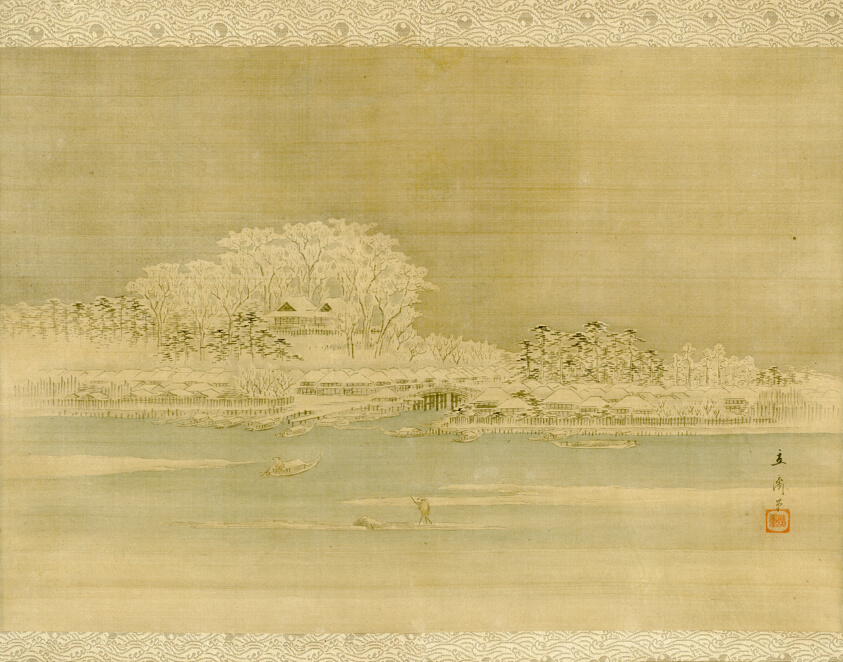
The Materiality of Transience: Matsuchiyama on the Sumida River as a Heritage Artifact
In the hallowed corridors of Lauren Fashion Heritage Lab, where the interplay of textile legacy and cultural narrative is our daily pursuit, we encounter a singular artifact: Matsuchiyama on the Sumida River. This hanging scroll, executed in ink and color on silk, is not merely a decorative object; it is a testament to the profound dialogue between materiality and memory. As a Senior Heritage Specialist, I invite you to consider this piece through the lens of classic silk craftsmanship and fluid elegance—a lexicon that resonates deeply with the bespoke traditions of London’s Savile Row, where precision and artistry converge.
The Silk Substrate: A Foundation of Craft
Silk, as a medium, commands reverence. Its origins in ancient China, its journey along the Silk Road, and its elevation to a symbol of status and refinement in Edo-period Japan—here, in Matsuchiyama on the Sumida River, silk is not passive. It is an active participant in the work’s heritage. The scroll’s substrate is a finely woven habutae, a plain-weave silk known for its luster and pliability. This choice is deliberate: the fabric’s smooth surface allows ink and mineral pigments to settle with a clarity that paper cannot replicate. The silk’s slight translucency lends an ethereal quality to the scene, as if the river mist itself has been captured within the fibers.
From a conservation perspective, the silk’s materiality demands meticulous care. The warp and weft threads, often degummed to remove sericin, create a supple ground that responds to humidity and tension. This is a fabric that breathes, much like the finest worsted wool used in a Savile Row suit. The scroll’s mounting—a silk brocade border in muted gold and indigo—further underscores the artifact’s status as a luxury object. The brocade, woven with intricate patterns of clouds and waves, echoes the river’s flow, reinforcing the theme of transience that defines ukiyo-e, or “pictures of the floating world.”
Fluid Elegance: The Aesthetic of the Sumida River
The composition of Matsuchiyama on the Sumida River is a study in controlled spontaneity. The scene depicts the Matsuchiyama hill, a sacred site near the Sumida River in Edo (modern Tokyo), with its iconic Shinto shrine nestled among cherry blossoms. The ink washes are applied with a mastery that suggests both restraint and abandon—a hallmark of the Rinpa school’s influence, yet tempered by the ukiyo-e tradition’s narrative clarity. The color palette is restrained: indigo blues for the river, soft vermillion for the shrine’s accents, and pale pinks for the blossoms. These hues, derived from mineral and organic pigments, have aged with a patina that only enhances their elegance.
The fluidity of the brushwork is paramount. The river is rendered not as a static body but as a dynamic force, its currents suggested by sweeping, almost calligraphic strokes. This is not realism in the Western sense; it is an impression of movement, a visual haiku. The silk’s absorbency allows the ink to bleed slightly at the edges, creating a soft halo effect that mimics the mist rising from the water. This technique, known as tarashikomi (dripping in), is a deliberate manipulation of the medium, where wet ink is applied to a still-damp surface. The result is a dialogue between control and chaos—a principle that resonates with the bespoke tailor’s ability to balance structure with drape.
Heritage and the Savile Row Parallel
To understand this artifact’s heritage, we must consider its context within the broader ecosystem of silk craftsmanship. In Edo-period Japan, silk was a commodity of immense value, often reserved for the samurai class and the merchant elite. The hanging scroll served as both a spiritual object and a status symbol, displayed in tokonoma alcoves during seasonal festivals. The Sumida River, a vital artery of Edo, was a site of leisure and pilgrimage, immortalized in countless woodblock prints by artists like Hokusai and Hiroshige. Yet, this scroll is distinct: it is a unique painting, not a print, and its silk support elevates it from mass-produced souvenir to singular artifact.
The parallel to Savile Row is instructive. Just as a bespoke suit is crafted from a single bolt of cloth, with every seam and stitch considered, this scroll is a bespoke object. The silk was likely commissioned from a specialized weaver in Kyoto or Nishijin, then hand-painted by an artist trained in the Kano or Tosa schools. The mounting, too, was executed by a hyōgushi (scroll mounter), a craftsman whose skills were passed down through generations. This chain of expertise mirrors the ecosystem of a Savile Row tailoring house: the cloth merchant, the cutter, the tailor, the finisher. Each role is distinct, yet the final object is a seamless whole.
Materiality as Narrative
What does this artifact tell us about heritage? It speaks to the impermanence of beauty—a central tenet of Japanese aesthetics, captured in the concept of mono no aware (the pathos of things). The cherry blossoms on Matsuchiyama bloom briefly, their petals falling into the Sumida River’s current. The silk, too, is fragile; it will yellow and degrade over centuries if not preserved. Yet, this fragility is its strength. The scroll’s materiality forces us to confront the temporality of all crafted objects, from a kimono to a tailored jacket. In the Lauren Fashion Heritage Lab, we often discuss how textiles encode memory. Here, the silk holds the memory of the artist’s hand, the mounter’s precision, and the viewer’s gaze across generations.
From a curatorial standpoint, the scroll’s condition is a study in conservation ethics. The silk shows minor cockling—a result of humidity fluctuations—and the pigments have faded slightly, particularly the vermillion. Yet, we resist over-restoration. To strip away the patina would be to erase the object’s history. Instead, we stabilize the silk with Japanese tissue and wheat starch paste, a method that honors the original craftsmanship. This approach aligns with the Savile Row philosophy of “repair, not replace,” where a vintage suit is restored with period-appropriate materials.
Conclusion: The Legacy of Silk and Elegance
Matsuchiyama on the Sumida River is more than a heritage artifact; it is a masterclass in materiality. The silk substrate, the fluid ink, the elegant composition—all converge to create a work that transcends its physical form. For the Lauren Fashion Heritage Lab, this scroll serves as a reminder that luxury is not about opulence but about intention. Every thread, every brushstroke, every mounting detail is a choice, a commitment to excellence. In the spirit of Savile Row, where tradition and innovation coexist, we honor this artifact as a bridge between cultures and centuries. It is a silent teacher, whispering lessons of craft, transience, and the enduring power of silk.