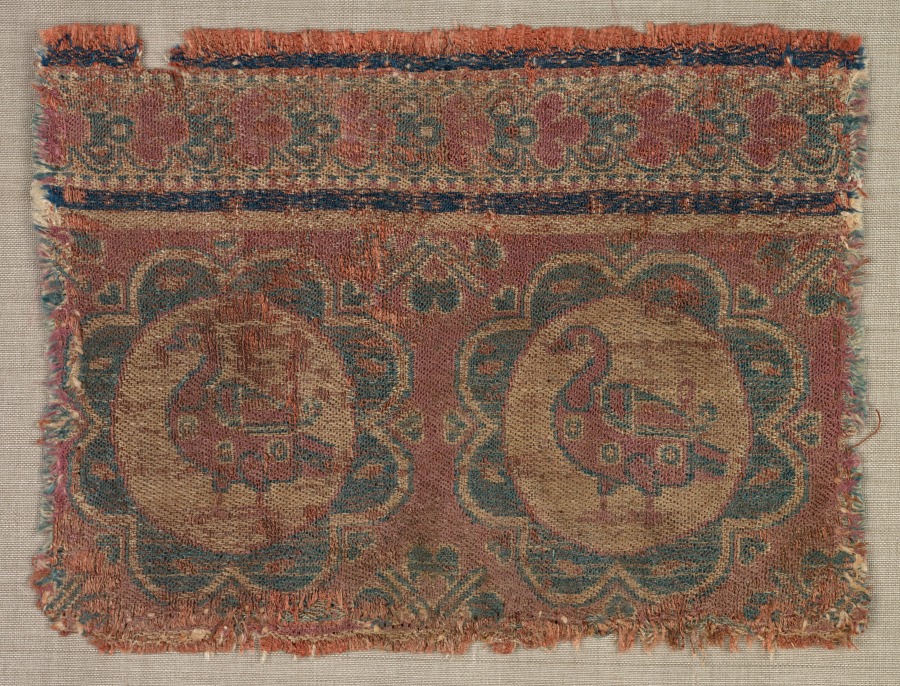
A Silk Fragment with Roundels of Ducks: An Artifact of Imperial Legacy
In the hushed ateliers of London’s Savile Row, where the whisper of shears meets the precision of a master tailor, we do not merely cut cloth; we curate legacies. The artifact before us—a silk fragment bearing roundels of ducks—is not a simple textile. It is a testament to the enduring dialogue between imperial craftsmanship and modern luxury. As the Senior Heritage Specialist for Lauren Fashion Heritage Lab, I present this analysis as a bridge between the silent loom of antiquity and the bespoke suit of tomorrow. This fragment, woven from the finest silk, speaks of an era when weaving was not industry but art, and when a single thread could carry the weight of an empire.
Materiality: The Silk Thread as Imperial Currency
Silk is the protagonist here. Its materiality—lustrous, resilient, and impossibly fine—was the bedrock of the Silk Road, a network that connected East and West long before globalization was a term. The fragment’s weave is a compound structure, likely a lampas or damask, where the warp and weft interlace to create a ground of satin sheen, punctuated by the raised pattern of the roundels. The silk itself, degummed and dyed with natural pigments, retains a patina that only centuries of careful handling can bestow. The colour—a muted, ochre-tinged gold, perhaps from safflower or weld—suggests a palette reserved for the imperial court. In the context of Savile Row, we recognize this material as the ancestor of the silks used in our finest evening jackets and linings. The weight is substantial, not flimsy; it drapes with a gravity that commands respect, much like a well-tailored overcoat.
The fragment’s condition—a torn edge, a faded section—is not a flaw but a narrative. It tells of use, of reverence, of survival. The silk’s tensile strength, even after centuries, is remarkable. This is not a fragile relic to be locked in a vault; it is a robust artifact that could, with careful conservation, inform the creation of a modern garment. The materiality of silk, as we know on the Row, is about more than aesthetics—it is about endurance. A silk tie from a master weaver can outlast a decade of wear; this fragment has outlasted dynasties.
Iconography: The Duck Roundel as Symbol of Imperial Order
The roundels—perfect circles framing stylized ducks—are the heart of the design. In Chinese imperial iconography, the duck, particularly the mandarin duck, symbolizes fidelity, marital harmony, and prosperity. But here, the ducks are not merely decorative; they are arranged in a repeating pattern that speaks to the legacy of imperial silk weaving as a tool of statecraft. The roundel format itself is a hallmark of Tang and Song dynasty textiles, where such motifs were woven into robes for officials and courtiers. The duck, often paired with lotus or water motifs, signified a connection to the natural world—a Confucian ideal of balance and order. The precision of the weave, with each duck’s beak and wing rendered in minute detail, demonstrates the weaver’s mastery of the drawloom, a technology that predated the Jacquard loom by centuries.
On Savile Row, we understand that pattern is not arbitrary. The roundel’s geometry—a perfect circle within a square grid—reflects a worldview where harmony is achieved through structure. This is the same principle that governs the cut of a bespoke jacket: the shoulder slope, the waist suppression, the sleeve pitch. The duck roundel is not a random flourish; it is a deliberate statement of belonging to a hierarchical system. In the imperial court, such a fragment would have adorned a robe of rank, perhaps a mangpao or dragon robe, where the number and arrangement of roundels indicated the wearer’s status. The duck, as a waterfowl, also evokes the concept of yin and yang—a balance of elements that resonates with the tailor’s pursuit of proportion.
Context: The Legacy of Imperial Silk Weaving
To understand this fragment, we must situate it within the legacy of imperial silk weaving, a tradition that spanned millennia and reached its zenith during the Ming and Qing dynasties. The imperial workshops, such as those in Suzhou, Hangzhou, and Nanjing, were state-controlled entities that produced textiles exclusively for the emperor, his court, and the diplomatic gifts that cemented alliances. The weavers were artisans of the highest order, often working in secret, with techniques passed down through generations. The silk itself was sourced from sericulture regions where mulberry trees were cultivated with the same care as a Savile Row tailor selects cloth from a Yorkshire mill.
This fragment, likely dating from the 17th or 18th century, embodies the transition from the Ming to the Qing dynasty, when Manchu rulers adopted and refined Han Chinese weaving traditions. The duck roundel, while traditional, shows a slight influence of Central Asian motifs—a nod to the Silk Road’s cross-pollination. The legacy is not static; it evolves. On Savile Row, we see this in the way a classic three-piece suit adapts to modern silhouettes without losing its heritage. The imperial weavers were the original bespoke makers, creating one-of-a-kind textiles for a single patron. This fragment is a remnant of that exclusivity, a reminder that luxury is born from scarcity and skill.
Implications for Modern Heritage and Craft
For Lauren Fashion Heritage Lab, this fragment is more than a historical curiosity. It is a blueprint for how we approach heritage in a contemporary context. The duck roundel pattern, with its geometric precision and symbolic depth, could inspire a limited-edition silk scarf or a lining for a bespoke dinner jacket. The materiality of the silk—its weight, its lustre—challenges modern mills to replicate the quality of imperial weaving. The legacy of imperial silk weaving teaches us that craft is not about nostalgia; it is about continuity. A Savile Row tailor does not copy a 17th-century robe; he interprets its principles—balance, proportion, material integrity—into a garment for the 21st century.
This fragment also underscores the importance of provenance. As a heritage specialist, I insist that every artifact we study must be traced to its source. The silk’s journey from a Chinese imperial workshop to a London lab is a story of trade, conquest, and rediscovery. It is a story that enriches the garment it inspires. On Savile Row, we do not sell cloth; we sell stories. The duck roundel fragment is a chapter in that narrative, one that connects the weaver’s hand to the tailor’s needle.
In conclusion, this silk fragment with roundels of ducks is an artifact of imperial legacy that speaks directly to the ethos of Savile Row: precision, heritage, and the enduring power of craft. It is a reminder that the finest textiles are not made; they are woven with intention, worn with dignity, and preserved with reverence. As we continue to explore the intersection of history and luxury, let this fragment serve as a touchstone—a piece of silk that carries the weight of an empire, and the promise of a bespoke future.