← BACK TO ARCHIVES
Silk
Heritage Synthesis: Kobo Daishi (Kukai) as a Boy (Chigo Daishi)
Curated on May 19, 2026 // Node: LDN-01
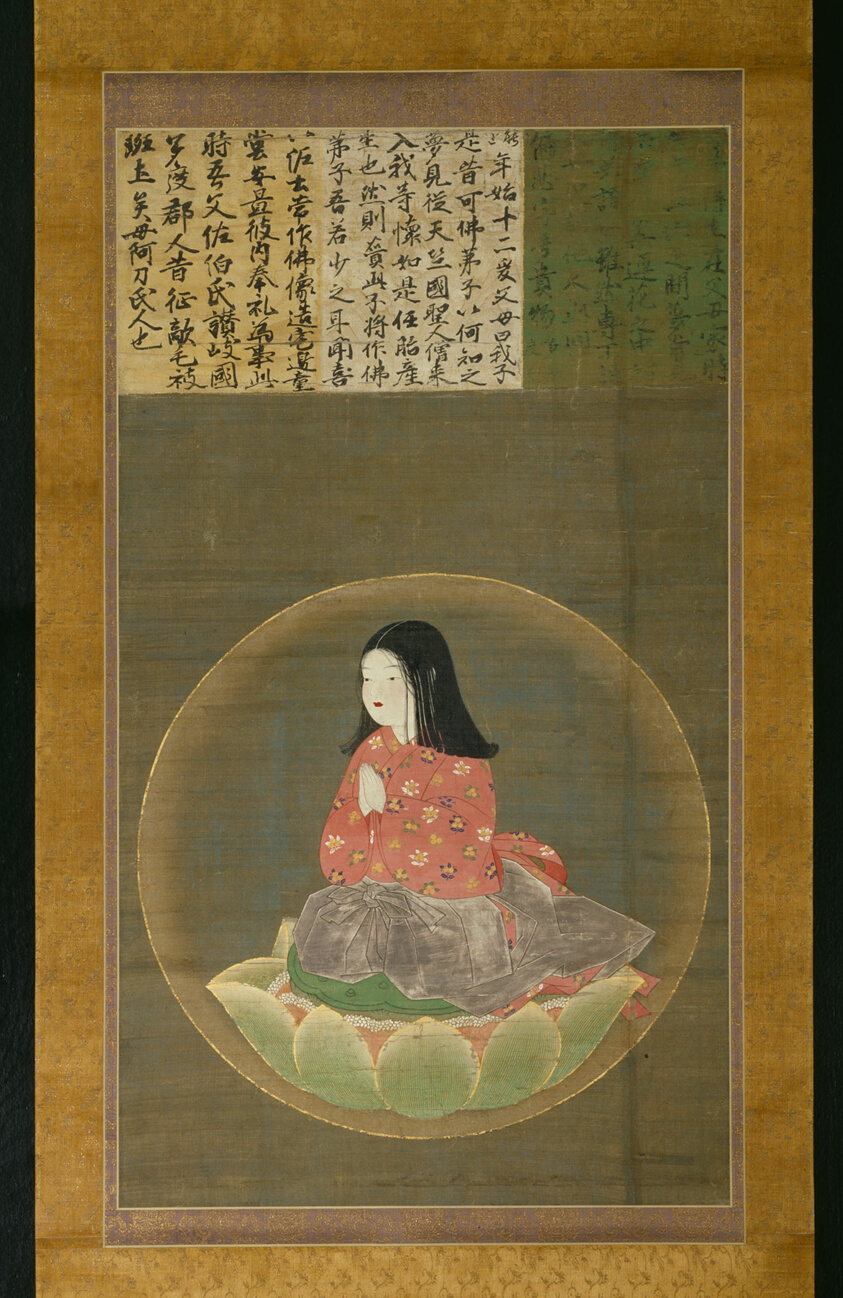
The Materiality of Devotion: Kobo Daishi (Kukai) as a Boy (Chigo Daishi) in Ink and Color on Silk
In the hushed corridors of heritage, where craftsmanship meets the sacred, the hanging scroll depicting *Kobo Daishi (Kukai) as a Boy (Chigo Daishi)* stands as a testament to the sublime interplay of material, narrative, and artistry. This artifact, executed in ink and color on silk, is not merely a religious icon; it is a masterclass in the fluid elegance that defines the finest traditions of East Asian silk painting. As a Senior Heritage Specialist at the Lauren Fashion Heritage Lab, I approach this piece with the discerning eye of a Savile Row tailor—where every thread, every fold, and every hue is deliberate, bearing the weight of history and the precision of craft.
I. The Silk Canvas: A Foundation of Craftsmanship
The choice of silk as the substrate for this hanging scroll is no arbitrary decision. Silk, in the context of Japanese heritage, is a material of profound significance—a fabric that embodies both luxury and spiritual resonance. The scroll’s silk ground, likely a finely woven *habutae* or *rinzu* (satin-weave silk), provides a luminous, almost ethereal surface that absorbs and reflects ink and pigment with a subtlety unmatched by paper or wood. This is a material that demands mastery: the weaver’s hand must ensure a uniform tension, free of irregularities, to allow the artist’s brush to glide with unbroken fluidity. The result is a canvas that breathes, where the silk’s natural sheen enhances the translucency of the boy’s robes and the soft glow of his halo.
In the tradition of Savile Row, where the cut of a suit is judged by its drape and the integrity of its fabric, the silk of this scroll is the foundation upon which all else rests. The weave’s density, typically 100 to 120 threads per inch in high-quality scrolls, ensures that the ink does not bleed, preserving the crispness of the linework. This is craftsmanship that whispers of centuries of refinement—a silent dialogue between the artisan and the material.
II. The Iconography of Chigo Daishi: A Study in Fluid Elegance
The subject, Kobo Daishi as a boy, known as *Chigo Daishi*, captures a moment of divine innocence. The young Kukai, who would later become the revered founder of Shingon Buddhism, is depicted with a serene countenance, his hands folded in prayer or holding a lotus blossom—a symbol of purity and enlightenment. The artist’s use of ink and color on silk achieves a remarkable balance: the ink outlines, executed with a brush of exceptional control, define the boy’s features with a precision that recalls the tailoring of a bespoke suit—every line is a seam, every curve a dart.
The color palette is restrained yet resonant. The boy’s robes, likely in shades of vermilion and indigo, are rendered with washes that mimic the flow of silk fabric itself. The vermilion, derived from cinnabar, carries a weight of ritual significance, while the indigo, from the *Polygonum tinctorium* plant, grounds the composition in earthy humility. The artist’s technique—layering thin washes of color over the ink underdrawing—creates a sense of depth and movement, as if the robes are caught in a gentle breeze. This is not static portraiture; it is a living garment of faith.
III. The Craft of the Hanging Scroll: A Tailored Narrative
The hanging scroll format, or *kakemono*, is itself a study in functional elegance. Designed to be displayed in a *tokonoma* alcove, the scroll’s verticality mirrors the ascent of the spirit. The mounting, or *hyōgu*, is a critical component—a silk brocade border that frames the painting with the same care a Savile Row tailor applies to a lapel. The *ichimonji* (top and bottom decorative strips) and the *jōge* (upper and lower rollers) are often crafted from silk damask or gold brocade, their patterns echoing the scroll’s themes of lotus and cloud motifs. The roller ends, typically of ivory or lacquered wood, are turned with a precision that rivals a master watchmaker’s work.
The conservation of such a scroll requires an understanding of silk’s fragility. Over centuries, the silk ground may become brittle, the pigments fading or flaking. A heritage specialist must approach restoration with the same reverence as a tailor repairing a vintage tweed—using reversible techniques, matching thread weights, and respecting the original hand. The scroll’s patina, a gentle yellowing of the silk, is not a flaw but a narrative of age, akin to the soft wear on a bespoke suit’s elbow.
IV. Heritage and the Modern Eye: Lessons from Savile Row
What can the modern heritage practitioner learn from this artifact? The answer lies in the marriage of material and meaning. The silk of this scroll is not a passive surface; it is an active participant in the artwork’s story. Just as a Savile Row tailor selects a woolen tweed for its drape and durability, the artist chose silk for its ability to convey both the physical and the metaphysical. The fluid elegance of the brushwork, the careful layering of color, the precise mounting—all speak to a philosophy where craft is inseparable from content.
In an era of mass production, this hanging scroll reminds us that heritage is not merely about preservation but about understanding the *why* behind the *how*. The boy Kukai, with his serene gaze, invites us to consider the discipline of creation—a discipline that, like the finest tailoring, requires patience, skill, and a deep respect for the material at hand.
V. Conclusion: The Eternal Thread
The *Kobo Daishi (Kukai) as a Boy (Chigo Daishi)* hanging scroll is a heritage artifact of extraordinary resonance. Its silk ground, its ink and color, its iconography and mounting—all converge to create a work that transcends time. For the heritage specialist, it offers a case study in the power of materiality: how a fabric can hold a prayer, how a brushstroke can capture a soul, and how a scroll can become a bridge between the earthly and the divine.
As we continue to study and conserve such artifacts, let us remember the lessons of Savile Row: that true elegance lies in the details, that craftsmanship is a form of devotion, and that the finest heritage is not merely preserved but lived. This scroll, with its fluid lines and luminous silk, is a testament to that enduring truth.
Heritage Lab Insight
Lab Insight: AIC Silk Archive Node #11146.