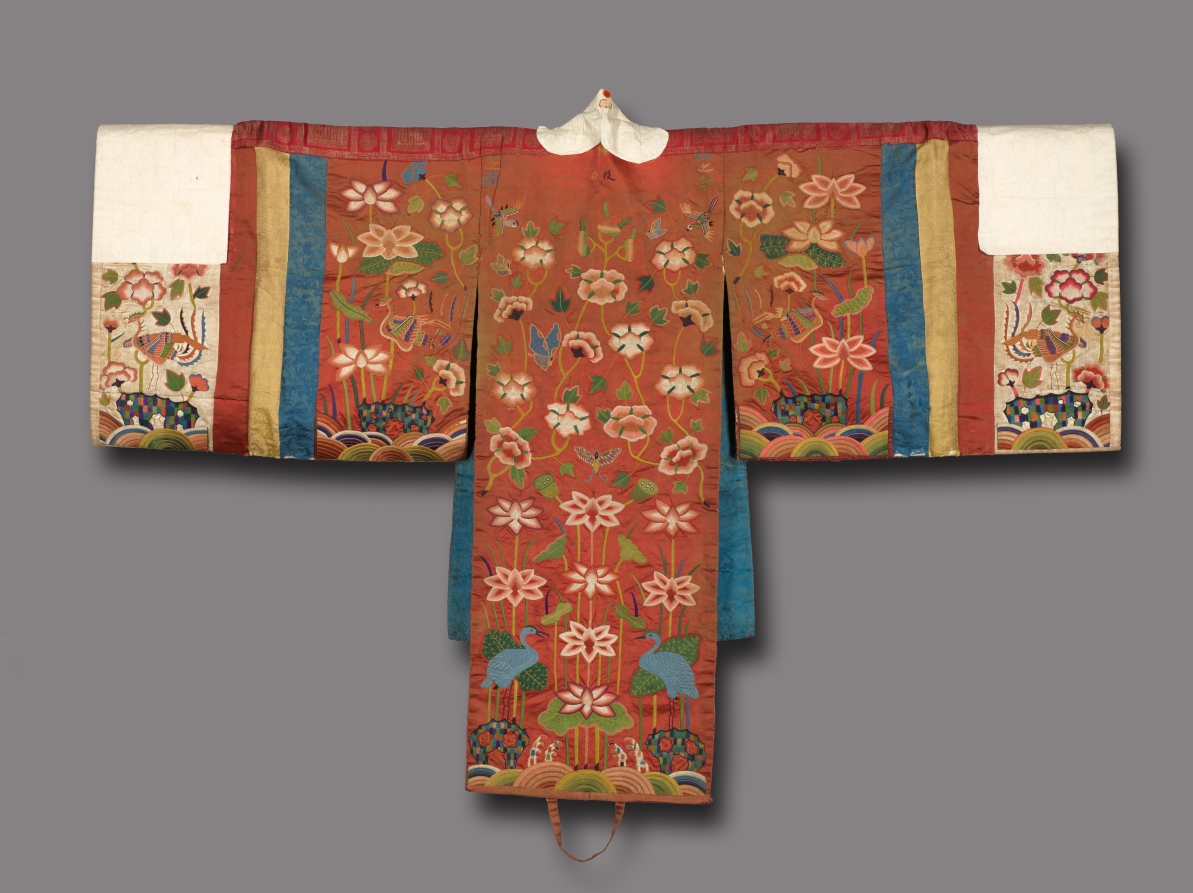
The Hwarot: A Confluence of Imperial Silk Weaving and Bridal Iconography
In the rarefied echelons of heritage textiles, few artifacts command the reverence and technical admiration accorded to the Korean Hwarot—a ceremonial bridal robe that embodies the zenith of imperial silk weaving. As a Senior Heritage Specialist at the Lauren Fashion Heritage Lab, I approach this artifact not merely as a garment but as a document of dynastic power, artisanal mastery, and cultural transmission. The Hwarot, traditionally worn by Korean royalty and later by commoners during the Joseon Dynasty (1392–1910), is a testament to the legacy of silk weaving that once flourished under imperial patronage. Its materiality—pure silk—is both a foundation and a narrative, woven with threads of history, symbolism, and unyielding craftsmanship.
Materiality and the Imperial Silk Legacy
The Hwarot’s foundation is silk, a fiber that has defined luxury and authority across East Asia for millennia. The silk used in these robes was not the mass-produced variety of later centuries but a refined, hand-reeled product from sericulture techniques perfected in the imperial workshops of China and Korea. The fabric’s weight, drape, and luminosity are the result of a meticulous process: silkworms fed on mulberry leaves of specific provenance, cocoons boiled at precise temperatures, and threads twisted to achieve a tensile strength that allowed for intricate embroidery without distortion. This is the legacy of imperial silk weaving—a system where every stage, from silkworm rearing to loom operation, was governed by courtly protocols and transmitted through generations of artisan families.
The Hwarot’s construction typically employs damask or satin-weave silk, often with a ground of deep crimson, indigo, or celadon—colors reserved for the elite. The weave itself is a study in precision: a five-end satin structure that creates a smooth, reflective surface, ideal for the dense embroidery that follows. This is not a fabric for the faint of hand; it demands a weaver’s eye for tension and a dyer’s mastery of natural pigments. The imperial silk legacy is evident in the absence of compromise—every thread aligns with a standard that predates the modern concept of quality control.
Design and Symbolism: The Art of Imperial Embroidery
Beyond its material, the Hwarot is a canvas for symbolic embroidery that reflects Confucian cosmology and dynastic authority. The robe’s surface is adorned with motifs rendered in gold-wrapped silk threads, peonies, phoenixes, and cranes—each emblem carrying specific meanings. The phoenix, or bonghwang, signifies virtue and marital harmony; the peony represents wealth and honor; the crane embodies longevity. These are not arbitrary decorations but a visual language that aligns the bride with the celestial order—a concept central to imperial ideology.
The embroidery technique, known as jasu, involves couching and satin stitches that create a three-dimensional relief. Gold threads, often made from silk wrapped in gilded paper, are laid in parallel lines and secured with fine silk stitches. This method, perfected in the royal workshops of the Joseon court, required a level of skill that took decades to cultivate. The legacy of imperial silk weaving is thus not only in the loom but in the needle—a discipline where every stitch is a negotiation between tradition and the individual artisan’s hand. The Hwarot’s design is also notable for its symmetry and balance, reflecting Confucian ideals of order. The front and back panels are mirror images, with motifs arranged in a hierarchical composition that draws the eye upward toward the collar—a subtle nod to the wearer’s elevated status.
Context: The Hwarot in the Bridal Rite
The Hwarot was worn during the pyebaek ceremony, a ritual where the bride pays respects to the groom’s family. This context is critical to understanding the robe’s materiality. The silk’s weight and structure were designed to facilitate movement—the robe’s long sleeves, often with detachable cuffs, allowed for graceful bows and gestures. The fabric’s sheen, visible under candlelight, transformed the bride into a luminous figure, a living embodiment of the family’s prosperity. The imperial silk legacy here serves a dual purpose: it is both a display of wealth and a functional garment for ritual performance.
The Hwarot’s evolution from royal exclusivity to broader adoption in the late Joseon period reflects a democratization of luxury, yet the materiality remained uncompromised. Even when commoners commissioned these robes, they sought silk from the same regional workshops—Andong, Jeonju, and Seoul—that had supplied the court. This continuity ensured that the legacy of imperial silk weaving persisted beyond the monarchy, embedded in the cultural fabric of Korean weddings.
Preservation and the Modern Gaze
Today, the Hwarot is a rare artifact, preserved in museums and private collections. Its condition—often fragile due to the natural degradation of silk and metallic threads—demands conservation protocols that respect its materiality. At the Lauren Fashion Heritage Lab, we approach these robes with the same reverence as a Savile Row tailor would a bolt of superfine wool. The silk must be stored in climate-controlled environments, away from UV light and fluctuations in humidity. The embroidery requires stabilization with silk crepeline, a sheer fabric that supports the threads without obscuring them. This is not merely preservation; it is an act of stewardship for a craft that spans centuries.
The Hwarot’s legacy is also a lesson in sustainability. Imperial silk weaving was inherently slow, localized, and biodegradable—a stark contrast to the fast-fashion ethos of our era. The robe’s construction, with its modular sleeves and detachable elements, speaks to a philosophy of reuse and adaptation. Each Hwarot was often passed down through generations, altered to fit new brides, and repaired with the same gold threads. This cyclical approach to luxury is a model for contemporary heritage brands seeking to reconcile tradition with modernity.
Conclusion: The Hwarot as a Heritage Artifact
The Hwarot is more than a bridal robe; it is a heritage artifact that encapsulates the legacy of imperial silk weaving. Its materiality—silk of the highest order—is the foundation upon which a complex system of symbolism, ritual, and craft is built. For the Lauren Fashion Heritage Lab, studying the Hwarot is an exercise in understanding how material culture transmits values across time. The robe’s threads, dyed with natural pigments and embroidered with gold, tell a story of dynastic power, artisanal discipline, and cultural continuity. In an age of disposable luxury, the Hwarot stands as a reminder that true heritage is woven, not manufactured—and that the legacy of imperial silk weaving endures in every stitch.