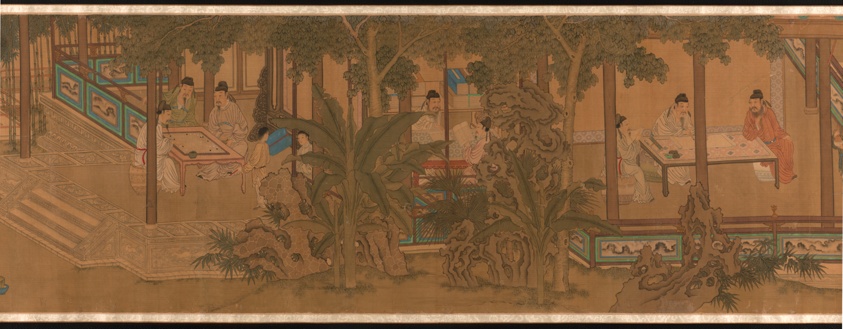
The Four Accomplishments: A Heritage Artifact of Refined Mastery
Introduction: The Confluence of Craft and Culture
In the hallowed corridors of Lauren Fashion Heritage Lab, we examine artifacts that transcend mere decoration to embody the ethos of timeless sophistication. The Four Accomplishments—a handscroll executed in ink and color on silk—represents a pinnacle of classical Chinese artistry, yet its resonance extends far beyond its geographic origins. This artifact, rooted in the materiality of silk, speaks to a universal pursuit of excellence: the cultivation of mind, body, and spirit through disciplined practice. For the connoisseur of heritage, whether on Savile Row or in the ateliers of Milan, the Four Accomplishments offer a lexicon of grace—a reminder that true luxury is not ostentation, but the quiet mastery of one’s craft.
This paper examines the artifact through the lens of materiality, technique, and cultural symbolism, drawing parallels to the bespoke traditions of London’s tailoring district. The handscroll, like a well-cut suit, is a study in restraint, precision, and narrative flow.
Materiality: Silk as the Canvas of Elegance
Silk, the foundation of this artifact, is no mere substrate. It is a living thread that connects the artisan to centuries of heritage. In the context of the Four Accomplishments, the choice of silk—specifically, a handwoven, lustrous variety—elevates the work from a functional scroll to an object of veneration. The fabric’s natural sheen interacts with the ink and color washes, creating a subtle interplay of light that shifts with the viewer’s angle. This is not unlike the way a Savile Row tailor selects a worsted wool or a cashmere blend, knowing that the drape and luster will define the garment’s character.
The handscroll format itself is a testament to the ritual of viewing. Unlike a framed painting, which demands static attention, a handscroll unfolds horizontally, revealing its narrative in segments. This sequential revelation mimics the process of discovery—a quality that resonates with the bespoke experience, where a client’s measurements and preferences are gradually translated into a finished piece. The silk’s flexibility allows for this unrolling, yet its strength ensures the artifact’s preservation across centuries. In the Lauren Fashion Heritage Lab, we recognize that materiality is not passive; it is an active participant in the story.
The Four Accomplishments: A Study in Disciplined Grace
The Four Accomplishments—qin (the zither), qi (the game of Go), shu (calligraphy), and hua (painting)—represent the classical Chinese ideal of the cultivated scholar-gentleman. Each discipline demands years of practice, a quiet devotion to technique, and an understanding of balance. In this handscroll, the artist depicts these pursuits with fluid brushwork, the ink bleeding into the silk with controlled spontaneity. The figures are rendered in elegant, elongated forms, their postures suggesting concentration and ease—a duality that defines mastery.
Consider the qin player: fingers poised over the strings, eyes half-closed, as if listening to an internal melody. The silk captures the tension in the wrist, the weight of the instrument. This is not a static portrait but a moment of creation. Similarly, the qi players sit across a board, their hands hovering over stones, the composition of the scene mirroring the strategic tension of the game. The calligraphy and painting sections are meta-references—the artist inscribing characters and landscapes within the very medium that defines the artifact. This self-referential quality echoes the bespoke tailor’s craft, where the tools of the trade (needle, thread, chalk) become part of the final garment’s story.
Technique: Ink, Color, and the Handscroll Tradition
The technical execution of this handscroll reveals a deep understanding of silk’s absorptive properties. The artist likely applied a sizing of alum and glue to the silk before painting, a process that prevents the ink from bleeding uncontrollably while allowing for subtle gradations. The colors—vermilion, malachite green, and indigo—are mineral-based, ground and mixed with animal glue to achieve opacity. This palette, restrained yet vibrant, mirrors the understated luxury of a Savile Row suit: a navy worsted with a faint windowpane check, or a charcoal flannel with a silk lining.
The brushwork is equally deliberate. The artist uses a combination of gongbi (meticulous) and xieyi (freehand) techniques, with the former defining the figures’ faces and hands, and the latter suggesting the flow of robes or the texture of a pine tree. This interplay of precision and spontaneity is the hallmark of a master. In the context of heritage fashion, it mirrors the tailor’s ability to balance structure with drape—a shoulder seam that is both sharp and yielding, a lapel that rolls with natural ease.
Cultural Symbolism: The Scholar’s Path and Bespoke Ideals
The Four Accomplishments are not merely pastimes; they are metaphors for self-cultivation. The qin represents harmony with nature, the qi strategic wisdom, the shu the discipline of thought, and the hua the observation of beauty. Together, they form a holistic framework for living with intention. This ethos aligns with the philosophy of Savile Row, where a garment is not a commodity but a relationship—a dialogue between client and tailor that unfolds over fittings, each adjustment refining the fit and the narrative.
In the handscroll, the scholar is depicted in a garden setting, surrounded by bamboo and rocks—elements that symbolize resilience and permanence. This setting is not accidental; it grounds the accomplishments in a natural order, reminding the viewer that mastery is not an escape from the world but a deeper engagement with it. For the heritage specialist, this artifact serves as a reminder that luxury is not about excess but about the quiet pursuit of excellence—a principle that defines both the classical Chinese scholar and the modern bespoke tailor.
Conclusion: A Legacy of Fluid Elegance
The Four Accomplishments handscroll, with its silk foundation and meticulous execution, is a testament to the enduring power of craftsmanship. It speaks to a time when art and life were inseparable, when the scholar’s brush was as much a tool of self-expression as the tailor’s needle. In the Lauren Fashion Heritage Lab, we study such artifacts not as relics but as living dialogues—reminders that the principles of discipline, balance, and material respect are timeless.
As we continue to explore the intersections of heritage and fashion, let us carry forward the lessons of the Four Accomplishments: that true elegance is born of practice, that silk is more than a fabric—it is a medium for the soul, and that the handscroll, like a bespoke suit, is a narrative waiting to be unfolded.