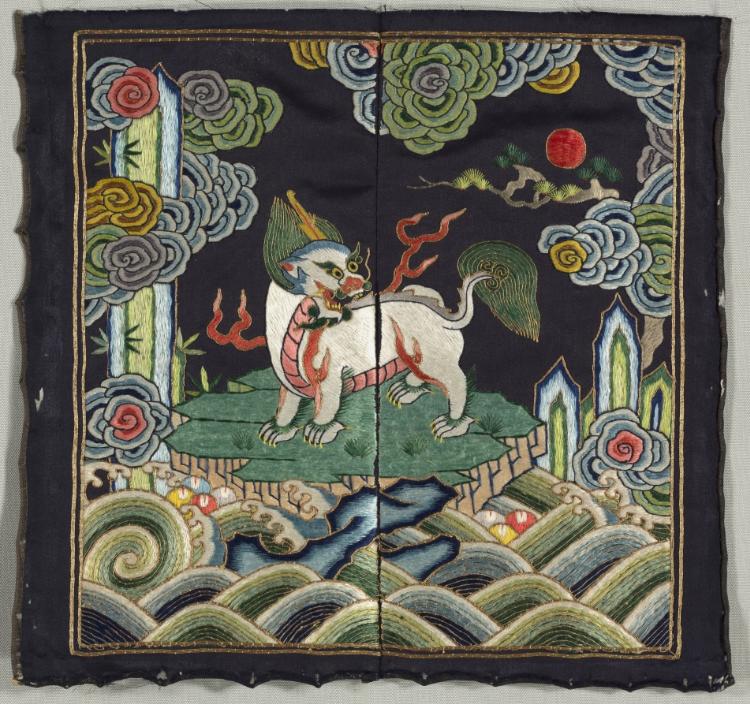
The Rank Badge (Buzi): A Testament to Imperial Silk Weaving’s Enduring Legacy
Introduction: The Buzi as a Confluence of Craft and Consequence
In the hallowed ateliers of London’s Savile Row, where precision tailoring and heritage fabrics define a century of sartorial excellence, one encounters a profound respect for materiality. The Rank Badge (buzi), a square or circular silk panel worn by Chinese civil and military officials during the Ming (1368–1644) and Qing (1644–1912) dynasties, represents a pinnacle of this ethos. Crafted from the finest silk, these badges were not mere insignia; they were woven narratives of status, imperial power, and artisanal mastery. For the modern heritage specialist, the buzi offers a compelling case study in how silk—a material synonymous with luxury and durability—can encode cultural identity and hierarchical order. This artifact, preserved in the Lauren Fashion Heritage Lab, demands a rigorous examination of its materiality, its production within the imperial silk weaving system, and its enduring relevance to contemporary luxury fashion.
Materiality: The Silk Substrate as a Carrier of Meaning
The buzi’s foundation is silk, a fiber that has defined Chinese luxury for millennia. Unlike cotton or wool, silk possesses a natural luster, tensile strength, and dye affinity that made it the preferred medium for imperial regalia. The materiality of the buzi is not incidental; it is deliberate. The silk used in these badges was often kesi (cut silk tapestry) or embroidery on satin, techniques that required thousands of hours of labor. Kesí, in particular, involved weaving silk threads in a discontinuous weft technique, allowing for intricate, polychrome designs that could depict birds, animals, and celestial motifs. This method, reserved for the highest echelons of the court, ensured that the buzi was not just a badge but a microcosm of imperial weaving’s technical zenith.
The tactile quality of the silk—its smoothness, its ability to hold pigment without fading—was essential to the buzi’s function. When affixed to the front and back of a court robe (the chaofu or mangpao), the badge had to withstand repeated wear, humidity, and the rigors of court ceremonies. The silk’s natural resilience, combined with the tight weave of kesi, ensured longevity. For the Savile Row tailor, this echoes the principle of fabric integrity: a garment’s material must endure while conveying its intended narrative. The buzi’s silk, dyed with mineral and vegetal pigments (such as indigo, madder, and orpiment), also demonstrates an early understanding of colorfastness—a lesson in sustainable luxury that resonates with today’s focus on heritage craftsmanship.
Context: The Legacy of Imperial Silk Weaving
The buzi cannot be understood without its production context: the imperial silk weaving workshops of Suzhou, Hangzhou, and Nanjing. These centers, overseen by the Imperial Household Department, operated under a system of rigorous quality control. Master weavers, often from families with generations of expertise, were tasked with producing silk that met exacting standards of thread count, dye uniformity, and pattern precision. The buzi was a commissioned artifact, not a mass-produced item. Each badge was tailored to the rank of its wearer—civil officials wore birds (e.g., the crane for first rank), while military officials wore beasts (e.g., the lion for first rank). The silk’s color and weave density varied by rank, with higher officials receiving more elaborate kesi work and rarer dyes.
This system of hierarchical materiality mirrors the Savile Row tradition of bespoke tailoring, where fabric choice, cut, and finish denote the client’s status and taste. The imperial silk weavers were, in effect, the ancestors of today’s heritage artisans. They understood that silk was not a neutral canvas but an active participant in the performance of power. The buzi’s motifs—such as the five-clawed dragon for the emperor or the golden pheasant for civil officials—were woven with symbolic precision, often incorporating auspicious clouds, waves, and Buddhist emblems. The silk’s sheen caught the light during court processions, creating a visual hierarchy that reinforced the cosmic order of the Ming and Qing dynasties.
The decline of imperial silk weaving after 1912 did not erase its legacy. Instead, it was absorbed into the global luxury market, influencing Western fashion houses and textile mills. The buzi, as a surviving artifact, offers a direct link to this lineage. Its silk, now aged and patinated, tells a story of labor, trade, and cultural exchange. The Lauren Fashion Heritage Lab preserves such artifacts to study how materiality shapes identity—a principle that guides our curation of historical textiles for contemporary inspiration.
Analysis: The Buzi as a Heritage Artifact for Modern Luxury
From a heritage management perspective, the buzi exemplifies the intersection of craft, commerce, and culture. Its silk materiality demands conservation strategies that respect its age while allowing for scholarly study. The Lab employs climate-controlled storage, pH-neutral mounts, and digital imaging to document the badge’s weave structure and dye composition. This approach aligns with Savile Row’s commitment to preserving tailoring techniques—such as hand-stitching and pattern cutting—for future generations.
For the luxury fashion industry, the buzi offers a model of narrative-driven design. The badge’s use of animal symbols to convey rank prefigures modern branding, where logos and motifs signify status. Yet, the buzi’s beauty lies in its subtlety: the silk’s texture and the weave’s intricacy communicate more than the motif alone. This is a lesson for contemporary designers: materiality is not a backdrop but a protagonist. The buzi’s silk, with its inherent luxury and durability, challenges the fast-fashion paradigm of disposability. It advocates for a return to investment pieces—garments that, like a Savile Row suit, are built to last and to tell a story.
Conclusion: The Buzi’s Enduring Thread
The Rank Badge (buzi) is more than a historical curiosity; it is a testament to the power of silk as a medium of authority and artistry. Its materiality—the silk’s weave, dye, and texture—encodes centuries of imperial weaving expertise. For the Lauren Fashion Heritage Lab, this artifact serves as a touchstone for understanding how luxury is constructed through material choice and craft tradition. As we continue to study and preserve such objects, we honor the legacy of the weavers who, thread by thread, wove the fabric of an empire. In the language of Savile Row, the buzi is a bespoke masterpiece—a reminder that true heritage is not replicated but revered.