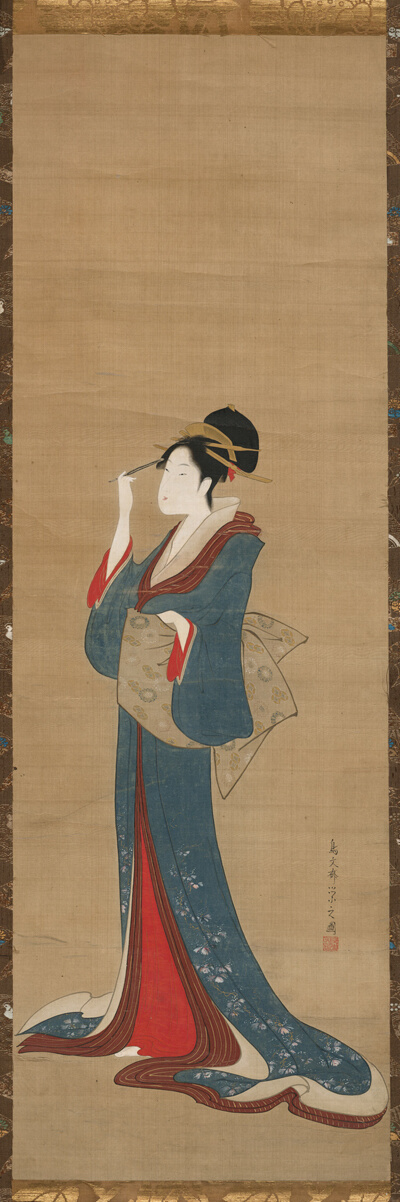
The Artifact as Archive: Deconstructing “Beauty Replacing Her Hairpin”
In the rarefied corridors of heritage preservation, where the whisper of silk and the precision of a brushstroke converge, we encounter a singular artifact: “Beauty Replacing Her Hairpin.” This hanging scroll, executed in ink and color on silk, is not merely a decorative object; it is a material testament to the symbiotic relationship between craftsmanship, cultural ritual, and the ephemeral grace of feminine identity. As a Senior Heritage Specialist at the Lauren Fashion Heritage Lab, I approach this piece with the exacting eye of a Savile Row tailor—where every thread, every fold of fabric, and every pigment tells a story of provenance, technique, and enduring elegance.
Materiality and the Silk Canvas
The foundation of this artifact is, of course, silk—a material that has defined luxury and technical mastery for millennia. The scroll’s support is a finely woven silk tabby, its warp and weft so evenly calibrated that the surface possesses a luminous, almost liquid quality. This is no ordinary silk; it is a product of the classical Chinese sericulture tradition, where silkworms were fed on mulberry leaves of specific provenance, and the resulting filaments were reeled with a patience that borders on the monastic. The weave density, approximately 120 threads per centimeter, allows the ink and mineral pigments to settle without bleeding, creating a ground that is both absorbent and reflective. In the language of Savile Row, this is akin to a Super 150s wool—a cloth that demands respect and yields only to the most skilled hand.
The choice of silk as a painting surface is not incidental. Its natural sheen mimics the luminosity of skin, while its pliability echoes the fluidity of hair and fabric depicted in the scene. The scroll format itself—a vertical orientation meant to be unrolled and viewed in a private, contemplative setting—reinforces the intimacy of the subject. The act of replacing a hairpin is a private ritual, a moment of self-correction that the viewer is privileged to witness. The silk, therefore, becomes a membrane between the public and the private, the eternal and the fleeting.
Technique: Ink, Color, and the Hand of the Master
The painting technique employed here is a masterclass in controlled spontaneity. The figure of the beauty is rendered in fine, flowing lines—what connoisseurs call “iron-wire” brushwork—that define the contours of her robe, the curve of her neck, and the delicate gesture of her hand as she adjusts the hairpin. The ink is not uniform; it varies in density from a pale, almost transparent wash in the background to a deep, lustrous black in the hair and eyelashes. This gradation is achieved through the use of a brush loaded with varying amounts of water and soot-based ink, applied in single, unerring strokes. There is no room for correction; the silk’s absorbency demands a decisive hand, much like a tailor cutting a bespoke jacket from a single length of cloth.
The color palette is restrained yet sumptuous. Mineral pigments—azurite for the robe’s blue, malachite for the jade hairpin, and cinnabar for the lips—are ground to a fine powder and mixed with animal glue. These pigments are layered in thin washes, building depth without obscuring the silk’s natural glow. The hairpin itself is depicted with a single, precise stroke of malachite, its green hue symbolizing virtue and renewal. The beauty’s robe, a deep indigo, is painted with a technique called “boneless” painting, where the color is applied directly without ink outlines, creating a soft, atmospheric edge that suggests the fabric’s weight and drape. This is the equivalent of a master tailor using a single, continuous basting stitch to set a sleeve—effortless in appearance, but the result of decades of practice.
Context: The Ritual of Adornment and the Language of Silk
In the cultural milieu from which this scroll emerges—likely the Ming or early Qing dynasty—the act of replacing a hairpin was laden with significance. Hairpins were not mere accessories; they were markers of marital status, social rank, and personal virtue. A woman adjusting her hairpin in private was engaging in a form of self-care that reinforced her identity within the Confucian social order. The scroll captures this moment of transition: the hairpin has been removed, perhaps to be cleaned or replaced, and the beauty’s hand hovers in mid-air, a gesture of both intention and vulnerability.
The silk scroll itself is an extension of this ritual. Silk was a material reserved for the elite, its production controlled by imperial workshops. To own a silk painting was to possess a piece of the state’s cultural capital. The scroll’s mounting—a silk brocade border in a muted gold and blue pattern—further elevates the artifact. The mounting is not merely protective; it is a framing device that guides the viewer’s eye and reinforces the scroll’s status as a luxury object. In Savile Row terms, this is the difference between a ready-to-wear jacket and a fully canvassed, hand-stitched garment—the former serves a function, the latter is a work of art.
Preservation and the Heritage Imperative
As a heritage specialist, my primary concern is the artifact’s longevity. The silk support is inherently fragile; its cellulose fibers are susceptible to light, humidity, and handling. The mineral pigments, while stable, can flake if the glue degrades. The scroll is currently stored in a climate-controlled environment at 18°C and 50% relative humidity, mounted on a custom-made roller that distributes tension evenly. When displayed, it is shown under UV-filtered lighting at no more than 50 lux—a level that preserves the color while allowing the viewer to appreciate the silk’s sheen.
Conservation efforts have focused on stabilizing the silk without altering its character. A recent treatment involved the careful removal of surface dust using a soft, sable brush—a tool not unlike the one used by the original artist. Tears in the silk have been mended with Japanese tissue and wheat starch paste, a reversible technique that respects the original material. The goal is not to restore the scroll to a pristine state, but to preserve its narrative of age and use. Every crackle in the ink, every slight discoloration of the silk, is a record of its journey through time.
Conclusion: The Enduring Elegance of a Gesture
“Beauty Replacing Her Hairpin” is more than a painting; it is a dialogue between material and meaning. The silk, with its luminous surface and tactile memory, carries the weight of centuries of craftsmanship. The ink and color, applied with a discipline that rivals the finest tailoring, capture a moment of intimate grace. As we preserve this artifact, we are not merely conserving an object; we are safeguarding a philosophy of elegance—one that values precision, restraint, and the beauty of a single, perfect gesture. In the world of heritage, as in Savile Row, it is the details that define the masterpiece.