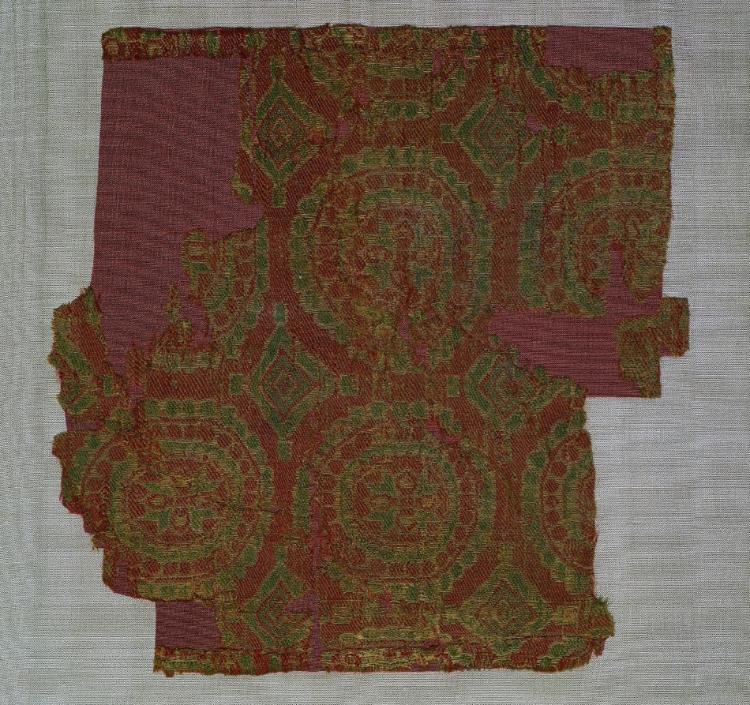
The Samite with Roundels of Rosettes: A Study in Imperial Silk Weaving and Its Enduring Legacy
Introduction: The Materiality of Power
In the hallowed ateliers of London’s Savile Row, where precision tailoring meets centuries of textile tradition, the study of heritage fabrics is not merely an academic pursuit—it is a living dialogue with the past. Among the most evocative artifacts in the Lauren Fashion Heritage Lab is the Samite with roundels of rosettes, a silk textile that embodies the apex of imperial weaving. This artifact, rendered in luxurious silk, transcends its physical form to become a testament to the technical mastery, cultural symbolism, and enduring influence of imperial silk production. Its materiality—the weight, sheen, and tactile richness of silk—speaks to a legacy that has shaped global fashion, from Byzantine courts to modern tailoring houses.
The samite, a heavy, twill-woven silk often embellished with gold or silver threads, was a fabric of supreme status in the Byzantine and early medieval periods. The roundels of rosettes, meticulously arranged in repeating geometric patterns, are not merely decorative; they are a visual language of authority, eternity, and divine order. This paper examines the samite as a heritage research artifact, exploring its material composition, historical context, and the technical ingenuity of imperial silk weaving, while drawing parallels to the craftsmanship ethos of Savile Row.
Materiality and Craft: The Silk of Empires
Silk, as a material, has long been synonymous with luxury and power. The samite’s construction—a compound weave using a warp-faced structure—required exceptional skill. The silk filaments, sourced from the mulberry silkworm (Bombyx mori), were meticulously degummed, dyed, and woven on drawlooms, a technology that allowed for complex patterns. The roundels of rosettes, often framed by concentric circles or interlocking motifs, were achieved through a technique known as “samite weaving,” where supplementary wefts of silk or metallic threads created a raised, textured effect. This not only enhanced the fabric’s visual depth but also its durability—a quality that made it ideal for ceremonial garments, ecclesiastical vestments, and royal regalia.
The rosette motif itself is a universal symbol of renewal and perfection, but in the context of imperial silk, it carried specific connotations. In Byzantine iconography, the rosette represented the celestial order, often associated with the emperor’s divine right to rule. The repetition of roundels—each a self-contained universe of pattern—mirrored the hierarchical structure of the empire itself. The silk’s rich hues, from deep crimson to sapphire blue, were derived from natural dyes such as kermes and indigo, further underscoring the fabric’s exclusivity. Only the imperial workshops, or gynaecia, possessed the resources and expertise to produce such textiles, making them tools of diplomacy and status.
Historical Context: The Legacy of Imperial Silk Weaving
The legacy of imperial silk weaving is inextricably linked to the Silk Road, a network of trade routes that facilitated the exchange of raw materials, techniques, and aesthetics between East and West. By the 6th century, the Byzantine Empire had established its own silk industry, breaking the Chinese monopoly. Under Emperor Justinian I, silkworm eggs were smuggled into Constantinople, leading to the rise of state-controlled workshops. The samite with roundels of rosettes emerged from this crucible of innovation, blending Persian, Chinese, and Greco-Roman design elements into a distinctly imperial aesthetic.
This fabric was not merely a commodity; it was a statement of power. The “imperial purple” dye, extracted from the murex snail, was reserved for the emperor and his court. Samite garments, often lined with fur or embroidered with pearls, were worn during coronations, religious ceremonies, and diplomatic audiences. The roundels of rosettes, when viewed in the context of Byzantine art, echo the mosaics of Hagia Sophia and the illuminated manuscripts of the era. They are a microcosm of the empire’s worldview—ordered, eternal, and divinely sanctioned.
The fall of Constantinople in 1453 did not mark the end of this legacy. The Ottoman Empire, which inherited Byzantine weaving traditions, continued to produce silk samites, while the Renaissance courts of Europe coveted these fabrics as symbols of sophistication. By the 19th century, the Industrial Revolution democratized silk production, but the artistry of imperial weaving remained a benchmark for luxury. Today, the samite serves as a reference point for high-end textile design, from the runways of Paris to the bespoke tailoring houses of Savile Row.
Parallels with Savile Row: Craftsmanship and Continuity
The ethos of Savile Row—meticulous handwork, reverence for tradition, and an unwavering commitment to quality—finds a direct antecedent in the imperial silk workshops. Just as Byzantine weavers spent months on a single garment, Savile Row tailors dedicate hours to hand-stitching a suit’s lapels, ensuring every seam aligns with the client’s anatomy. The samite’s roundels of rosettes, with their precise symmetry and tactile richness, mirror the attention to detail in a bespoke jacket’s pattern matching or the subtle sheen of a silk lining.
Moreover, the samite’s role as a marker of identity—whether imperial, ecclesiastical, or aristocratic—resonates with Savile Row’s tradition of dressing the elite. A Savile Row suit is not merely clothing; it is a statement of personal and professional authority. Similarly, the samite was a fabric that conferred status upon its wearer, often bearing motifs that signified lineage or allegiance. In this sense, both the samite and the Savile Row garment are artifacts of “wearable heritage,” where materiality and meaning are inextricably linked.
Preservation and Interpretation: The Role of the Heritage Lab
At the Lauren Fashion Heritage Lab, the samite with roundels of rosettes is more than a static object—it is a research tool. Through non-invasive analysis, such as spectral imaging and fiber microscopy, we can trace the dye sources, weaving techniques, and even the provenance of the silk. This data informs contemporary textile designers, who seek to replicate the fabric’s luster and drape using sustainable methods. The roundels of rosettes, when digitized, become a pattern library for modern embroidery and jacquard weaving, bridging the gap between ancient artistry and modern production.
Preserving such artifacts also involves storytelling. The samite is a narrative of human ingenuity—of silkworms raised in secret, of looms that clattered in imperial workshops, of garments that draped the shoulders of emperors. By contextualizing this fabric within the broader history of silk, we honor the craftsmen who created it and the cultures that valued it. For the Savile Row client, this narrative adds depth to a bespoke commission; for the scholar, it offers a lens into the dynamics of power, trade, and aesthetics.
Conclusion: The Enduring Thread
The samite with roundels of rosettes is a masterclass in the materiality of silk and the legacy of imperial weaving. Its intricate patterns, luxurious texture, and historical resonance remind us that fashion is not ephemeral—it is a continuum. From the Byzantine workshops to the ateliers of Savile Row, the thread of craftsmanship remains unbroken. As we study this artifact, we are not merely looking at a piece of cloth; we are witnessing the convergence of art, power, and human skill. In the hands of a heritage specialist, the samite becomes a bridge across millennia, inviting us to appreciate the timeless dialogue between fabric and form.