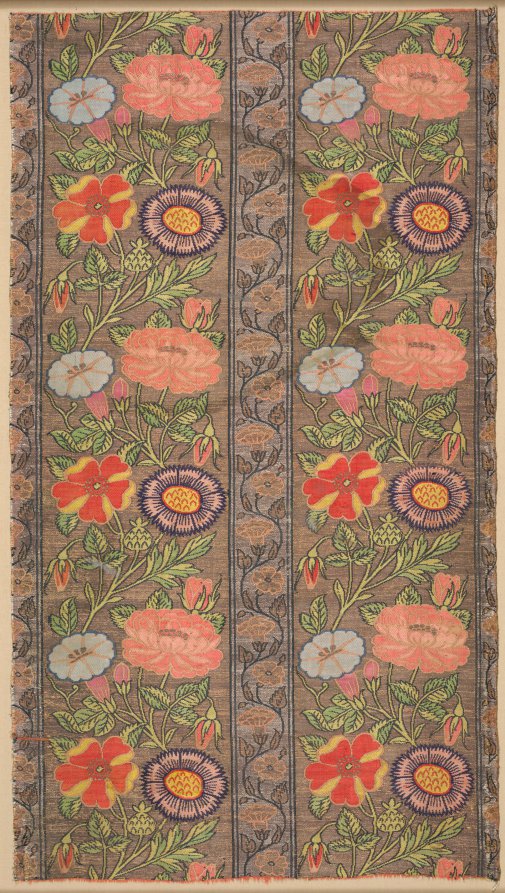
The Golden Ground: A Study in Floral Striped Silk and Imperial Legacy
In the hushed ateliers of London’s Savile Row, where precision meets provenance, the fabric speaks before the needle touches cloth. The subject of this heritage research artifact—a floral striped silk woven upon a golden ground—represents more than a textile. It is a testament to the enduring dialogue between imperial craftsmanship and modern tailoring. As Senior Heritage Specialist for the Lauren Fashion Heritage Lab, I present this analysis with the rigor expected of a Row house: exacting, contextual, and reverent of materiality.
Materiality: The Silk Itself
Silk, the filament of the Bombyx mori, has long been the aristocrat of fibres. Its natural lustre, tensile strength, and capacity for vibrant dye absorption render it unparalleled for luxury garments. In this artifact, the silk is woven with a floral stripe pattern—a juxtaposition of organic motifs and linear discipline. The floral elements, likely derived from 18th-century botanical engravings or Chinese export designs, are rendered in subtle tonalities: soft pinks, muted greens, and ivory, all set against a golden ground. This ground is not a mere colour; it is a statement of wealth and lineage. The gold is achieved through a combination of metallic thread—often a core of silk wrapped in gilded silver or gold leaf—and a deep, warm yellow dye derived from weld or saffron. The result is a fabric that catches light like liquid treasure, shifting from amber to champagne as the wearer moves.
The weave structure is a satin-faced twill, a technique perfected in Lyon and later adopted by British mills. This allows the golden ground to dominate, while the floral stripes emerge with a matte, almost velvet-like texture. The stripe itself is not rigid; it undulates, suggesting a hand-painted quality. This is no accident. The legacy of imperial silk weaving—from the workshops of Ming Dynasty Suzhou to the looms of 19th-century Spitalfields—demands that pattern and ground coexist in tension. The floral stripe is a nod to the chinoiserie that captivated European courts, yet the golden ground anchors it in the opulence of Byzantine and Ottoman traditions. It is a fabric that speaks of cross-continental trade routes, of silks carried along the Silk Road, and of the British Empire’s insatiable appetite for luxury.
Context: The Legacy of Imperial Silk Weaving
To understand this artifact, one must trace the lineage of imperial silk weaving. In China, silk was a state secret for millennia, reserved for emperors and their courts. The golden ground was a prerogative of the Son of Heaven, symbolizing the sun and divine authority. By the 17th century, European monarchies—Louis XIV’s France, the Habsburgs, and the British Crown—sought to replicate this prestige. The result was a hybrid: European looms adapted Chinese motifs, while maintaining their own heraldic and floral traditions. The floral stripe, as seen in this artifact, emerged in the 18th century as a favourite of the French court, later adopted by British tailors for waistcoats and dressing gowns. It was a fabric of leisure, of the grand tour, and of the gentleman-scholar who collected art and textiles as markers of refinement.
By the 19th century, the Industrial Revolution transformed silk weaving. British mills in Macclesfield and Coventry mechanized production, yet the golden ground remained a hallmark of bespoke luxury. Savile Row tailors, such as Henry Poole and Huntsman, sourced these silks from specialist weavers like Vanners or Stephen Walters, who preserved hand-finishing techniques. The floral stripe on a golden ground became a staple for evening wear, smoking jackets, and ceremonial robes. It was a fabric that whispered of empire—of tea plantations in Assam, of silk worms in Bengal, and of the East India Company’s vast textile networks. To wear it was to participate in a global narrative of power and taste.
Savile Row Interpretation: The Tailor’s Eye
From a Savile Row perspective, this fabric demands a garment that honours its heritage without descending into costume. The floral striped silk on a golden ground is best suited for a dinner jacket or a smoking jacket—pieces that allow the fabric to dominate while maintaining a tailored silhouette. The cut must be clean, with minimal pocketing or lapel ornamentation, to let the pattern speak. A shawl collar in black silk grosgrain provides a necessary counterpoint, grounding the gold. The lining, if visible, should be a solid dark silk—perhaps midnight blue or charcoal—to avoid visual chaos. The trousers should be in a plain black wool barathea, ensuring the jacket remains the focal point.
This is not a fabric for the timid. It requires a client who understands the weight of history—a patron who sees the jacket as an heirloom, not a trend. The golden ground will patina over time, the metallic threads softening with wear. This is desirable. A true Savile Row garment is meant to age, to carry the memory of dinners, dances, and late-night conversations. The floral stripes, once vivid, will fade into a gentle ghost of their former selves, lending the piece a quiet dignity.
Preservation and Provenance
As a heritage artifact, this silk must be stored with care. Avoid direct light, which will degrade the metallic threads. Maintain a stable humidity of 50-55% to prevent the silk from becoming brittle. If the fabric is to be used for a new commission, request a reproduction weave from a mill like Gainsborough Silk Weaving Company, which specializes in historic patterns. The original artifact should remain in archival conditions, documented with photographs and thread-count analysis. Its provenance—whether from a 1920s trousseau or a 19th-century court robe—must be traced through dealer records, family archives, or auction house ledgers. This is the work of the Heritage Lab: to ensure that the story of the golden ground endures.
In conclusion, this floral striped silk on a golden ground is not merely a textile. It is a chronicle of imperial ambition, artisanal mastery, and the enduring allure of luxury. For Savile Row, it represents the highest calling of the tailor: to transform history into a garment that fits the present. As we preserve and reinterpret such fabrics, we honour the hands that wove them and the eyes that first admired them. The golden ground remains, as it always has, a beacon of excellence.