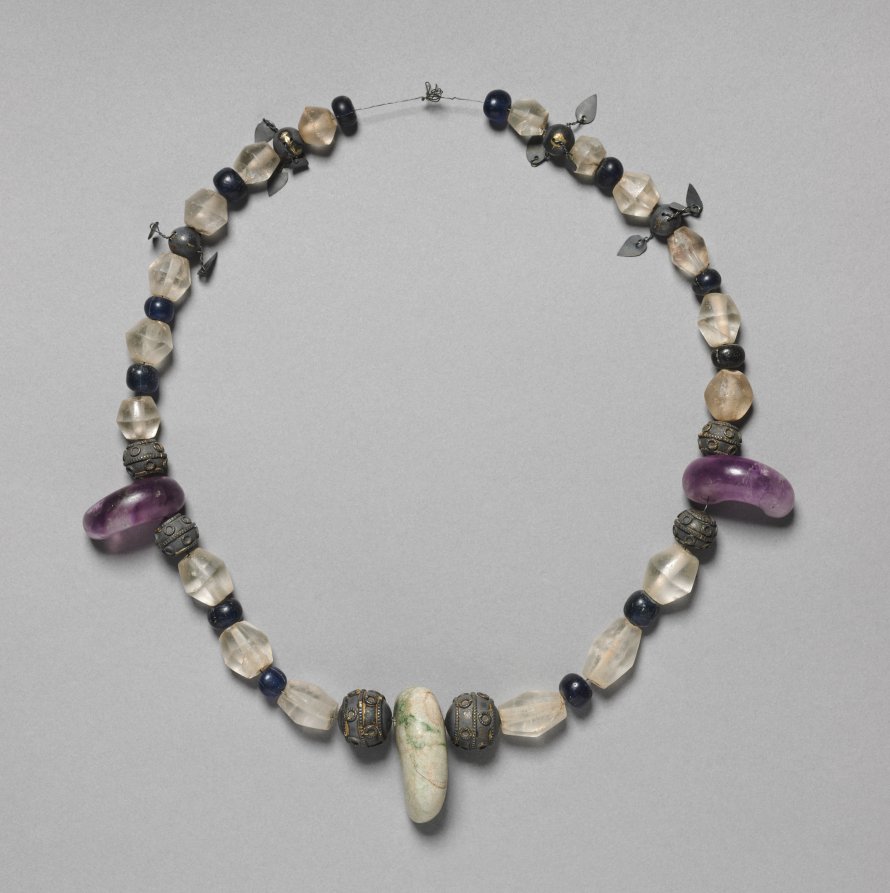
On the Material Distinction of the Imperial Necklace
To consider the necklace—a form so fundamental to personal adornment that its history is coterminous with our own—is to engage with a narrative of power, proximity, and profound technical assertion. When the medium in question is silk, and specifically the legacy of imperial silk weaving, one moves beyond mere accessory into the realm of sovereign expression. This is not ornamentation in the trivial sense; it is a calculated demonstration of dominion over nature, loom, and, ultimately, the visual field of the court. The imperial silk necklace stands as a testament to a singular truth: the most formidable assertions of status are those worn against the skin, at the very pulse of the wearer.
The Sovereign Thread: From Cocoon to Command
The foundation of this distinction lies, as all superior things do, in the raw material. Imperial silk weaving did not begin at the loom; it commenced with the meticulous, state-controlled sericulture of Bombyx mori. The cultivation of the mulberry grove, the husbandry of the larvae, and the careful unreeling of the continuous filament—these were not agricultural processes but acts of statecraft. The resulting thread, possessing a tensile strength and luminous sheen unmatched by any other fibre, was the exclusive province of the imperial workshops. To drape a necklace of such silk about the throat was, therefore, to wear the product of a vast, disciplined ecosystem. It was to announce that the might of the empire could be refined into a substance of sublime softness, a paradox that is the very essence of cultivated power.
The Loom as Legislative Chamber
Upon this rarefied substrate, the imperial weavers—artisans bound to the court, their knowledge a guarded secret—executed their work. The legacy here is one of staggering technical legislation. We speak of complex loom technologies, of draw-looms and later Jacquard mechanisms, which translated intricate iconography into damask, brocade, and kesi. For a necklace, this mastery was applied on a miniature, demanding scale. A floral motif was not merely a pattern; it was a coded language. A five-clawed dragon, a phoenix, a cloud scroll—each element, rendered in silk of contrasting weaves or supplemented with precious metal-wrapped threads, communicated rank, lineage, and celestial mandate with silent, absolute clarity.
The materiality of the woven silk necklace offered a textural vocabulary absent in forged metal or carved stone. Through the interplay of satin and twill weaves, areas could be made to absorb or reflect light differentially, causing the design to emerge and recede with the wearer’s movement. This was not static jewellery; it was a living, shimmering discourse. The weight, too, was instructive: a substantial collar of densely woven silk possessed a dignified heft, a tangible reminder of its provenance and the gravity of the position it adorned.
Proximity and Intimacy: The Politics of the Personal
Herein lies the particular genius of the form. Crowns are worn above, sceptres held at a distance. The silk necklace, however, resides in the intimate sphere. It rests against the most vulnerable part of the anatomy, the throat, and by extension, lies in close proximity to the heart. To encase this vulnerability in the ultimate product of imperial industry is a profound political act. It signifies that the empire’s protection and its bounty are not abstract concepts, but are felt directly upon the person. The cool, smooth caress of the silk becomes a constant, tactile reinforcement of belonging to the apex of a meticulously ordered world.
Furthermore, the necklace frames the face and, by convention, the countenance of authority. It acts as a sartorial fulcrum, directing the eye upward to the source of command. A magnificently woven piece, with its intricate borders and central pendant element, creates a structured visual field that dignifies and contains, much like the gilded frame of a state portrait. It announces that the individual is both a person and an institution, with the silk serving as the corporeal link between the two states of being.
A Legacy Woven in Continuity
The contemporary appreciation for such an artifact must be informed by this layered legacy. To behold an imperial silk necklace is not to see a mere string of beads or a band of fabric. It is to witness the culmination of agricultural monopoly, technical innovation, and symbolic language. Its value is archival as much as aesthetic. Each thread carries the echo of the loom’s rhythm, each colour the dictate of sumptuary law, each motif the weight of dynastic expectation.
In an age of mass production and synthetic imitation, the imperial silk necklace stands as a corrective monument to the principles of true distinction. It reminds us that luxury, in its highest form, is never simply decorative. It is narrative. It is the product of a coherent culture capable of projecting its utmost authority into an object of breathtaking beauty and personal intimacy. The silk is not just the material; it is the medium through which empire whispered its most potent assurances directly to the ear, and to the world, of the one who wore it.