← BACK TO ARCHIVES
Silk
Heritage Synthesis: Dragons Chasing Flaming Pearls
Curated on May 20, 2026 // Node: LDN-01
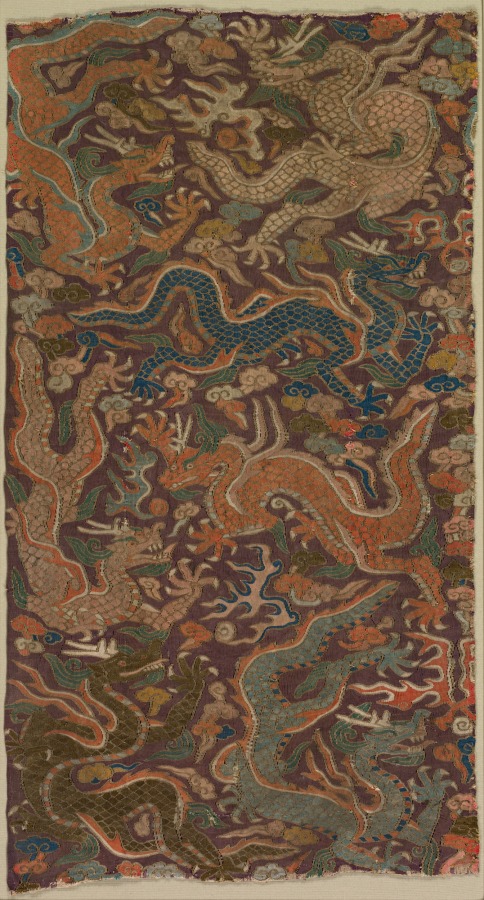
The Dragon and the Pearl: A Study in Imperial Silk Weaving and the Materiality of Power
In the hushed, wood-panelled ateliers of London’s Savile Row, where the cut of a sleeve is a matter of honour and the weight of a cloth is a testament to centuries of craft, we speak of legacy. But true legacy is not merely tailored; it is woven. It is the thread that connects the present to a past of profound artistry and imperial ambition. Today, we examine a motif of singular potency and enduring elegance: the Dragon Chasing the Flaming Pearl, rendered in the most hallowed of fibres—silk. This is not a mere pattern; it is a heritage artifact, a material chronicle of power, cosmology, and the unbroken lineage of imperial silk weaving.
The Materiality of Silk: A Foundation of Imperial Prestige
Before we dissect the dragon’s pursuit, we must first understand the canvas. Silk, in the context of imperial China, was never a commodity. It was a currency of diplomacy, a marker of rank, and a physical embodiment of the emperor’s mandate from heaven. The cultivation of the silkworm, *Bombyx mori*, was a state secret, guarded with the ferocity of a dragon itself. The resulting filament—a continuous, lustrous protein fibre—possessed a unique materiality: a tensile strength exceeding that of steel of equivalent diameter, a natural dye affinity that yielded colours of impossible depth, and a drape that could whisper of authority or roar with opulence.
For the imperial workshops, particularly those of the Ming (1368–1644) and Qing (1644–1912) dynasties, silk was the medium through which cosmic order was rendered tangible. The *kesi* (silk tapestry) and *jin* (brocade) techniques demanded not just skill, but a form of devotion. A single robe for the Son of Heaven could require months, even years, of labour by master weavers, each thread a prayer for stability and prosperity. The materiality of this silk—its weight, its sheen, its tactile resistance—was designed to command respect. When a courtier or a foreign envoy beheld an imperial dragon robe, they were not merely seeing a garment; they were experiencing the material presence of the state.
The Motif: Dragons Chasing the Flaming Pearl
The central motif—the five-clawed *long* dragon in pursuit of a luminous, flaming pearl—is a masterpiece of symbolic compression. The dragon, in Chinese cosmology, is not the malevolent beast of Western myth. It is a benevolent, yang-aligned entity, a lord of water, rain, and the heavens. Its five claws were a strict prerogative of the emperor; any lesser noble or foreign ruler was permitted only four. The flaming pearl, or *huozhu*, is a polysemous symbol: it represents the sun, the moon, spiritual energy (*qi*), wisdom, and the attainment of immortality. The dragon’s chase is not one of aggression, but of aspiration. It is the eternal pursuit of perfection, of cosmic harmony, of the ultimate truth.
In the context of imperial silk weaving, this motif was not a static decoration. It was a dynamic narrative woven into the fabric of power. The dragon’s sinuous body, often depicted with a serpentine grace, twists through clouds and waves, its scales rendered in gold thread, its mane in vibrant blues and greens. The pearl, a sphere of intense radiance, is often encircled by flames of red and orange silk, its glow suggesting an inner fire. The composition is a study in controlled energy: the dragon’s gaze is fixed, its claws extended, yet the overall effect is one of majestic poise, not frantic pursuit. This balance—between motion and stillness, between ambition and serenity—is the hallmark of the finest imperial weaving.
Technique and Legacy: The Weave of Authority
The creation of such an artifact demanded an extraordinary mastery of technique. In *kesi* weaving, the weaver uses small shuttles to create discontinuous, colour-blocked patterns, allowing for the intricate detailing of the dragon’s scales and the pearl’s flames. The result is a fabric that is both tapestry and textile, with a subtle, reversible quality that speaks to the weaver’s absolute control. In *jin* brocade, the pattern is woven directly into the ground weave, often with supplementary gold or silver threads. The metallic threads, made from gilded paper or silk wrapped in gold leaf, added not only visual opulence but a literal weight of value. A dragon robe could be so heavy with gold that it stood upright on its own—a wearable throne.
The legacy of this craft is not confined to museum vitrines. It lives in the DNA of luxury textiles. The discipline of the imperial weaver—the precision, the patience, the understanding of how materiality communicates status—is the same discipline that informs the finest Savile Row tailoring. When a cutter selects a silk for a smoking jacket or a bespoke evening coat, they are inheriting a tradition that values the fibre as much as the form. The dragon and the pearl motif, in particular, has transcended its original context. It appears in contemporary fashion, in interior design, in the branding of luxury houses. But the true connoisseur understands that its power lies not in the image alone, but in the silk that carries it.
Conclusion: The Eternal Pursuit
The Dragons Chasing Flaming Pearls is more than a heritage research artifact. It is a testament to the belief that beauty and power are not abstract concepts, but are forged in the loom, dyed in the vat, and woven into the very fabric of civilization. The silk of imperial China, with its dragons and its pearls, speaks of a world where every thread was a statement of cosmic and temporal authority. For us, in the quiet, discerning world of Savile Row, it is a reminder that true luxury is not about novelty, but about the mastery of material and the preservation of meaning. The dragon still chases the pearl. And we, as custodians of this legacy, continue to weave the story.
Heritage Lab Insight
Lab Insight: CMA Silk Archive Node integration.