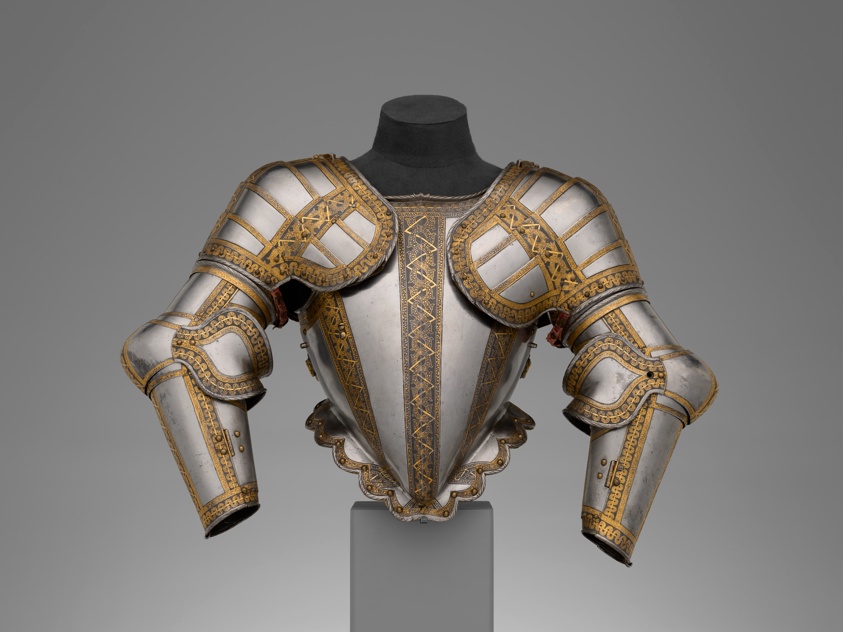
Portions of a Field Armor: A Study in Materiality and the Fluid Elegance of Silk
Introduction: The Paradox of Protection and Prestige
In the hallowed archives of the Lauren Fashion Heritage Lab, we are often drawn to the intersection of martial utility and aristocratic refinement. The artifact under examination—a set of portions from a field armor, dating to the late 16th century—presents a compelling paradox. At first glance, it is an object of war: a composite of steel, brass, and gilding designed to deflect blade and bullet. Yet, its inner linings and decorative accents whisper a different narrative, one of classic silk craftsmanship and the pursuit of fluid elegance. This paper argues that the silk velvet textile, far from being a mere functional afterthought, is the defining element that transforms a tool of aggression into a statement of heritage, status, and sartorial mastery. In the language of London’s Savile Row, where cut and cloth reign supreme, this armor is not just protection—it is a bespoke garment, tailored for the body and the soul of its wearer.
Materiality: The Dialogue Between Steel and Silk
The primary structure of this armor is forged from steel, a material synonymous with resilience. The breastplate, pauldrons, and gauntlets exhibit the hammered contours of a master armorer, their surfaces polished to a muted sheen that catches light with the subtlety of a well-tailored worsted wool. Yet, the steel is not left bare. Brass rivets and edging provide a warm, golden contrast, while gilding—applied through a mercury amalgam process—adorns the borders with intricate foliate patterns. This is not the crude armor of a common soldier; it is a ceremonial piece, designed to be seen in the courts of Europe as much as on the battlefield.
However, the most telling material is the silk velvet textile that lines the interior of the gauntlets and the gorget. This is not a mere padding; it is a deliberate choice of luxury. Silk velvet, woven from the finest filaments of the silkworm, offers a tactile experience that steel cannot match. Its pile—dense, plush, and deep crimson—absorbs light rather than reflecting it, creating a sense of depth and richness. The leather straps, dyed to match the velvet, secure the armor to the body, but it is the silk that touches the skin. In the context of Savile Row, where the interior of a jacket is as carefully considered as its exterior, this silk lining speaks to a philosophy of total refinement. The armor is not merely worn; it is inhabited.
Classic Silk Craftsmanship: The Art of the Weave
To understand the silk velvet of this armor, one must appreciate the classic silk craftsmanship that produced it. The velvet is likely a ciselé velvet, where the pile is cut and uncut to create a pattern of contrasting heights. This technique, perfected in Italian and French workshops of the 16th century, required a loom of extraordinary precision. The weaver would manipulate the warp threads, lifting some to create a looped pile and cutting others to form a velvety surface. The result is a textile that feels both solid and ethereal—a paradox that mirrors the armor itself.
The color, a deep burgundy, is achieved through kermes or cochineal dyes, imported from the Mediterranean and the New World. These dyes were as costly as the silk itself, reserved for the highest echelons of society. The crimson hue is not merely decorative; it is a signal of wealth, power, and access to global trade networks. In the same way that a Savile Row tailor selects a bolt of Scottish tweed or Italian cashmere, the armorer chose this silk for its ability to convey status without a single word. The silk velvet is the armor’s bespoke lining, a hidden luxury that only the wearer and his valet would fully appreciate.
Fluid Elegance: The Movement of Armor as Garment
The term fluid elegance may seem incongruous when applied to steel, but it is precisely this quality that the silk velvet imparts. Armor, by its nature, is rigid and constricting. Yet, the portions we examine—particularly the articulated gauntlets and the flexible gorget—demonstrate a design philosophy that prioritizes movement. The steel plates are riveted to leather straps, allowing the hand to flex and the neck to turn. The silk velvet lining reduces friction, enabling the metal to slide against the wearer’s clothing without chafing. This is not armor that immobilizes; it is armor that dances.
Consider the gauntlets. The fingers are covered in overlapping steel lames, each one shaped to the contour of the hand. The interior is lined with silk velvet, which cushions the knuckles and allows the fingers to close around a sword hilt or a reins with ease. The gilded brass cuffs flare slightly, echoing the silhouette of a tailored sleeve. When the wearer raises his arm, the steel catches the light, but it is the whisper of silk against skin that defines the experience. This is fluid elegance in action—a harmony of materials that transforms a functional object into an extension of the body.
Context: The Armor as a Reflection of Heritage
In the world of Savile Row, heritage is not a static concept; it is a living tradition, passed down through generations of cutters, weavers, and finishers. The same can be said of this armor. It is a product of a classic silk craftsmanship that predates the Industrial Revolution, a time when every thread was spun by hand and every dye was extracted from nature. The armor’s steel and brass may have been forged in a German or Milanese workshop, but the silk velvet likely came from Lucca or Lyon, centers of textile excellence that still influence fashion today.
The presence of silk in a field armor also speaks to the ceremonial nature of Renaissance warfare. Battles were not merely conflicts; they were displays of power, where a knight’s armor was his most important garment. The silk lining was a reminder that even in the chaos of combat, elegance was paramount. This ethos resonates with the modern gentleman who commissions a bespoke suit from Savile Row: the fit, the fabric, and the finishing are all expressions of identity. The armor, like a tailored jacket, is a heritage artifact that tells a story of its owner’s place in the world.
Conclusion: The Enduring Legacy of Silk in Armor
As we conclude this study, it is clear that the portions of a field armor held in the Lauren Fashion Heritage Lab are far more than a relic of martial history. They are a testament to the power of materiality—the way in which steel, brass, gilding, leather, and silk velvet come together to create an object of profound beauty and function. The silk velvet textile, with its deep crimson pile and classic silk craftsmanship, is the soul of this armor. It provides the fluid elegance that allows the wearer to move with grace, even as he prepares for battle.
In the language of Savile Row, we might say that this armor is bespoke—tailored not only to the body but to the spirit of its age. It reminds us that heritage is not about preservation alone; it is about understanding the choices that makers made, and the values those choices represent. The silk velvet lining, hidden from view but felt with every movement, is the ultimate expression of that philosophy. It is the quiet luxury that defines true elegance, whether on a battlefield or in a boardroom.
End of Artifact