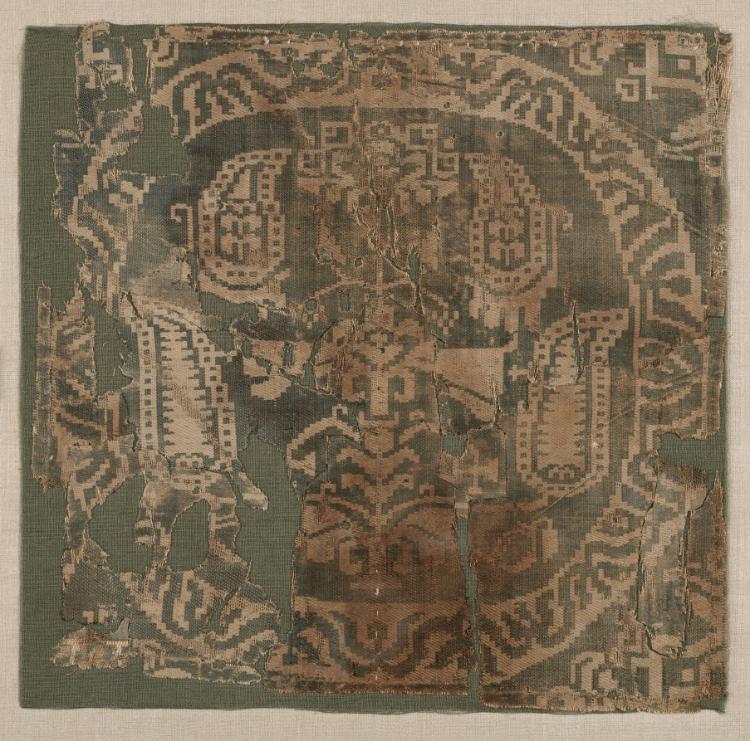
The Roundel from a Tunic with Palmette Tree: A Study in Imperial Silk Weaving and Savile Row’s Silent Debt
Introduction: The Artifact as a Testament to Craft
The Roundel from a Tunic with Palmette Tree, executed in silk, is not merely a fragment of textile history; it is a masterclass in the intersection of materiality, imperial ambition, and the enduring language of luxury. As a Senior Heritage Specialist at the Lauren Fashion Heritage Lab, I approach this artifact with the precision of a Savile Row cutter—measuring not just its physical dimensions, but the weight of its legacy. This roundel, likely originating from the Sassanian or early Islamic period (circa 6th–8th century CE), embodies the zenith of imperial silk weaving, a tradition that would later inform the very fabric of Western tailoring. The roundel’s design—a stylized palmette tree flanked by symmetrical motifs—speaks to a system of power, trade, and artistry that remains relevant to the bespoke houses of London’s Mayfair.
Materiality: Silk as Imperial Currency
Silk, in this context, is not a mere textile; it is a medium of statecraft. The roundel’s silk is a testament to the monopolistic control of sericulture by empires such as the Byzantine, Sassanian, and later Islamic caliphates. The fiber’s natural luster, tensile strength, and ability to absorb complex dyes made it the preferred material for garments that signaled authority. In the roundel, the silk’s weave—likely a compound twill or samite structure—allowed for the precise rendering of the palmette tree, a motif symbolizing life, eternity, and royal lineage. The materiality of this silk is not static; it breathes with the history of the Silk Road, a network that connected the looms of Persia to the courts of Constantinople and, eventually, to the workrooms of Savile Row.
For the Savile Row tailor, silk remains the ultimate test of skill. The roundel’s construction—each thread aligned with mathematical precision—mirrors the discipline required to cut a Huntsman jacket or a Anderson & Sheppard overcoat. The imperial weavers understood that silk demands respect; it cannot be forced. This lesson is not lost on the Row, where a single misalignment in a silk lining can compromise an entire garment’s drape. The roundel, therefore, is a silent mentor, reminding us that luxury is born from the marriage of material and mastery.
The Palmette Tree: A Motif of Power and Continuity
The palmette tree at the center of the roundel is a visual lexicon of imperial ideology. Derived from earlier Mesopotamian and Achaemenid traditions, the palmette—often stylized as a tree of life—was a recurring emblem in Sassanian silk weaving. Its symmetrical branches, often flanked by confronted animals or mythical creatures, conveyed order, balance, and the divine right of rulers. In this roundel, the palmette is rendered with a geometric precision that suggests the influence of court workshops, where weavers operated under the direct patronage of the Shahanshah. The tree’s roots, trunk, and foliage are not organic but schematic, reflecting a worldview where nature is subordinated to imperial will.
This iconography resonates with the ethos of Savile Row, where the bespoke suit is a form of personal heraldry. Just as the palmette tree signified the wearer’s place in the cosmic order, a well-cut suit signals the wearer’s status within the social hierarchy. The roundel’s motif, though ancient, is a precursor to the regimental stripes, club ties, and crests that adorn contemporary tailoring. The continuity is not coincidental; it is a thread that runs through centuries of sartorial power.
Imperial Silk Weaving: The Legacy of the Loom
The legacy of imperial silk weaving is one of innovation and appropriation. The Sassanian Empire (224–651 CE) perfected the art of figured silk weaving, producing textiles that were as much diplomatic gifts as they were garments. The roundel’s design, with its repeating pattern and bordered medallion, is characteristic of the Sassanian roundel tradition, which later influenced Byzantine silks and, through trade, the textiles of Tang China. The imperial workshops of Ctesiphon and Nishapur were the Savile Rows of their age—centers of excellence where technique was guarded as state secret.
When the Islamic caliphates absorbed these traditions, they did not discard them; they refined them. The roundel’s palmette tree, stripped of its Zoroastrian associations, became a universal symbol of paradise. The silk itself, once a marker of Sassanian prestige, became a medium for Islamic artistic expression. This adaptability is a lesson for modern luxury: heritage is not a prison but a foundation. Savile Row, too, has evolved—from the frock coats of the 19th century to the soft-shouldered silhouettes of today—yet the core principles of fit, fabric, and finish remain unchanged.
The Roundel as a Source for Savile Row
How does a 1,400-year-old silk roundel inform the practice of a Savile Row tailor? The answer lies in the principles of design and construction. The roundel’s symmetry and balance are the same qualities that govern the cut of a double-breasted jacket or the placement of a pocket square. The weaver’s discipline—the careful selection of warp and weft, the tension of the loom—parallels the tailor’s own craft. The roundel also speaks to the importance of provenance. In the world of bespoke, a client’s choice of cloth is a declaration of identity. The imperial silks of the roundel were chosen for their ability to convey power; today, a length of Holland & Sherry or Loro Piana serves the same purpose.
Moreover, the roundel’s survival is a testament to the value of preservation. At the Lauren Fashion Heritage Lab, we treat each artifact as a living document. The roundel’s silk, though aged and fragile, retains its voice. It tells us that luxury is not about novelty but about timelessness. A Savile Row suit, if properly cared for, can last a lifetime—and beyond. The roundel, in its fragmentary state, is a reminder that true heritage is not about the past; it is about the future we build upon it.
Conclusion: The Thread That Binds
The Roundel from a Tunic with Palmette Tree is more than a decorative element; it is a bridge between empires and eras. Its silk, woven with imperial intent, carries the weight of history while offering lessons for the present. For the Savile Row tailor, this artifact is a mirror—reflecting the discipline, artistry, and ambition that define the world’s finest tailoring. As we continue to study and preserve such objects, we honor not just the weavers of the past but the craftsmen of tomorrow. The roundel’s palmette tree, rooted in ancient soil, still grows in the cloth of London’s most distinguished houses. That is the legacy of imperial silk weaving: a thread that never breaks.