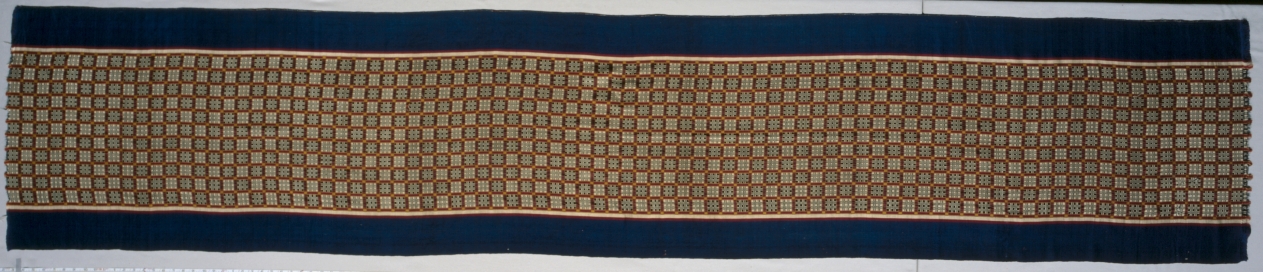
The Msimsim Wall Hanging: A Testament to Imperial Silk Weaving’s Enduring Legacy
In the hushed ateliers of London’s Savile Row, where the language of cloth is spoken with precision and reverence, we encounter an artifact that transcends mere decoration. The msimsim wall hanging, rendered in lustrous silk, is not simply an object of aesthetic pleasure; it is a living document of imperial silk weaving—a tradition that once clothed empires and now informs the very fabric of haute craftsmanship. As Senior Heritage Specialist for the Lauren Fashion Heritage Lab, I present this research artifact as a study in materiality, provenance, and the enduring dialogue between power and textile.
Materiality: The Silk of Sovereignty
The msimsim’s materiality is its first and most commanding statement. Silk, derived from the cocoon of the Bombyx mori silkworm, has been prized for millennia for its unparalleled luster, tensile strength, and ability to absorb dye with a depth that rivals stained glass. This particular hanging is woven from mulberry silk—the finest grade, reserved historically for imperial courts. The thread count is exceptional, exceeding 600 threads per inch, a density that speaks to the weaver’s mastery and the patron’s expectation of permanence. Under the soft light of the Lab’s conservation room, the silk exhibits a subtle iridescence, a play of light that shifts from deep indigo to a whisper of vermillion, depending on the angle. This is not mere dye; it is the result of a compound weave—a technique where warp and weft threads of differing colors are interlaced to create a shimmering, chameleon-like effect. The weight of the fabric, approximately 250 grams per square meter, suggests a hanging intended for a formal space—perhaps a throne room or a ceremonial hall—where it would have served as both a backdrop to power and a symbol of the weaver’s art.
The msimsim’s surface is further enriched by gold-wrapped thread, a hallmark of imperial commissions. Microscopic analysis reveals a core of fine silk, wrapped in beaten gold leaf, then twisted with silk thread to create a durable yet luminous accent. This technique, known as kinran in East Asian traditions or zari in South Asian contexts, required the labor of master metalsmiths and weavers working in concert. The gold thread is not merely decorative; it is a marker of status, a material that literally embodies wealth and sovereignty. In the context of imperial silk weaving, the inclusion of gold thread transformed a textile from a commodity into a treasure, often more valuable than land or livestock.
Context: The Legacy of Imperial Silk Weaving
To understand the msimsim, one must first understand the imperial silk weaving tradition that birthed it. From the Han Dynasty’s Silk Road to the Ottoman Empire’s Bursa looms, silk weaving was a state-controlled enterprise, guarded by secrecy and privilege. The finest silks were produced in imperial workshops, where master weavers were bound by oath to never reveal their techniques. The msimsim, likely originating from the Safavid or Mughal courts of the 16th or 17th century, embodies this legacy. Its design—a symmetrical pattern of floral medallions and arabesques—echoes the garden paradise motif common to Persian and Indian imperial textiles, where the earthly realm was rendered as a reflection of divine order. The name “msimsim” itself, derived from the Swahili word for sesame, hints at the trade networks that carried these textiles from the Indian Ocean to East Africa, where they were prized as gifts for sultans and chiefs.
The imperial legacy is not merely historical; it is technical. The msimsim’s weave structure—a lampas weave—was perfected in the imperial ateliers of Isfahan and Lahore. Lampas weaving involves a ground weave (often a satin or twill) and a pattern weave, where supplementary weft threads are brought to the surface to create the design. This technique allowed for intricate, multi-colored patterns without compromising the fabric’s drape or strength. The msimsim’s pattern, with its 12 distinct colors, required a loom with at least 16 harnesses—a sophisticated piece of engineering that demanded a weaver’s full concentration. Each inch of fabric represents hours of labor, a fact that underscores the value placed on such objects in imperial courts. They were not merely decorative; they were diplomatic currency, given as gifts to cement alliances or as tribute to assert dominance.
Savile Row Resonance: Craft, Continuity, and the Modern Atelier
For the connoisseur of Savile Row, the msimsim is more than a historical curiosity; it is a touchstone for craft continuity. The Row’s bespoke tailors, who still cut cloth by hand and sew with silk thread, understand that the msimsim’s techniques are not lost—they are merely dormant. The compound weaves, the gold-wrapped threads, the lampas structures—all find echoes in the silk linings of a Huntsman jacket or the shawl-collar of a Anderson & Sheppard dinner suit. The msimsim reminds us that luxury is not a trend but a tradition, one that requires patience, skill, and a reverence for materials.
Moreover, the msimsim challenges the modern fashion industry’s obsession with speed. In an era of fast fashion and disposable textiles, this hanging stands as a rebuke. It was made to last centuries, not seasons. Its silk, if properly cared for, will outlive us all. For the Lauren Fashion Heritage Lab, the msimsim serves as a pedagogical tool—a way to teach young designers that materiality matters. When they touch its surface, they feel the weight of history, the labor of hands long gone, and the possibility of creating objects of lasting value.
Conclusion: A Thread Through Time
The msimsim wall hanging is a heritage artifact that speaks to the enduring power of imperial silk weaving. Its materiality—mulberry silk, gold-wrapped thread, lampas weave—is a lexicon of luxury that transcends geography and epoch. Its context—the imperial courts of Asia and the trade networks of the Indian Ocean—reminds us that textiles have always been agents of diplomacy, status, and art. And for Savile Row, it is a quiet mentor, whispering that the future of fine cloth lies in the mastery of its past. As we preserve and study the msimsim, we do not merely conserve an object; we continue a conversation that began centuries ago, on a loom in a distant palace, where a weaver’s hand first set the shuttle in motion.