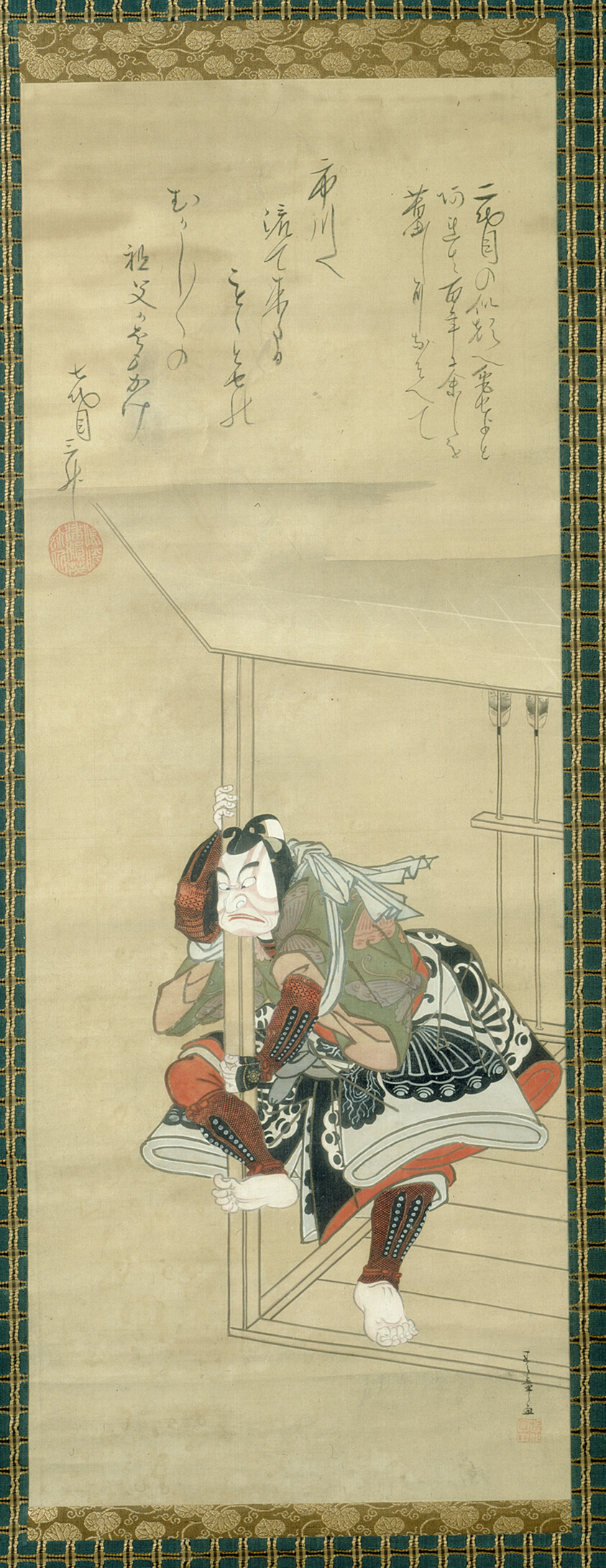
A Consideration of Lineage and Line: The Danjûrô II Portrait Scroll
In the rarefied world of bespoke craftsmanship, where heritage is not merely inherited but meticulously curated and perpetually honed, the concept of lineage stands paramount. It is the invisible yet palpable thread connecting generations of mastery, a silent dialogue between precedent and innovation. This principle, so deeply ingrained in the traditions of Savile Row tailoring—where the cut of a lapel or the construction of a shoulder speaks volumes of its house—finds a profound and elegant parallel in the artistic traditions of Edo-period Japan. The portrait scroll of the Kabuki actor Ichikawa Danjûrô II (1689-1758) is not a mere representation; it is a statement of succession, rendered with a fluid elegance on the most noble of canvases: silk.
The Canvas: A Foundation of Unspoken Quality
Before a single line of sumi ink meets its surface, the silk itself establishes the artifact’s stature. Much like the foundational canvases and exquisite wools selected by a master tailor—fabrics whose weight, weave, and hand are the unsung heroes of the final form—this silk is the silent partner to the spectacle. Its fine, consistent grain provides a surface that accepts pigment with a particular clarity and depth, allowing for both the sharp, definitive lines of the actor's form and the soft, atmospheric washes of colour that define the ground. The inherent slight sheen of the silk, a natural luster born of the fibre's structure, imparts a vital luminosity to the work. It ensures that the image does not sit flatly upon its ground but possesses a subtle, living glow, a quality that changes with the ambient light, much as a finely tailored garment reveals different aspects of its character in the soft glow of a club or the clear light of day. This is not a support for an image; it is the integral first layer of meaning, a testament to a patronage and a purpose that demanded nothing less than the finest ground.
The Cut of the Brush: Defining the Silhouette of Power
The depiction of Danjûrô II is an exercise in authoritative draughtsmanship. The lines that describe his form—from the severe angle of his kamishimo robes to the set of his jaw and the iconic aragoto style glare—are applied with a certainty that brooks no hesitation. This is the sartorial equivalent of a master cutter’s chalk line: decisive, confident, and defining a silhouette of immense dramatic power. The aragoto style, which Danjûrô I pioneered and his successor perfected, is one of exaggerated, superhuman strength. The brushwork captures this essence not through photographic realism, but through a calculated abstraction and amplification of form—a tailoring of the visual image to project a specific, overwhelming character. The folds of the costume are not merely descriptive; they are orchestrated to lead the eye, to emphasise breadth of shoulder and dynamism of posture, creating a visual architecture as considered as the padding and canvas of a power suit intended to command a boardroom or a stage.
The Palette: Colours as Insignia
The colour application, while restrained in its tonal range, is precise and symbolic. The pigments, derived from mineral and organic sources, are layered with a transparency that allows the silk’s luminosity to persist. The specific hues of the ceremonial robes, the particular red of the lips, and the stark white of the facial makeup (keshō) are not arbitrary. They are, in effect, a uniform. They immediately signal the actor’s lineage, his school, and the specific heroic role he embodies. In the lexicon of Kabuki, colour and pattern are as heraldic as a family crest on a blazer pocket or the distinctive stripe of a regimental tie. They communicate identity to the cognoscenti at a glance. The artist’s skill lies in applying these colours with a fluidity that breathes within the ink-defined forms, ensuring they enhance rather than overwhelm the commanding line. There is a harmony here, a balance between the structural authority of the brush line and the dignified, traditional resonance of the palette.
Provenance as Performance: The Artifact in Context
Finally, one must consider the artifact’s intended performance. As a hanging scroll (kakemono), it was designed for intermittent display, to be unfurled and contemplated in a specific setting—perhaps in the home of a discerning patron or a theatre guild—before being carefully rolled and stored in its protective box. This ritual of viewing mirrors the relationship one has with a cherished heirloom garment: brought out for significant occasions, appreciated for its craftsmanship and history, and preserved with reverence for future generations. The scroll does not merely depict Danjûrô II; it performs its own role as a custodian of his legacy. Every element, from the quality of the silk and the silk cords to the mastery of the brushwork, conspires to affirm the status of the subject and the taste of the owner. It is an object of connoisseurship, speaking of a world where artistic patronage and personal or familial identity were inextricably woven together.
In conclusion, the portrait scroll of Ichikawa Danjûrô II stands as a peerless example of heritage materialised. Through the supreme materiality of silk, the definitive cut of the brush, the symbolic resonance of its palette, and its very nature as a display artifact, it articulates a philosophy of lineage, mastery, and performed identity. It reminds us that true elegance, whether on the stages of Edo or the pavements of Mayfair, is never a mere surface effect. It is the profound and fluent expression of a tradition worn—or in this case, painted—with unquestioned authority.