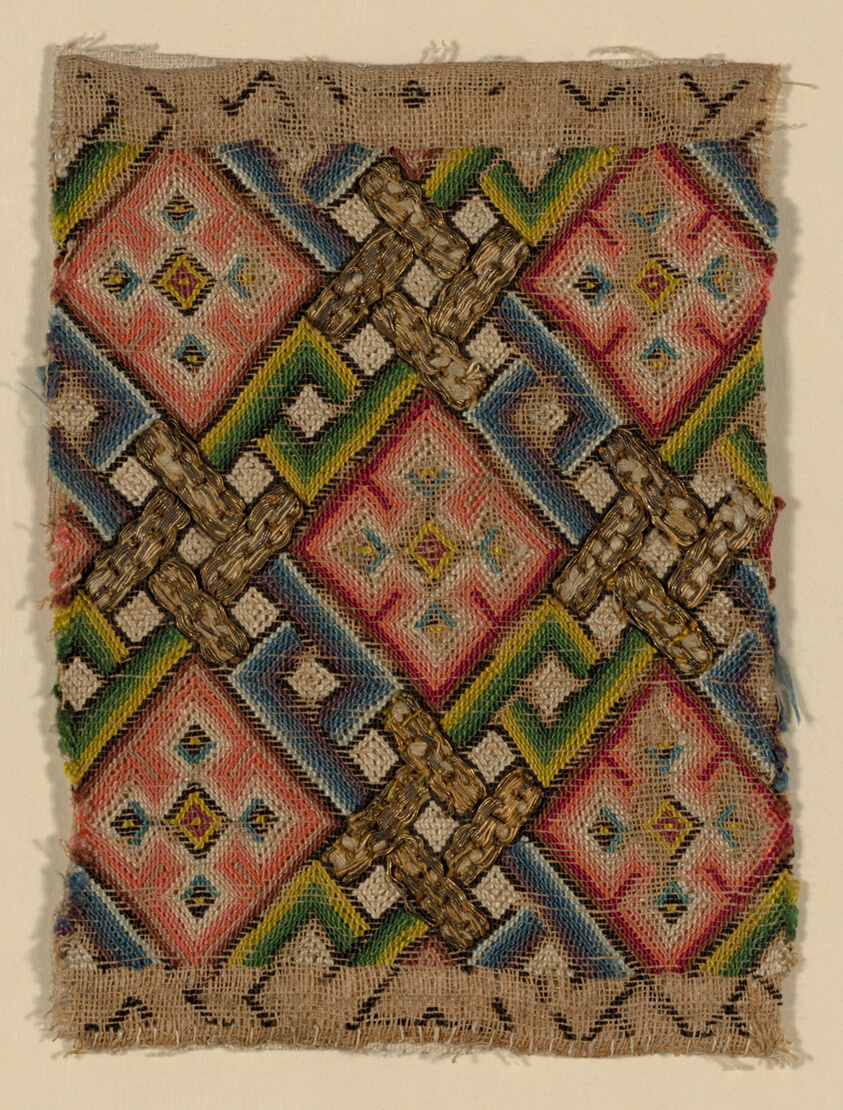
A Fragment of Unfinished Business: On the Materiality of Interrupted Elegance
To consider the fragment is to engage with a narrative deliberately suspended. It is not a ruin, which implies a conclusion wrought by time or catastrophe. No, a fragment is a proposition halted mid-sentence, a gesture captured in the moment before its full expression. The specimen in question—a plain-weave linen ground, embroidered with silk floss and gilt- and silvered-metal-strip-wrapped silk in tent stitch, with elements of padded couching—presents not as a relic, but as a suspended act of sartorial congress. Its materiality speaks of an ambition in a state of becoming, a dialogue between structure and fluidity left purposefully, perhaps poignantly, unresolved.
The Ground: Linen as the Silent Partner
One must first appreciate the foundation. The choice of a plain-weave linen is, in itself, a statement of intent. Linen provides a substrate of understated authority—crisp, stable, and possessing a tensile strength that belies its refined appearance. It is the silent partner in this enterprise, the Savile Row canvas upon which the more flamboyant narrative of silk is to be inscribed. Its very mundanity is its virtue; it does not compete. It offers a field of neutral discipline, a bastion of order against which the fluid elegance of the silk embroidery will ultimately define itself. This is the bespoke principle in its rawest form: the unseen foundation dictating the longevity and comportment of the visible artistry.
The Discourse of Stitch and Filament
Upon this disciplined ground, the language of silk commences. The use of silk floss for the core embroidery establishes the primary vocabulary—a vocabulary of soft luminosity and inherent, organic sheen. The tent stitch, worked with meticulous regularity, is the grammar. A diagonal stitch occupying a single intersection of the linen’s weave, it creates a dense, pixelated surface, a tapestry-like effect that translates the designer’s cartoon into a pliable, textile reality. It is a labour-intensive, meditative process, building tone and form through accumulation. This is the crafted body of the work.
However, the true inflection, the sprezzatura within the discipline, arrives with the gilt- and silvered-metal-strip-wrapped silk. Here, materiality transcends mere colour and enters the realm of light itself. The metal-strip wrapping captures and refracts illumination in a manner flat pigment cannot, creating points of dynamic emphasis that shift with the wearer’s carriage. The application of this material, however, is not left to the humble tent stitch alone. It is here that the technique of padded couching is introduced—a masterstroke of dimensional strategy.
Padded Couching: The Architecture of Opulence
Padded couching is not merely decorative; it is structural and rhetorical. First, a foundation of padding—often layers of thread or felt—is laid upon the linen ground. The metal-wrapped thread is then laid over this raised form and ‘couched’ down, secured by tiny, virtually invisible stitches of a finer silk at intervals. The result is a low-relief topography: a corded edge, a heraldic crest, a foliate motif that stands proud of the surface. This technique transforms the fragment from a decorated textile into a micro-architecture of luxury. It engages not just the eye, but the mind’s understanding of form and shadow. It declares that this embroidery is to be experienced in the round, its worth ascertained through the play of light across its deliberately constructed peaks and valleys. It is the sartorial equivalent of chiaroscuro.
The Aesthetic of the Unfinished: A Study in Potential
And yet, it remains a fragment. This is of paramount importance. We observe areas where the linen ground remains bare, a ghostly outline of the intended whole. We see sections where the silk floss work is complete, but the crucial metal-wrapped threads lie beside the frame, still in their skeins. The padded couching exists in some elements, suggesting the final, bold punctuation of the design, while elsewhere it is merely indicated by chalk marks.
This state of suspension is where the true research value resides. It allows us to deconstruct the hierarchy of making. We witness the procedural logic: ground, then tonal infill with floss, then the application of dimensional metallic emphasis. We are privy to the workshop’s methodology, seeing the construction of elegance in its phased assembly. The fragment does not whisper of lost glory; it eloquently debates the relationship between substance and sheen, between the foundational labour and the final flourish.
The intended effect, as suggested by the context of “fluid elegance,” was surely a garment where this intricate, structured artistry would, paradoxically, yield a sensation of effortless movement. The stiffness of the heavily embroidered panel would be strategically placed—on a cuff, a lapel, a yoke—so that against the flow of a coat or gown, it would serve as an anchor of exquisite craftsmanship, a fixed point of luxury from which fluid lines could emanate.
In conclusion, this fragment is a treatise in miniature. It articulates the classic principles of silk craftsmanship—luminosity, tactility, and transformative potential—while grounding them in the rigorous disciplines of embroidery and structural padding. Its unfinished state is not a deficit but a scholarly boon. It presents, with forensic clarity, the very anatomy of elegance: the linen’s discipline, the silk’s narrative, the metal’s spectacle, and the couching’s intellect. It is, in the final estimation, a permanent pause in a conversation between material and maker, a conversation about how light, texture, and form conspire to create an authority that is, unmistakably, bespoke.