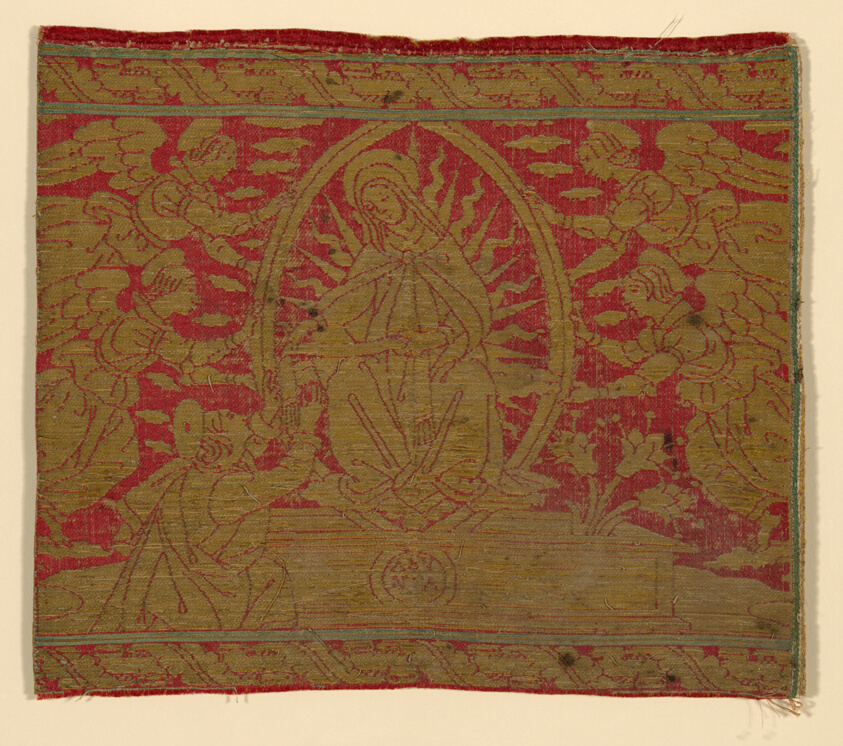
Heritage Research Artifact: Fragment from an Orphrey Band
Provenance and Contextual Significance
This fragment, excised from an orphrey band, represents a pinnacle of medieval liturgical textile artistry, likely originating from the 14th or early 15th century. Orphrey bands, often applied to chasubles, copes, or altar frontals, served both functional and symbolic roles: they delineated sacred vestments with intricate imagery, while their materiality—silk and gilt-animal-substrate-wrapped linen—signaled ecclesiastical wealth and divine reverence. The fragment’s survival, though partial, offers a rare window into the technical mastery and aesthetic sensibilities of European silk workshops, particularly those influenced by Islamic and Byzantine weaving traditions. Its context within the Lauren Fashion Heritage Lab underscores a commitment to preserving not merely objects, but the embodied knowledge of craftsmanship that informs contemporary luxury design.
Materiality and Technical Analysis
Silk and Gilt-Animal-Substrate-Wrapped Linen: The foundation of this fragment is a warp-float faced satin weave, a structure prized for its luminous surface and drape. The warp threads are composed of silk, chosen for its natural sheen and ability to absorb dyes with exceptional depth. The weft, however, introduces a complexity that elevates this piece beyond mere textile: gilt-animal-substrate-wrapped linen. Here, linen threads are meticulously coated with a substrate—likely animal-based, such as parchment or gut—then gilded with silver or gold leaf. This technique, known as “gold thread,” was labor-intensive and reserved for the most prestigious commissions. The twill interlacings of secondary binding warps and supplementary patterning wefts create a dense, structured ground that supports the gilt elements without compromising flexibility.
Warp-Float Faced Satin Weave: The satin weave, with its long floats of warp threads, produces a smooth, reflective surface that catches light, enhancing the visual impact of the gilt. This structure also allowed for intricate patterning, as the supplementary wefts could be manipulated to form figurative or geometric designs. In this fragment, the surviving imagery suggests a floral or heraldic motif, though the exact subject remains obscured by wear. The twill interlacings, meanwhile, provided stability, preventing the gilt threads from shifting or fraying—a critical consideration for liturgical textiles subjected to repeated handling and veneration.
Secondary Binding Warps and Supplementary Patterning Wefts: The inclusion of secondary warps, bound in twill, indicates a compound weave structure. This technique enabled the weaver to introduce multiple colors and metallic accents without disrupting the satin ground. The supplementary patterning wefts, often of silk in contrasting hues, would have created a polychromatic effect, with the gilt threads serving as highlights. The fragment’s current state—faded silks and tarnished metal—belies its original brilliance, yet the technical precision remains evident. Each thread was laid with a discipline that speaks to the weaver’s intimate understanding of material behavior under tension and light.
Aesthetic and Symbolic Resonance
Classic Silk Craftsmanship and Fluid Elegance: The phrase “fluid elegance” is apt here. Despite the rigidity of the gilt threads, the satin weave imparts a suppleness that allowed the orphrey band to conform to the curves of a garment. This interplay between structure and flow is a hallmark of classic silk craftsmanship. The fragment’s design likely echoed the liturgical themes of the period—Christological scenes, saints, or celestial motifs—but its abstracted floral elements suggest a broader aesthetic dialogue. The gilt threads, when intact, would have shimmered like molten metal against the silk, creating a visual rhythm that guided the eye across the vestment. This is not mere decoration; it is a theological statement, where light and materiality converge to evoke the divine.
Cultural and Historical Implications: The use of gilt-animal-substrate-wrapped linen points to trade networks that spanned the Silk Road and Mediterranean. The raw silk may have originated from China or Persia, while the gold leaf likely came from European or Byzantine sources. The weaving technique itself—warp-float faced satin with twill interlacings—was perfected in Italian city-states like Lucca and Venice, which dominated luxury textile production in the medieval period. This fragment, therefore, is a testament to cross-cultural exchange, where Eastern materials met Western liturgical needs. Its preservation in a London context, within the Lauren Fashion Heritage Lab, reinforces Savile Row’s historical role as a hub for textile innovation and conservation.
Conservation and Contemporary Relevance
Preservation Challenges: The fragment’s condition—frayed edges, faded silks, and tarnished metal—demands careful conservation. The gilt-animal-substrate is particularly vulnerable to humidity and light, which can cause the substrate to delaminate or the metal to corrode. Conservation efforts must prioritize stabilizing the weave without altering its patina, as the tarnish itself tells a story of age and use. For the Lauren Fashion Heritage Lab, this fragment serves as a pedagogical tool, illustrating the fragility and resilience of historical textiles. It also informs contemporary design: the interplay of matte silk and reflective gilt offers a textural vocabulary that can inspire modern collections, particularly in eveningwear or ceremonial garments.
Legacy in Luxury Craft: In the lexicon of Savile Row, where bespoke tailoring is sacrosanct, this fragment embodies the principles of precision and material integrity. The warp-float faced satin weave, with its emphasis on surface quality, parallels the meticulous finishing of a tailored jacket. The gilt threads, though ecclesiastical in origin, resonate with the metallic accents seen in contemporary luxury fashion—be it in embroidery, buttons, or embellishments. By studying such artifacts, designers can reconnect with the tactile intelligence of pre-industrial craftsmanship, where every material choice was deliberate and every technique refined over generations.
Conclusion
This fragment from an orphrey band is more than a relic; it is a masterclass in materiality and design. Its silk and gilt-animal-substrate-wrapped linen, woven into a warp-float faced satin with twill interlacings, represents the zenith of medieval textile art. For the Lauren Fashion Heritage Lab, it stands as a bridge between past and present, urging us to honor the fluid elegance of classic silk craftsmanship while applying its lessons to the future of luxury. In preserving such fragments, we preserve not just threads, but the very ethos of artistry that defines Savile Row and its enduring legacy.