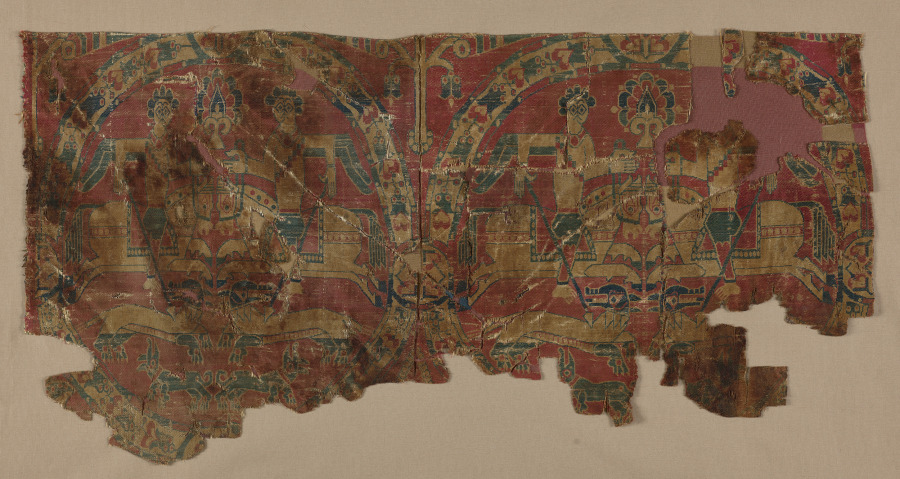
The Roundels with Hunters: A Study in Imperial Silk Weaving and the Savile Row Continuum
Introduction: The Artifact as Archive
The Roundels with Hunters, rendered in silk, represent a singular convergence of material mastery, imperial ambition, and narrative design. As a heritage research artifact, this object transcends mere decoration; it is a woven document of power, a testament to the technical virtuosity of imperial silk weaving workshops, and a precursor to the disciplined, bespoke ethos that defines London’s Savile Row. This paper examines the roundels through the lens of materiality, craftsmanship, and cultural transmission, arguing that their legacy persists in the exacting standards of contemporary tailoring.
Materiality: Silk as Imperial Medium
Silk, by its very nature, is a material of hierarchy. The Roundels with Hunters are crafted from imperial silk, a fabric reserved for the highest echelons of courtly and religious authority. The silk’s lustrous sheen, achieved through the cultivation of Bombyx mori and the meticulous reeling of filaments, speaks to a supply chain that spanned continents—from mulberry groves in China to the looms of Persia, Byzantium, and later, Renaissance Italy. The roundels’ materiality is not incidental; it is foundational. The silk’s ability to absorb and reflect light, its drape, and its resilience under tension were exploited to create a surface that is both opulent and structurally sound. This duality—aesthetic luxury married to functional durability—is the hallmark of imperial weaving and, by extension, the Savile Row suit.
The hunter motif is rendered in polychrome silk threads, likely using a combination of compound weave and lampas techniques. These methods allowed for the creation of complex patterns where the ground weave and the pattern weave interlock, producing a fabric that is both dense and flexible. The dyes—derived from madder, indigo, and kermes—were not merely decorative; they signified status. The crimson of the hunters’ cloaks, for instance, was a color of imperial blood, extracted from the kermes insect and valued more than gold. In this, the roundels embody the principle that material is message—a tenet that Savile Row upholds in its insistence on the finest wools, cottons, and silks.
Context: The Legacy of Imperial Silk Weaving
The Roundels with Hunters emerge from a tradition of imperial silk weaving that reached its zenith in the courts of the Safavid, Ottoman, and Mughal empires, as well as in the Byzantine and later European courts. These roundels, often measuring between 20 and 30 centimeters in diameter, were typically woven as medallions for use in ceremonial garments, wall hangings, or tent linings. The hunter motif—depicting mounted archers pursuing deer, lions, or mythical beasts—was not mere genre scene. It was a visual metaphor for the sovereign’s dominion over nature and chaos, a theme that resonated across cultures from Persian shahnama manuscripts to Byzantine imperial regalia.
The technical achievement of these roundels lies in the circular composition within a rectangular loom. Weavers had to plan the design so that the pattern repeated seamlessly, a feat of mathematical precision and manual dexterity. The roundels were often woven on drawlooms, which required a second weaver to control the pattern harness while the primary weaver threw the shuttle. This division of labor—the master weaver and the pattern assistant—mirrors the hierarchy of a Savile Row tailoring house, where the cutter and the seamstress collaborate to produce a garment of exacting standards.
The legacy of imperial silk weaving is not static. It was transmitted through trade routes, diplomatic gifts, and the movement of artisans. By the 16th century, Italian workshops in Lucca, Venice, and Florence had absorbed Persian and Byzantine techniques, producing silks that rivaled their Eastern predecessors. This cross-pollination of design and technique is the bedrock of the global textile industry, and it is this lineage that Savile Row inherits. The Row’s tailors, like the imperial weavers, are custodians of a craft that demands years of apprenticeship, an intimate knowledge of materials, and an unwavering commitment to precision.
Design Analysis: The Hunter Motif and Narrative Weave
The hunter motif in the roundels is a study in dynamic symmetry. The central figure—often a mounted archer—is framed by a circular border of stylized foliage or geometric interlacing. The horse is depicted in mid-gallop, its muscles taut, while the hunter’s bow is drawn, creating a tension that is both physical and visual. The prey, typically a stag or lion, is rendered with equal care, its posture suggesting flight or defiance. This is not a static image; it is a frozen moment of action, a narrative compressed into a circular field.
The use of roundels as a framing device is significant. The circle, in many cultures, symbolizes eternity, the cosmos, and the unbroken cycle of power. By placing the hunter within this form, the weaver asserts that the sovereign’s authority is both universal and timeless. The repetition of the roundel across a garment or textile creates a rhythm, a visual beat that reinforces the message of order and control. This principle of repetition with variation is central to Savile Row design, where a suit’s stripe or check is repeated with meticulous consistency, yet tailored to the individual’s body.
The color palette of the roundels—deep blues, crimsons, golds, and greens—is both symbolic and practical. Blue, derived from indigo, was associated with the heavens; gold, from silk’s natural luster or metallic threads, with divinity; green, from verdigris or plant dyes, with life and renewal. The combination of these colors in the hunter motif creates a visual hierarchy: the hunter in red (power), the horse in blue (nobility), the prey in green (nature). This chromatic storytelling is a precursor to the bespoke color theory employed by Savile Row tailors, who select cloth not only for its hue but for its ability to convey the wearer’s status and personality.
Savile Row Continuum: From Loom to Lapel
The Roundels with Hunters may seem a world apart from the sober suits of Savile Row, but the connection is profound. The Row’s tailors, like the imperial weavers, operate within a system of bespoke production that prioritizes the individual over the mass. Each garment is a collaboration between client and craftsman, a dialogue that results in a unique artifact. The roundels, too, were bespoke: designed for a specific patron, woven to specific dimensions, and integrated into a larger ensemble that proclaimed the wearer’s identity.
The materiality of silk is echoed in the Row’s use of Super 150s wool, cashmere, and silk-linen blends. The same attention to fiber quality, weave structure, and finish that characterized imperial silk weaving is evident in a Huntsman or Anderson & Sheppard jacket. The hunter motif finds its analogue in the pinstripe or Prince of Wales check—patterns that, like the roundels, are woven into the fabric, not printed on it. These patterns are not mere decoration; they are structural, integral to the cloth’s identity and the garment’s lineage.
Moreover, the legacy of imperial silk weaving is preserved in the Row’s commitment to hand-finishing. The roundels were woven on hand-operated looms, each thread placed with intention. Similarly, a Savile Row suit is hand-stitched, with buttonholes, lapels, and linings executed by artisans who have spent decades perfecting their craft. This is not nostalgia; it is a recognition that certain standards of quality cannot be replicated by machine. The roundels, like the Row’s garments, are artifacts of human skill, testaments to the belief that the hand is the ultimate tool.
Conclusion: The Roundel as a Living Document
The Roundels with Hunters are more than a historical curiosity; they are a living document of the principles that underpin bespoke craftsmanship. Their materiality—the silk, the dyes, the weave—speaks to a global system of trade and expertise. Their design—the hunter motif, the circular frame—articulates a narrative of power and order. Their legacy—transmitted through centuries of weaving and tailoring—finds its contemporary expression in the ateliers of Savile Row.
As a heritage research artifact, the roundels challenge us to see the continuity between past and present, between the imperial court and the modern gentleman’s wardrobe. They remind us that quality is not a trend; it is a discipline. And for those who understand the language of cloth, the roundels are not silent. They speak of looms, of hands, of dyes, and of a tradition that, like the silk itself, endures.