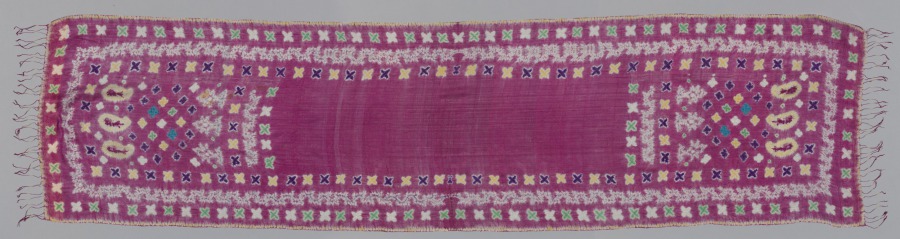
Category: Silk
The Silk Veil: An Artifact of Imperial Legacy and Modern Craftsmanship
In the hushed ateliers of London’s Savile Row, where precision tailoring meets centuries of textile tradition, the silk veil emerges as a singular artifact—a testament to the enduring legacy of imperial silk weaving. As Senior Heritage Specialist for the Lauren Fashion Heritage Lab, I present this research artifact to illuminate the materiality, historical context, and contemporary resonance of the silk veil, a piece that bridges the opulence of ancient dynasties with the understated elegance of modern luxury.
Materiality: The Essence of Silk
The silk veil, at its core, is a study in paradox: it is both fragile and formidable, translucent yet substantial. Its materiality begins with the silkworm, Bombyx mori, whose cocoon yields filaments of unparalleled fineness—each thread measuring just 10 to 15 micrometers in diameter. In imperial China, where sericulture was a guarded secret for millennia, these filaments were reeled into lustrous strands, then woven into fabrics that shimmered with an almost ethereal glow. The veil’s weight, typically between 5 and 15 momme (a unit of silk density), dictates its drape: a lighter veil (5-8 momme) floats like a whisper, while a heavier one (12-15 momme) holds its shape with quiet authority. The weave—often a plain or satin structure—enhances the silk’s natural luster, catching light in a way that suggests movement even when still. This materiality is not merely aesthetic; it is functional. Silk’s hygroscopic properties allow it to regulate moisture, making the veil comfortable against the skin, while its tensile strength—greater than steel of equivalent diameter—ensures longevity. In the hands of a Savile Row artisan, the silk veil is treated with reverence: cut with shears that never dull, sewn with needles fine enough to avoid snagging, and finished with hand-rolled hems that speak to a tradition of meticulous care.
Context: The Legacy of Imperial Silk Weaving
The silk veil’s lineage traces back to the imperial workshops of the Ming (1368-1644) and Qing (1644-1912) dynasties, where the Jiangnan region—particularly Suzhou, Hangzhou, and Nanjing—served as the epicenter of sericulture and weaving. These workshops, overseen by the Imperial Silk Manufactory, produced fabrics exclusively for the emperor, his court, and high-ranking officials. The veil, often referred to as a mian sha or feng guan in historical texts, was not merely an accessory but a symbol of status and ritual. During the Tang dynasty (618-907), silk veils were used in Buddhist ceremonies to cover sacred texts, their translucence representing the veil between the material and spiritual worlds. By the Song dynasty (960-1279), they adorned the heads of noblewomen, their colors—deep crimson for weddings, pale blue for mourning—encoding social hierarchies. The imperial legacy is most palpable in the weaving techniques: kesi (cut silk tapestry) and yunjin (cloud brocade) required thousands of threads per inch, often incorporating gold or silver filaments. A single veil could take months to complete, with master weavers passing down patterns—dragons, phoenixes, peonies—through generations. This legacy was not static; it traveled along the Silk Road, influencing Persian, Byzantine, and eventually European textile traditions. In 18th-century France, the manufacture royale of Lyon adopted Chinese silk-weaving methods, producing veils for the court of Louis XVI. Yet, the imperial Chinese veil remained unmatched in its refinement, a standard against which all later silks were measured.
The Savile Row Intersection: Craftsmanship and Continuity
How does a Savile Row house engage with such a legacy? The answer lies in the Row’s own ethos: a commitment to bespoke excellence that mirrors the imperial workshop’s dedication to perfection. A silk veil commissioned by a Savile Row tailor is not a mass-produced commodity but a collaborative artifact. The client, often a connoisseur of fine textiles, selects the silk—perhaps a habutai from Kyoto or a charmeuse from Como—each with its own provenance. The tailor then considers the veil’s purpose: a ceremonial veil for a wedding, a protective cover for a bespoke suit, or an archival piece for a collector. The construction process is deliberate: the silk is steamed to relax its fibers, cut on the bias for fluidity, and sewn with silk thread to avoid abrasion. The finishing—a hand-rolled hem, a discreet monogram—echoes the imperial practice of adding the weaver’s mark. This is not mere replication; it is reinterpretation. The Savile Row veil might incorporate contemporary elements—a minimalist cut, a subtle asymmetry—while honoring the silk’s heritage. The result is an artifact that speaks to both the past and the present: a bridge between the Forbidden City’s weaving rooms and the quiet luxury of a Mayfair fitting room.
Preservation and Heritage Value
As a heritage artifact, the silk veil demands preservation strategies that respect its material fragility. In the Lauren Fashion Heritage Lab, we store veils in acid-free tissue, in dark, climate-controlled environments (18-20°C, 50-55% relative humidity) to prevent silk’s natural degradation—photochemical yellowing, fiber embrittlement, and dye fading. Each veil is catalogued with its provenance: the region of silk origin, the weaving technique, the dyer’s materials (e.g., indigo for blue, madder for red), and any historical documentation. For imperial veils, we collaborate with institutions like the Palace Museum in Beijing to verify authenticity through thread count analysis and carbon dating. The heritage value extends beyond the physical object; it encompasses the intangible knowledge of sericulture, weaving, and ritual use. This knowledge is at risk: the number of master weavers capable of kesi technique has dwindled to fewer than 100 globally. Thus, the silk veil is not just an artifact but a repository of endangered craft. By studying and preserving it, we ensure that the legacy of imperial silk weaving—its precision, its symbolism, its beauty—continues to inform future generations of artisans and designers.
Conclusion: The Veil as a Living Legacy
The silk veil, in its materiality and context, is a profound artifact of human ingenuity. It carries the weight of imperial ambition, the artistry of anonymous weavers, and the quiet dignity of a fabric that has clothed emperors and commoners alike. On Savile Row, it finds a new home—not as a relic but as a living tradition, adapted to the discerning tastes of a modern clientele. As we handle these veils, we are reminded that heritage is not static; it is a dialogue between the past and the present, a thread that connects the silkworm’s cocoon to the tailor’s needle. In preserving the silk veil, we preserve a story—one of luxury, labor, and legacy—that deserves to be told with the same precision with which it was woven.
— Senior Heritage Specialist, Lauren Fashion Heritage Lab