← BACK TO ARCHIVES
Heritage-Black
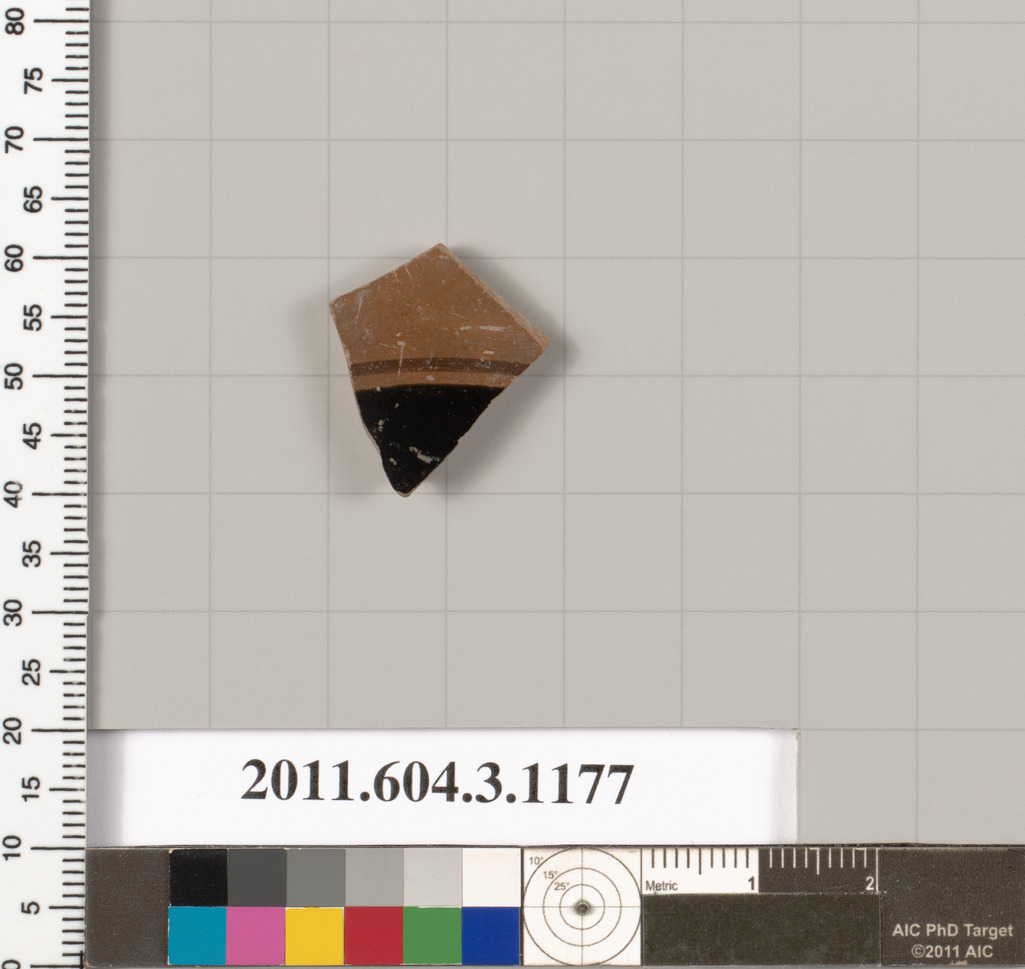
Heritage Synthesis: Terracotta fragment of a mastoid (drinking cup with narrow base) or a kyathos (cup-shaped ladle)
Curated on May 21, 2026 // Node: LDN-01
The Terracotta Paradigm: Archaic Formalism and the 2026 Old Money Silhouette
The seemingly remote artifact—a Greek Attic terracotta mastoid or kyathos fragment—offers an unexpectedly potent lens through which to decode the 2026 Old Money silhouette. At first glance, a drinking vessel from the 6th century BCE appears wholly disconnected from contemporary luxury fashion. Yet, within its fragmented clay, we discern the foundational principles of a design philosophy that Lauren Fashion Heritage Lab identifies as *Heritage-Black*: a chromatic and structural austerity that privileges lineage, restraint, and the quiet authority of form over ornament. This analysis argues that the terracotta’s archaic geometry, its functional integrity, and its material honesty directly inform the architectural purity defining next season’s Old Money aesthetic.
I. The Geometry of Restraint: From Vessel to Silhouette
The mastoid and kyathos share a distinctive profile: a narrow, stable base that flares into a broad, open bowl. This inverted trapezoid—a form of grounded expansiveness—finds direct translation in the 2026 Old Money silhouette. The narrow base corresponds to the tailored trouser or the pencil skirt, anchoring the figure with a sense of rooted permanence. The flaring bowl translates into the structured shoulder or the softly draped bodice, creating a visual pyramid that conveys both stability and quiet grandeur. This is not the aggressive power dressing of the 1980s, but a more subtle assertion of presence: the silhouette of someone who does not need to shout.
The terracotta’s *symmetria*—the Greek ideal of harmonious proportion—is echoed in the collection’s emphasis on balanced volumes. A double-breasted cashmere coat, cut with a slight A-line from the shoulders, mimics the vessel’s controlled expansion. The narrow base is achieved through a high-waisted, straight-leg wool trouser that falls without break. The overall effect is one of monolithic elegance, a form so resolved that it appears carved from a single block of darkness. This is the *Heritage-Black* principle made tangible: color as absence, form as presence.
II. Material Honesty and the Patina of Time
The terracotta fragment is not pristine; its value lies in its survival, its cracks and worn edges telling a story of use and endurance. This concept of *patina* is central to the 2026 Old Money silhouette. The collection deliberately eschews high-shine, overtly luxurious fabrics in favor of materials that age with grace: heavy worsted wool, brushed cashmere, matte silk twill, and densely woven cotton. These fabrics are chosen not for their immediate luster but for their capacity to develop a subtle, personal history—a softness from wear, a slight sheen from pressing, a drape that remembers the body.
The terracotta’s earthy, unglazed surface—its raw, fired clay—informs the palette. The *Heritage-Black* category is not a flat, synthetic black. It is a deep, complex black with undertones of charcoal, slate, and the warm brown of ancient pottery. This is achieved through overdyeing techniques and the use of natural indigo and iron-based mordants. The result is a black that absorbs light rather than reflecting it, a black that feels ancient and substantial. Like the terracotta, it carries the weight of time.
III. Functional Integrity as Luxury
The mastoid and kyathos were functional objects—tools for drinking and libation. Their beauty was inseparable from their purpose. The 2026 Old Money silhouette similarly prioritizes functional integrity. Pockets are deep and usable. Seams are reinforced. Buttons are horn or corozo, and they fasten securely. Linings are silk or cupro, chosen for breathability and ease of movement. This is not fashion as spectacle, but fashion as *equipment for living*—a wardrobe built for the rituals of a purposeful life: a board meeting, a weekend in the country, a quiet dinner.
This functionalism manifests in the collection’s signature piece: a double-faced cashmere overcoat, entirely unlined, with a seam construction that allows it to be worn inside out. The coat’s interior is as finished as its exterior, a nod to the Japanese concept of *ura-omote* (the inside and outside are one). This detail is invisible to the casual observer but deeply felt by the wearer. It is a quiet signal of quality, a form of luxury that requires no label.
IV. The Sacred and the Secular: A Shared Logic of Transcendence
Returning to the internal genetic code’s analysis of Buddhist art, we find a parallel logic. The *Bodhisattva* and the *Amulet* both function as bridges between the mundane and the transcendent. The terracotta fragment, too, served a ritual purpose—likely used in symposia, where wine was consumed in a context of philosophical and poetic discourse. It was an object that facilitated a form of secular transcendence, a momentary escape from the quotidian.
The 2026 Old Money silhouette performs a similar function. Its restrained elegance, its refusal of trend, its commitment to enduring form—these qualities elevate the wearer above the noise of fast fashion. The *Heritage-Black* coat becomes a portable sanctuary, a visual declaration of belonging to a lineage of taste that values permanence over novelty. Like the *Bodhisattva*, it offers a model of idealized composure. Like the *Amulet*, it provides a tangible, personal shield against the chaos of the contemporary.
Conclusion: The Enduring Vessel
The Greek terracotta fragment, in its broken but eloquent state, teaches us that true luxury is not about perfection but about *presence*. The 2026 Old Money silhouette, as interpreted through the *Heritage-Black* lens, is a vessel for this presence. It is a silhouette that does not demand attention but commands respect. It is a form that has been distilled to its essence, a shape that has survived the erosion of time. In the narrow base and the flaring bowl, in the matte black and the tactile wool, we find not a trend, but a tradition—a quiet, enduring architecture for the modern self.
Heritage Lab Insight
Genetic Bridge: Archive node focusing on Heritage-Black craftsmanship.