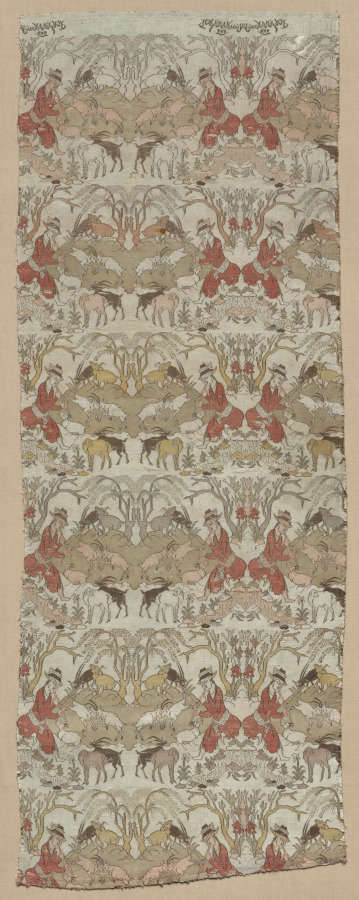
A Consideration of the Pastoral: The Goatherd in Imperial Silk
To engage with a textile of this nature—a silk depiction of goatherds in a landscape—is to handle not merely a decorative furnishing, but a complex manifesto of power, taste, and technical supremacy. It is an artifact that speaks, in the most refined of whispers, of an empire’s capacity to command both nature and narrative. The material, silk itself, is the non-negotiable foundation of this dialogue; a fibre so intrinsically linked to imperial identity that its very presence announces a provenance of the highest order. The legacy of imperial silk weaving is not one of mere production, but of orchestration—a relentless pursuit of perfection where every thread is a compliant subject.
The Primacy of the Material
Before a single pastoral scene is contemplated, one must first acknowledge the ground upon which it is built. Imperial silk is a statement of political economy. Its cultivation, its reelings, its dyeworks, and finally its looms, were often state-controlled monopolies, jealously guarded secrets of state. The sheen, the handle, the formidable tensile strength of the yarn—these were not happy accidents. They were the calculated results of standardised, imperial decree. To drape a chamber in such stuff was to literally envelope oneself in the tangible output of a perfectly administered realm. The canvas, therefore, is as significant as the image it carries; it is the silent, luxurious proof of reach and control.
The Pastoral as Political Narrative
Upon this rarefied ground, the depiction of the goatherd is deployed. This is no mere rustic whimsy. In the imperial canon, the pastoral scene is a highly codified genre, a deliberate construction of an idealised, harmonious natural order. The goatherd, at ease amidst his flock, represents a vision of benevolent stewardship and contented productivity. The landscape is typically bountiful, serene, and meticulously composed—a nature that has been arranged, much like the garden of a palace.
Consider the implications. An imperial court, the apex of staggering urban complexity and political intrigue, chooses to illustrate its interiors with visions of rural simplicity. This is a potent form of propaganda. It projects an image of the empire as a guardian of a peaceful, prosperous, and timeless agrarian order. The goatherd’s tranquillity is presented as a direct consequence of wise imperial rule. The scene assuages; it suggests that beyond the palace walls, all is well, all is as it should be, thanks to the stability provided by the centre. It is a narrative of control so complete that it can afford to aestheticise the subjects it governs.
The Technical Mastery: Weaving as World-Building
Herein lies the true genius of the artifact, where narrative and materiality become indivisible. To render a nuanced landscape—the dappled light on a distant hill, the varied textures of fleece, leaf, and cloud, the subtle recession into a hazy middle distance—all in the unforgiving medium of woven silk, is an act of breathtaking audacity. It represents the absolute subjugation of technique to artistic vision.
This would likely be the work of a drawloom, a formidable apparatus of wood and cord, requiring a team: a master weaver and a drawboy operating in precise, silent concert. Each colour, each shift in the pictorial plane, required a separate, pre-programmed set of warp lifts. The process was agonisingly slow, a matter of inches per day. The creation of such a textile was, therefore, a monumental investment in time, labour, and capital. The resulting image, for all its softness of scene, is a monument to human ingenuity and relentless, imperial-scale patience. The fluffy innocence of a goat’s coat is, in fact, a miracle of thread-count and colour-blending, a triumph of mind over material.
A Legacy of Contradiction
Thus, this silk textile stands as a vessel of elegant contradiction. It speaks of nature through the most sophisticated of man-made interventions. It extols rural simplicity from the heart of supreme urban power. It captures a fleeting, pastoral moment through a manufacturing process of glacial, meticulous slowness. This is the essence of the imperial silk-weaving legacy: the ability to hold these opposing ideas in perfect, luxurious tension.
To own such a piece, to display it, was to participate in this narrative. It was to align oneself with the cultivated sensibility capable of appreciating such a scene, and, more importantly, with the formidable power that could command its existence. It was not a picture of the world as it was, but as the empire wished it to be seen: ordered, peaceful, and beautifully, expensively composed.
In the end, the goatherds remain forever at their ease, eternally suspended in their ideal landscape. They are unaware that their pastoral idyll is woven from the very fabric of power. And that, precisely, is the point. The legacy of imperial silk weaving is the art of making the mechanisms of control invisible, leaving only the sheen, the scene, and the silent, overwhelming impression of a perfected world.