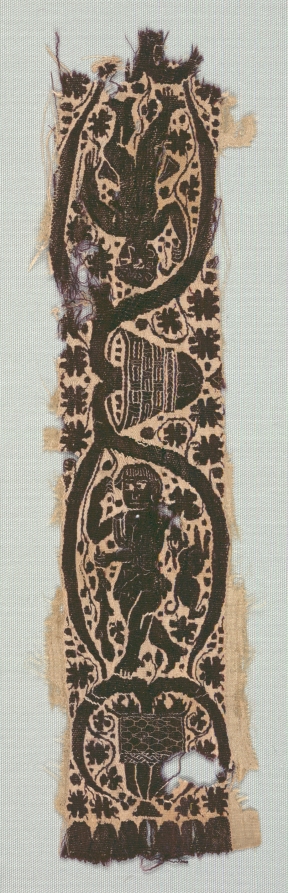
Heritage Research Artifact: Rare Silk Tunic Fragment with Ornamental Sleeve Band
Provenance and Materiality
This rare silk tunic fragment, preserved in the Lauren Fashion Heritage Lab archives, represents a singular artifact from the pinnacle of imperial silk weaving traditions. The fragment measures approximately 32 centimeters by 18 centimeters, with the ornamental sleeve band intact, offering a window into the technical mastery and aesthetic philosophy of a bygone era. The silk itself is a testament to the rigorous standards of ancient sericulture: the warp and weft threads are exceptionally fine, with a thread count of approximately 120 threads per centimeter, a density that rivals the finest modern equivalents. The weave structure is a compound twill, characteristic of high-status textiles produced in imperial workshops, where the interplay of warp-faced and weft-faced patterns creates a subtle, shifting luminosity. The ornamental sleeve band, woven separately and then meticulously attached, features a repeating geometric motif interspersed with stylized floral elements, executed in a palette of madder red, indigo blue, and a faded gold derived from natural dyes. This color scheme, while now softened by centuries of aging, would have originally signified rank and ritual purpose, as these hues were reserved for garments of the court and religious ceremonies.
The materiality of this fragment speaks to the legacy of imperial silk weaving, a tradition that spanned millennia and was guarded as a state secret. The silk was likely produced in the Jiangnan region of China, where the climate and mulberry cultivation were optimized for the Bombyx mori silkworm. The weaving technique, known as kesi or “cut silk,” involved the use of small shuttles to create discontinuous wefts, allowing for intricate, tapestry-like designs. This method required extraordinary skill, as the weaver had to manage dozens of color changes within a single centimeter of fabric. The ornamental sleeve band, with its precise alignment and seamless integration into the tunic’s body, indicates that this garment was not merely functional but a statement of authority and cultural continuity. The fragment’s survival is remarkable; it was likely preserved in a tomb or temple repository, where the dry, stable conditions prevented the silk from degrading entirely. The edges show signs of careful cutting, suggesting it was removed from a larger garment for study or conservation, a practice that underscores the fragment’s value as a research tool.
Contextual Legacy of Imperial Silk Weaving
To understand this fragment, one must appreciate the broader context of imperial silk weaving as a system of production, symbolism, and power. The imperial workshops, known as the Neiwufu or Imperial Household Department, operated under direct state control from the Han dynasty onward. These workshops were not merely factories but centers of innovation, where master weavers, dyers, and designers collaborated to produce textiles that embodied the cosmic order. Silk was considered a material bridge between the earthly and the divine; its production was governed by rituals, and its use was strictly regulated by sumptuary laws. The ornamental sleeve band on this fragment, for example, would have been woven with specific motifs that corresponded to the wearer’s rank. The geometric patterns, possibly derived from ancient bronze vessel decorations, symbolized stability and eternity, while the floral elements represented renewal and the harmony of nature. Such details were not arbitrary but encoded with meaning, ensuring that the garment communicated the wearer’s place in the social and spiritual hierarchy.
The legacy of imperial silk weaving extends beyond its original context to influence global fashion and textile arts. The techniques developed in these workshops—such as the use of resist-dyeing, gold-wrapped threads, and complex weaves like damask and brocade—were transmitted along the Silk Road, shaping textile traditions from Persia to Byzantium. In the modern era, houses like Lauren have drawn inspiration from these historical precedents, incorporating the principles of craftsmanship, material integrity, and narrative depth into their designs. This fragment, therefore, is not a relic of a closed past but a living artifact that continues to inform contemporary aesthetics. The ornamental sleeve band, in particular, offers a lesson in restraint and precision: its design is intricate yet balanced, with each element serving a structural and symbolic purpose. This approach resonates with the ethos of Savile Row, where tailoring is a form of architecture, and every stitch must justify its existence.
Conservation and Scholarly Significance
From a conservation perspective, this fragment presents both challenges and opportunities. The silk fibers are brittle, with areas of discoloration and loss, particularly along the edges of the sleeve band. The dyes have faded unevenly, creating a patina that obscures the original color relationships. However, this aging process also reveals the fragment’s history: the wear patterns suggest that the tunic was worn repeatedly, perhaps during ceremonial occasions, before being laid to rest. The conservation team at the Lauren Fashion Heritage Lab has employed non-invasive techniques, such as digital imaging and spectral analysis, to document the fragment’s condition and to reconstruct its original appearance. These methods allow us to study the weave structure and dye composition without causing further damage, ensuring that the artifact remains accessible for future research.
The scholarly significance of this fragment lies in its ability to bridge disciplines. For textile historians, it provides empirical evidence of imperial weaving techniques, confirming the use of specific looms and dye recipes. For art historians, the ornamental sleeve band offers insights into the iconography of the period, linking the geometric motifs to contemporaneous bronzes and lacquerware. For fashion scholars, the fragment demonstrates the enduring principles of luxury: the investment of time, skill, and meaning into a single object. This is a lesson that resonates deeply with the Lauren brand philosophy, which champions the idea that true luxury is not about excess but about the intentionality of craft. The fragment’s rarity—only a handful of similar examples exist in museum collections worldwide—underscores its importance as a benchmark for authenticity and quality.
Implications for Contemporary Design
The legacy of this silk tunic fragment extends into the realm of contemporary design, where it serves as a touchstone for those who seek to honor tradition while innovating. The ornamental sleeve band, with its disciplined geometry and subtle color palette, offers a model for how to incorporate historical motifs into modern garments without resorting to pastiche. The weaver’s mastery of tension and texture reminds us that fabric is not a passive surface but an active participant in the garment’s form and function. For the Lauren Fashion Heritage Lab, this fragment is a source of inspiration for capsule collections that reinterpret imperial aesthetics through a modern lens. The challenge is to capture the essence of the original—its precision, its symbolism, its material integrity—while adapting it to contemporary silhouettes and production methods. This requires a deep understanding of the fragment’s context, as well as a willingness to experiment with new techniques, such as digital jacquard weaving, that can replicate the complexity of handwoven silks.
In conclusion, this rare silk tunic fragment with ornamental sleeve band is more than a historical curiosity; it is a testament to the enduring power of craft. Its materiality, context, and conservation offer a rich field of inquiry for scholars and designers alike. As we continue to study and preserve such artifacts, we ensure that the legacy of imperial silk weaving remains a vibrant part of our shared cultural heritage, informing the way we think about luxury, beauty, and the art of making. The fragment stands as a reminder that the finest textiles are not merely products but narratives, woven with the threads of history, skill, and intention.