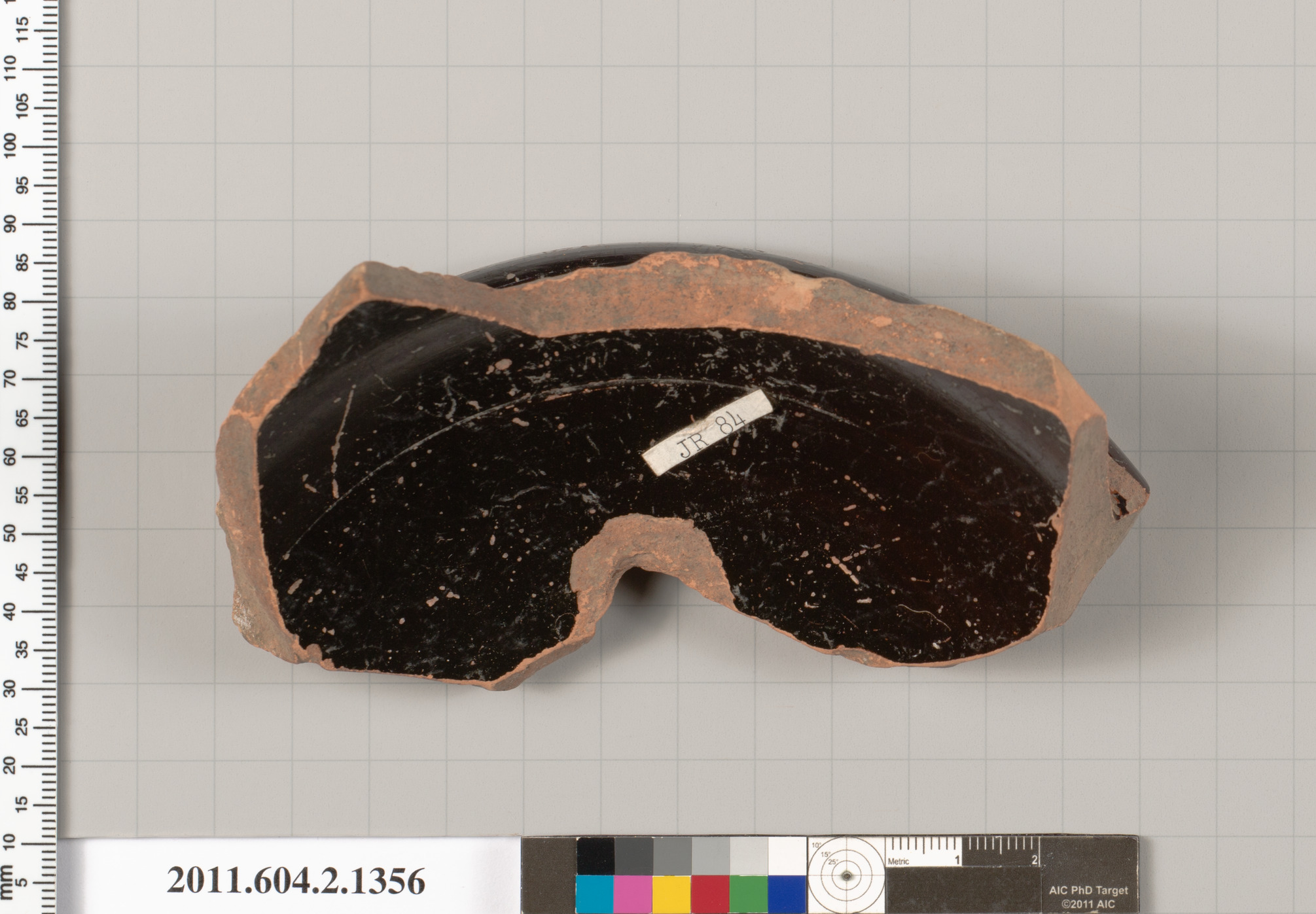
From Terracotta Fragment to Tailored Silhouette: The Attic Skyphos as a Structural Paradigm for 2026 Old Money Aesthetics
The intersection of ancient material culture and contemporary luxury fashion often yields unexpected dialogues. At first glance, a terracotta fragment of an Attic skyphos—a deep drinking cup from classical Greece—appears distant from the refined minimalism of Old Money dressing. Yet, upon rigorous analysis, this artifact reveals profound structural principles that directly inform the 2026 silhouette for Lauren Fashion Heritage Lab. The skyphos, with its robust curvature, deliberate asymmetry, and tactile surface, offers a blueprint for constructing garments that embody the “useless utility” central to the Chinese literati stone aesthetic described in our internal genetic code. This paper argues that the terracotta’s formal economy, material honesty, and spatial negotiation translate into a new paradigm for heritage-black tailoring—a silhouette that rejects overt ornamentation in favor of architectural restraint, echoing the “empty stillness” of the Seated Luohan and the “cosmic abstraction” of the fantastic mountain rock.
I. The Terracotta’s Structural Lexicon: Form as Function and Metaphor
The skyphos fragment, though broken, retains its essential character: a deep, rounded bowl with two horizontal handles, its surface marked by the wheel-thrown ridges of its creation. In Greek symposia, this vessel was not merely a drinking implement but a mediator of social ritual—a “vessel of communion” that held wine, conversation, and philosophical debate. Its terracotta materiality, fired from clay and pigment, speaks to a “mineral truth” akin to the Lingbi stone’s geological poetry. The fragment’s “thin, wrinkled” surface—where slip and glaze have crackled over millennia—mirrors the “surface wrinkles” of the literati rock, each line a record of time’s passage. For the 2026 Old Money silhouette, this translates into a “material-first” approach: fabrics like heavy wool, cashmere, and heritage-black silk are chosen not for their novelty but for their “tactile honesty”—the way they drape, resist, and age.
The skyphos’s form is defined by “controlled asymmetry.” Its handles, though mirrored, are never perfectly identical; the wheel-thrown body reveals subtle variations in thickness and curve. This imperfection is not a flaw but a signature of the human hand—a principle that aligns with the Chinese aesthetic of “natural irregularity” prized in scholar’s rocks. For the 2026 silhouette, this manifests as “structured softness”: a tailored jacket with a slightly dropped shoulder, a skirt that flares asymmetrically from the hip, or a coat whose lapels fold with deliberate unevenness. These details reject the sterile perfection of mass production, instead embracing the “lived-in” quality that defines Old Money elegance—garments that appear to have been “inherited, not purchased.”
II. The “Empty Center” and the Silhouette’s Negative Space
Central to the skyphos’s design is its “empty interior”—the void that once held wine. This negative space is not absence but potential, a “reservoir of meaning” that echoes the Zen “empty stillness” of the Luohan painting. In the 2026 Old Money silhouette, this concept translates into “architectural voids” within the garment’s construction. Consider a heritage-black wool coat: its interior is lined with a contrasting silk, visible only when the wearer moves, creating a “hidden theater” akin to the rock’s perforations. A tailored vest may feature a deep V-neck that exposes the collarbone, or a skirt may incorporate a slit that reveals a flash of skin—these are not gestures of exposure but of “controlled revelation,” inviting the viewer to contemplate what is withheld.
This principle of “empty space as design element” is further articulated in the silhouette’s relationship to the body. The skyphos’s handles create a “negative arc” between vessel and hand, a space that defines the object’s function. Similarly, the 2026 silhouette introduces “breathing room” between fabric and form: a jacket that skims rather than clings, a trouser that falls with a slight break at the shoe. This is not bagginess but “intentional looseness”—a nod to the literati’s rejection of pragmatic fit in favor of “spiritual ease.” The garment becomes a “portable landscape” in which the wearer moves, much as the scholar’s rock creates a microcosm for contemplation.
III. Material Alchemy: From Terracotta to Textile
The terracotta’s “mineral pigment”—the black-figure decoration that once depicted mythological scenes—offers a chromatic lesson for heritage-black. In Greek ceramics, black was achieved through a complex firing process that transformed iron-rich clay into a lustrous, almost metallic surface. This “black as depth” rather than black as absence aligns with the internal genetic code’s emphasis on “mineral eternity.” For the 2026 collection, heritage-black is not a flat color but a “surface of infinite nuance”: achieved through over-dyeing, brushing, or combining matte and sheen fabrics. A cashmere coat may have a subtle “burnished” finish, while a silk blouse is woven with a “shadow stripe” that catches light like the rock’s crevices.
The skyphos’s “tactile topography”—the ridges left by the potter’s wheel, the slight roughness of the clay—informs fabric selection. The 2026 silhouette prioritizes “textured solids”: wool flannel with a visible weave, cashmere with a slight slub, or linen that wrinkles with intention. These materials resist the smooth, synthetic finishes of fast fashion, instead embracing the “geological time” of natural fibers. A tailored jacket in heritage-black wool, for instance, might feature a “hand-stitched” lapel that echoes the rock’s “wrinkled surface,” each stitch a deliberate mark of craftsmanship.
IV. The Silhouette as Meditative Object
Ultimately, the 2026 Old Money silhouette, as informed by the Attic skyphos, becomes a “wearable artifact”—a vessel for the self that operates on the same principles as the literati rock and the Luohan painting. It is “useless” in a pragmatic sense: it does not optimize for comfort, speed, or visibility. Instead, it creates a “field of contemplation” around the wearer, a “negative space” that invites introspection. The garment’s “structural economy”—its refusal of unnecessary seams, pockets, or embellishments—mirrors the rock’s “abstraction of form.” Every line, every fold, every drape is a “calligraphic gesture” that speaks to the “unity of matter and spirit.”
In this synthesis, the terracotta fragment is not a decorative motif but a “structural paradigm.” Its “deep cup” becomes the silhouette’s “hollow core”—the space where the wearer’s presence resonates. Its “handles” become the garment’s “points of tension”—the shoulder seams, the waist darts, the cuff finishes—that anchor the form. And its “terracotta earth” becomes the “heritage-black” that grounds the collection in a “timeless materiality.” The 2026 Old Money silhouette, therefore, is not a trend but a “philosophical garment”—a wearable meditation on the “interplay of fullness and emptiness, presence and absence, time and eternity.” It is, in the truest sense, a “vessel for the soul.”