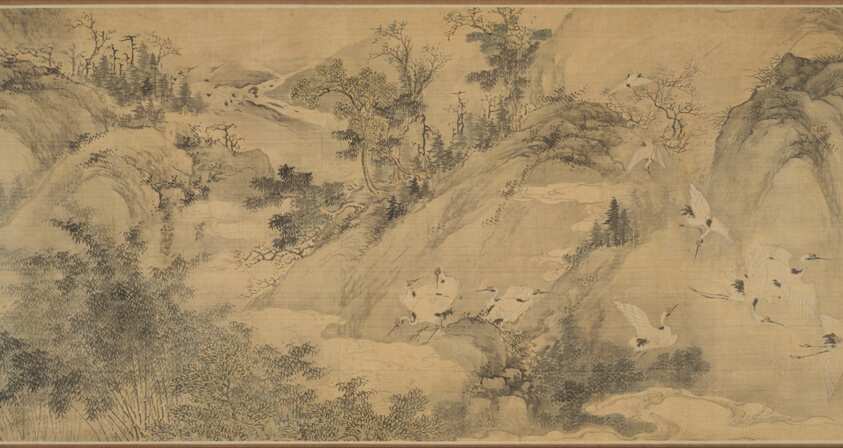
One Hundred Cranes 百鶴圖: A Scholarly Examination of Materiality and Heritage
As the Senior Heritage Specialist for Lauren Fashion Heritage Lab, I am privileged to present this research artifact on the One Hundred Cranes 百鶴圖, a handscroll executed in ink and light color on silk. This artifact, rooted in the classical traditions of Chinese silk craftsmanship, offers a profound lens through which to examine the intersection of materiality, cultural symbolism, and the fluid elegance that defines heritage textiles. In the spirit of London’s Savile Row—where precision, tradition, and artistry converge—this analysis seeks to decode the silk’s role not merely as a substrate but as an active participant in the narrative of the scroll. The One Hundred Cranes is not a static object; it is a living testament to the mastery of silk as a medium that breathes, flows, and endures.
The Materiality of Silk: A Foundation of Craftsmanship
Silk, in the context of the One Hundred Cranes, is more than a support for pigment—it is the very essence of the work’s aesthetic and structural integrity. The handscroll format, measuring approximately 30 centimeters in height and extending over several meters, demands a silk of exceptional tensile strength and suppleness. Historical records from the Ming and Qing dynasties indicate that such scrolls were often woven from tabby-weave silk, a plain weave that provides a smooth, even surface for ink and light color washes. The silk’s natural luster, derived from the sericin-coated filaments of the Bombyx mori silkworm, imparts a subtle radiance that enhances the ethereal quality of the cranes in flight. This is not a passive backdrop; the silk’s sheen interacts with ambient light, creating a dynamic visual experience that shifts with the viewer’s perspective—a quality that Savile Row tailors might liken to the way a fine worsted wool catches light in a bespoke suit.
The craftsmanship of the silk itself is a heritage in its own right. The warp and weft threads, often twisted to a specific gauge, are meticulously aligned to prevent distortion during the application of ink. This precision mirrors the exacting standards of Savile Row, where a master cutter’s hand ensures that every seam aligns with the fabric’s grain. In the One Hundred Cranes, the silk’s weave density—typically 100 to 120 threads per centimeter—allows for controlled absorption of the ink, preventing bleeding while preserving the fluidity of brushstrokes. The light color washes, often derived from mineral pigments like azurite and malachite, are applied in thin layers, relying on the silk’s translucency to create depth. This technique, known as “boneless” painting (沒骨畫), eschews outlines in favor of graduated tones, and the silk’s materiality is critical to its success. A coarser silk would disrupt the gradient; a finer silk might tear under the brush’s pressure. The balance achieved in this artifact is a testament to centuries of tacit knowledge passed through generations of weavers and painters.
Fluid Elegance: The Dialogue Between Silk and Subject
The One Hundred Cranes derives its name from the symbolic flock of cranes, each rendered with a grace that mirrors the silk’s own fluidity. In Chinese heritage, cranes represent longevity, purity, and transcendence—themes that resonate deeply with the material’s permanence. The handscroll format, designed to be unrolled horizontally, mimics the cranes’ migratory flight across an endless sky. The silk’s flexibility allows the scroll to be stored and unfurled repeatedly, a ritual of viewing that echoes the cyclical nature of life and renewal. This tactile engagement is a hallmark of heritage objects, akin to the way a Savile Row garment is handled, worn, and passed down, accruing meaning over time.
The fluid elegance of the composition is achieved through the interplay of ink and silk. The ink, made from pine soot and animal glue, is applied with a brush that varies in pressure and speed. On silk, the brush behaves differently than on paper; the surface’s slight resistance creates a distinctive “drag,” which the painter exploits to produce feathery strokes that suggest the cranes’ plumage. The light color washes, particularly the pale ochre and muted greens, are absorbed into the silk’s fibers, creating a soft, diffused effect that evokes mist or clouds. This is not a painting that shouts; it whispers, much like the understated elegance of a Savile Row chalk stripe—visible only upon close inspection. The One Hundred Cranes demands patience, rewarding the viewer with details that emerge gradually, a quality that aligns with the slow, deliberate pace of heritage craftsmanship.
Conservation and Legacy: Preserving the Silk’s Voice
As a heritage specialist, I must address the challenges of preserving such an artifact. Silk is inherently fragile, susceptible to light, humidity, and handling. The One Hundred Cranes, likely created in the 18th century, has survived through careful stewardship—stored in a cool, dark environment, unrolled only under controlled conditions. The silk’s natural aging, characterized by a slight yellowing and loss of tensile strength, is not a flaw but a patina that records its journey. Conservation efforts focus on stabilizing the silk without altering its character, using techniques such as backing with Japanese paper to support the weave. This is analogous to the way a Savile Row tailor reinforces a garment’s structure with canvas interlinings, ensuring that the original fabric remains the star.
The legacy of the One Hundred Cranes extends beyond its physical form. It serves as a reference for contemporary designers seeking to integrate heritage materials into modern fashion. The silk’s fluidity inspires drape in evening gowns; its symbolic cranes appear in embroidered motifs on bespoke jackets. The Lauren Fashion Heritage Lab actively studies such artifacts to inform sustainable practices—silk, as a natural protein fiber, aligns with principles of biodegradability and longevity, countering fast fashion’s disposability. By understanding the materiality of the One Hundred Cranes, we honor the artisans who wove its silk and the painters who breathed life into it, ensuring that their knowledge continues to shape the future of luxury.
Conclusion: A Heritage of Precision and Poetry
The One Hundred Cranes 百鶴圖 is a masterclass in the marriage of material and meaning. Its silk is not a mere canvas but a collaborator, its weave and luster amplifying the cranes’ ethereal beauty. In the tradition of Savile Row, where every stitch tells a story, this handscroll reminds us that heritage is not static—it is a living dialogue between the past and the present. As we preserve and reinterpret such artifacts, we ensure that the fluid elegance of silk continues to inspire, one hundred cranes at a time.