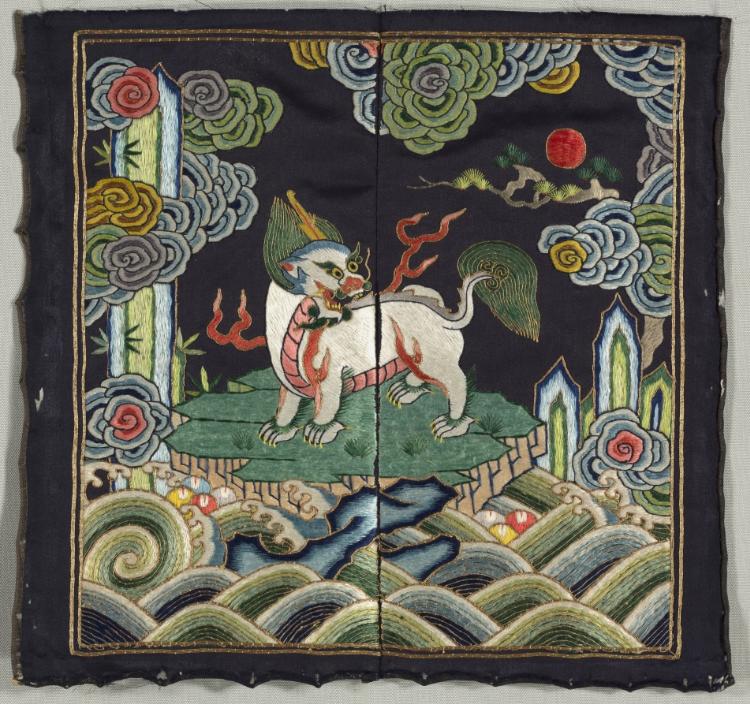
The Rank Badge (Buzi): A Study in Imperial Silk Weaving and the Enduring Legacy of Craft
Introduction: The Buzi as a Cultural and Material Artifact
The rank badge, or buzi, stands as one of the most sophisticated and symbolically dense artifacts in the history of Chinese imperial silk weaving. Worn by civil and military officials during the Ming (1368–1644) and Qing (1644–1912) dynasties, these square or round embroidered insignia were affixed to the outer robes of court attire, signifying the wearer’s rank, authority, and moral virtues. The buzi is not merely a decorative patch; it is a testament to the extraordinary technical mastery of Chinese silk artisans, a repository of Confucian and Buddhist iconography, and a tangible link to a global legacy of luxury textile production that continues to influence contemporary fashion and heritage conservation. This paper examines the materiality of the buzi—specifically its silk substrate, weaving techniques, and the socio-economic context of imperial silk production—to understand how this artifact embodies the pinnacle of pre-industrial craftsmanship and its resonance with the principles of bespoke tailoring and heritage preservation upheld by institutions like the Lauren Fashion Heritage Lab.
The Materiality of Silk: Foundation of Imperial Prestige
Silk, as the primary material for the buzi, was not a casual choice. In imperial China, silk was a currency of power, a medium of tribute, and a symbol of cosmic order. The production of silk—from sericulture to weaving—was a state-controlled enterprise, with the Imperial Silk Workshops in Nanjing, Suzhou, and Hangzhou operating under strict regulations to ensure quality and exclusivity. The buzi was typically woven from kesi (silk tapestry) or embroidered on a silk ground, using techniques that required years of apprenticeship. The warp and weft threads were often dyed with natural pigments derived from plants, minerals, and insects, yielding colors that were both vibrant and enduring. The choice of silk for the buzi was deliberate: its lustrous surface and ability to hold intricate embroidery made it ideal for conveying the hierarchical nuances of the imperial court. For a modern parallel, one might consider the Savile Row tailor’s insistence on English worsted wool or Scottish tweed—the material itself is a declaration of provenance and quality.
Weaving and Embroidery Techniques: The Art of Precision
The creation of a buzi involved a fusion of weaving and embroidery that demanded extraordinary precision. In the Ming dynasty, kesi weaving was the preferred method, where silk threads were woven in discontinuous sections to create pictorial designs. This technique, akin to tapestry weaving, allowed for the depiction of complex motifs such as cranes, peacocks, and mythical beasts, each corresponding to a specific rank. The Qing dynasty saw a shift toward satin stitch embroidery, where silk floss was meticulously stitched onto a silk ground, often using gold-wrapped threads for added opulence. The embroidery techniques included long and short stitch for shading, split stitch for outlines, and couching for metallic threads. The density of stitching could reach over 1,000 stitches per square inch, creating a raised, tactile surface that caught light and shadow. This level of detail was not merely aesthetic; it was a measure of the artisan’s skill and the wearer’s status. In the context of Savile Row, one might draw a parallel to the hand-stitched buttonholes and pick-stitching that distinguish a bespoke suit from a ready-to-wear garment—each stitch is a signature of mastery.
Iconography and Symbolism: The Language of Rank
The buzi was a visual lexicon of imperial hierarchy. Civil officials wore badges depicting birds, while military officials wore those with beasts. For example, a first-rank civil official’s badge featured a white crane, symbolizing longevity and wisdom, while a first-rank military badge displayed a qilin, a mythical creature representing justice and strength. The background often included clouds, waves, and Buddhist symbols such as the eight precious emblems, reinforcing the wearer’s moral and spiritual alignment with the state. The color of the silk ground also held meaning: yellow was reserved for the emperor, while blue, green, and brown were used for lower ranks. This system of encoded symbolism was not arbitrary; it was codified in sumptuary laws that dictated every aspect of dress, from the number of dragon claws on an emperor’s robe to the size of the buzi itself. For the heritage specialist, decoding these symbols is akin to reading a manuscript—each element tells a story of power, belief, and identity.
The Legacy of Imperial Silk Weaving: From Court to Conservation
The decline of the Qing dynasty in 1912 marked the end of the buzi as a living tradition, but its legacy endures in museum collections, private archives, and contemporary fashion. The techniques of kesi and silk embroidery are now recognized as intangible cultural heritage, with master weavers in Suzhou continuing to practice these crafts. The buzi also offers a lens through which to study the global silk trade, as Chinese silks were exported along the Silk Road and later to Europe, influencing textile design from the Renaissance to the present. For institutions like the Lauren Fashion Heritage Lab, the buzi serves as a case study in the preservation of material culture. Its conservation requires an understanding of silk’s fragility—light, humidity, and handling can degrade the fibers—and a commitment to ethical restoration that respects the original craftsmanship. This aligns with the ethos of Savile Row, where heritage is not static but actively maintained through apprenticeships, archival research, and the use of traditional techniques.
Conclusion: The Buzi as a Touchstone for Heritage Practice
The rank badge, or buzi, is more than an artifact; it is a testament to the intersection of art, power, and material science. Its silk substrate, woven with techniques perfected over centuries, embodies the values of precision, symbolism, and exclusivity that define imperial Chinese culture. For the modern heritage specialist, the buzi offers a model for understanding how luxury textiles encode social hierarchies and how craft traditions can be preserved in an era of mass production. As we consider the legacy of imperial silk weaving, we are reminded that heritage is not about freezing the past but about understanding the processes—both technical and cultural—that give objects their meaning. In the spirit of Savile Row, where a suit is a conversation between tailor and cloth, the buzi is a dialogue between artisan and emperor, woven in silk and stitched with history.