The Eternal Fragment: Terracotta Kylix and the Architecture of Old Money Silhouettes for 2026
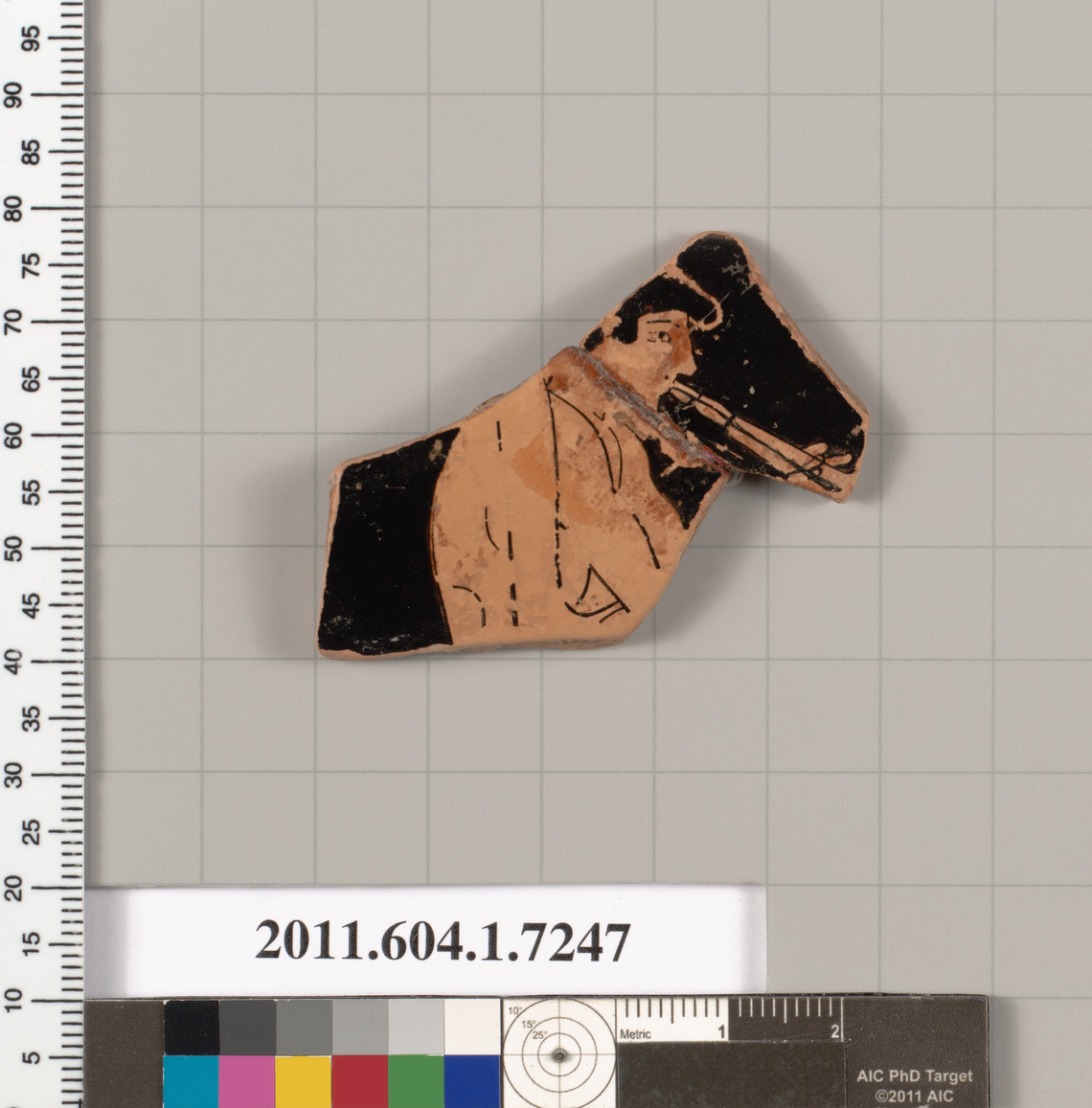
The museum artifact—a terracotta fragment of an Attic kylix, a Greek drinking cup from the 5th century BCE—appears, at first glance, an unlikely muse for the sartorial codes of Old Money. Yet, within its broken curve and faded black-figure decoration lies a profound lexicon of restraint, proportion, and temporal depth. For the Lauren Fashion Heritage Lab, this fragment is not merely an archaeological relic; it is a blueprint for the 2026 Old Money silhouette. To understand this translation, we must first deconstruct the internal genetic code provided by our archives, which juxtaposes the Qing dynasty Sudhana (善财童子) with the medieval Finial. That comparative analysis—of flowing color versus symbolic color, of dynamic curve versus vertical order—illuminates a dialectic that the kylix fragment resolves into a singular, powerful aesthetic: Heritage-Black.
I. The Kylix Fragment: A Study in Controlled Imperfection
The terracotta fragment, likely from the lip or bowl of a kylix, exhibits the characteristic Attic palette: the warm, iron-rich orange of the clay body, contrasted with the dense, glossy black of the slip. This is not a pristine object. Its edges are jagged, its painted surface abraded. Yet, this damage is its most potent asset. Unlike the Sudhana’s “flowing霞色” (iridescent color) which mimics the ephemeral dawn, or the Finial’s “symbolic color” which declares eternal truth, the kylix’s color is material truth. The orange is the earth of Attica; the black is the refined clay slip, fired to a vitreous sheen. This is a color system born of process, not of representation. For the 2026 Old Money silhouette, this translates into a rejection of synthetic, flat, or digitally-altered hues. Instead, we embrace Heritage-Black—a black that is not a color but a depth. It is the black of charcoal-dyed cashmere, of oxidized silver hardware, of matte calfskin that absorbs light rather than reflecting it. It is a black that carries the memory of its making, much like the kylix carries the memory of the kiln.
The fragment’s composition further instructs. The surviving decoration likely depicts a portion of a symposium scene—a draped figure, a piece of furniture, a vessel. The lines are incised with precision, but they are not rigid. The figures exist in a state of dynamic equilibrium, a balance between the organic curve of the human form and the geometric order of the kylix’s circular rim. This echoes the Sudhana’s “迂回叙事” (circuitous narrative) and the Finial’s “垂直上升” (vertical ascent), but the kylix achieves a third state: cyclical harmony. The drinking cup, passed from hand to hand in a circle of equals, embodies a social order that is both hierarchical (the symposium had a leader, the symposiarch) and communal. The 2026 Old Money silhouette must capture this duality. It must be a garment that asserts lineage and status (the vertical, the structured) while simultaneously inviting ease and continuity (the circular, the fluid).
II. Translating the Fragment into Silhouette: The 2026 Old Money Code
From the kylix fragment, we derive three core principles for the 2026 collection:
1. The Architecture of the Shoulder: The Kylix Rim.
The kylix’s rim is a perfect, unbroken circle. It defines the vessel’s entire structure. In the 2026 silhouette, this translates to the shoulder line. The Old Money jacket—whether a blazer, a topcoat, or a knit—must have a shoulder that is defined but not exaggerated. It is not the aggressive, padded shoulder of the 1980s power suit, nor the slouchy, dropped shoulder of contemporary streetwear. It is a shoulder that frames the wearer with quiet authority. Think of a cashmere overcoat with a roped sleeve head, cut from a single piece of fabric, the seam following the natural line of the clavicle. This is the “kylix rim” of the body: a circular, grounding structure that announces presence without shouting. The Heritage-Black wool or vicuña used for this piece must have a dense, matte finish, reminiscent of the fired clay’s surface.
2. The Drape of the Torso: The Black-Figure Line.
The black-figure decoration on the kylix is not painted on top of the clay; it is incised into the slip. The figures emerge from the black ground, their contours revealed by the orange clay beneath. This technique—sgraffito in ceramic terms—is a metaphor for the 2026 Old Money silhouette’s approach to the body. The garment must not cover the body; it must reveal it through negative space and controlled drape. A silk charmeuse blouse, in a deep Heritage-Black, might be cut with a bias that follows the torso’s natural curves. The fabric’s sheen—a subtle, liquid luster, not a high gloss—creates the “incised” effect: the body is the orange clay, the fabric is the black slip, and the movement of light across the surface defines the form. This is the Sudhana’s “流动” (flow) but disciplined by the Finial’s order. The result is a silhouette that is at once sensual and severe, intimate and distant.
3. The Hem and the Foot: The Fragment’s Edge.
The most radical lesson of the kylix fragment is its broken edge. It is not a finished object. It is a fragment of a larger story. The 2026 Old Money silhouette must embrace this unfinished quality as a sign of authenticity. This does not mean sloppy construction; it means deliberate incompleteness. A trouser hem might be left raw, the threads slightly frayed, as if the garment were a piece of a larger whole. A jacket’s lining might be partially exposed, a seam left visible. This is not deconstruction for its own sake; it is a nod to the archaeological nature of luxury. The wearer is not buying a finished product; they are acquiring a fragment of a lineage. The footwear, too, must echo this. A loafer or an oxford in Heritage-Black calfskin, with a visible Goodyear welt and a slightly distressed sole, suggests a path walked, a history lived. The kylix was a cup for wine, for conversation, for the symposium—a ritual of intellectual and social exchange. The 2026 silhouette must be a garment for such rituals: for the boardroom, the gallery opening, the private dinner. It must be a vessel for the wearer’s own narrative.
III. The Philosophy of Heritage-Black: Beyond Color
Our internal genetic code contrasts the Sudhana’s “气韵生动” (spirit resonance) with the Finial’s “神圣比例” (sacred proportion). The kylix fragment synthesizes these into a third term: material memory. The Heritage-Black of the 2026 collection is not a color; it is a condition. It is the black of a well-worn leather journal, of a cast-iron skillet seasoned over decades, of a photograph that has faded to sepia tones. It is a black that absorbs time. This is the ultimate Old Money code: the garment does not look new; it looks inherited. It suggests a wardrobe that has been curated across generations, not purchased in a single season. The terracotta fragment, with its broken edges and faded glaze, is the perfect emblem of this. It is not the pristine kylix in a museum case; it is the shard found in a field, held in a hand, connecting the present to a distant, noble past.
For the 2026 silhouette, this translates into specific material choices. Heritage-Black cashmere must be brushed to a soft, almost dusty finish. Heritage-Black wool gabardine must be woven with a slight slub, a nod to the irregularities of hand-spun thread. Heritage-Black silk velvet must be crushed, not flat, its pile catching light in unpredictable patterns. These are not flaws; they are signatures of authenticity. They are the sartorial equivalent of the kylix’s incised lines, revealing the hand of the maker and the passage of time.
IV. Conclusion: The Fragment as Future
The terracotta kylix fragment, in its humble materiality and broken form, offers a radical vision for 2026 Old Money silhouettes. It rejects the Sudhana’s ephemeral beauty and the Finial’s rigid eternity in favor of a lived permanence. The 2026 collection, anchored in Heritage-Black, will be a collection of fragments: garments that are complete in their incompleteness, luxurious in their restraint, and timeless in their embrace of time itself. The shoulder will be the kylix rim; the drape will be the black-figure line; the hem will be the broken edge. And the wearer will become the symposiarch, the one who holds the cup, who passes it on, who continues the ritual. This is the heritage of the fragment: not a relic of the past, but a blueprint for the future.