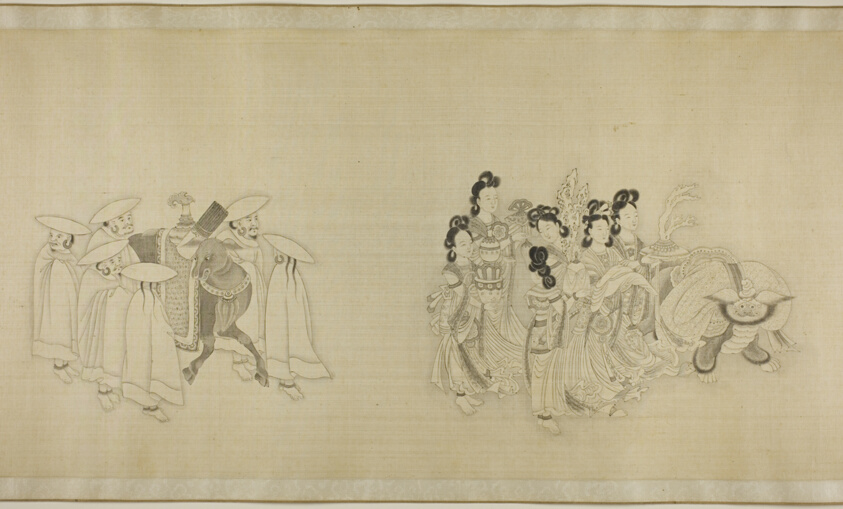
The Materiality of Diplomacy: Deconstructing “Envoys Presenting Tribute” as a Heritage Artifact
In the hushed, curated corridors of heritage, where the weight of history meets the precision of craft, we encounter “Envoys Presenting Tribute.” This is not merely a painting; it is a testament to the materiality of diplomacy, a handscroll executed in ink on silk that speaks to an era where the medium was as potent as the message. As a Senior Heritage Specialist for the Lauren Fashion Heritage Lab, I approach this artifact not as a static relic, but as a living document of textile intelligence, cultural exchange, and the unspoken codes of power. Here, on the Savile Row of historical analysis—where bespoke tailoring meets rigorous scholarship—we dissect the fiber of this object to understand how silk, the ultimate luxury textile, became the canvas for imperial narrative.
The Silk Substrate: A Foundation of Prestige
The choice of silk as the support for this handscroll is no accident. In the context of classical Chinese craftsmanship, silk was not merely a fabric; it was a currency of status, a medium of reverence, and a symbol of the empire’s sophisticated reach. The handscroll format, designed for intimate, sequential viewing, demands a material that can withstand repeated handling while retaining its fluid elegance. The silk used here—likely a fine, plain-weave tabby or a slightly heavier damask—offers a surface that absorbs ink with a unique luminosity. Unlike paper, which can be brittle or absorbent to the point of bleeding, silk provides a translucent, resilient ground that allows the ink to sit atop the fibers, creating a subtle, almost three-dimensional depth. This materiality mirrors the diplomatic mission itself: the envoys, like the silk, are carriers of a delicate yet durable message, woven into the fabric of the court’s visual language.
The preservation of such a scroll requires an understanding of its material vulnerabilities. Silk is hygroscopic, sensitive to light and humidity, and prone to creasing. Yet, its inherent strength—derived from the long, continuous filaments of the silkworm’s cocoon—allows it to survive centuries if properly stored. The handscroll’s mounting, often with a silk brocade border and a jade roller, further elevates its status. This is not a casual sketch; it is a ceremonial object, designed to be unrolled with ritualistic care, each section revealing a new layer of the tribute narrative. For the heritage specialist, the silk’s condition—its patina, its subtle discolorations, its weave density—tells a story of its own, one of climate, handling, and the passage of time.
Ink on Silk: The Fluidity of Power
The ink, applied with brush and precision, interacts with the silk in a dance of absorption and resistance. On a paper surface, ink bleeds and blurs; on silk, it sits with a controlled crispness, allowing for fine, unbroken lines that define the contours of the envoys, their robes, and the tribute goods they carry. This technique, known as gongbi (meticulous brushwork), demands a steady hand and an intimate knowledge of the medium. The artist must account for the silk’s weave, which can disrupt a stroke if not respected. The result is a visual language of elegance: the flowing sleeves of the envoys, the intricate patterns of their textiles, the precise rendering of exotic animals or precious objects—all rendered with a fluidity that suggests both movement and permanence.
The narrative of tribute is one of hierarchy and exchange. The envoys, often depicted in submissive postures, present their offerings—silk, spices, jade, or rare animals—to a central, often unseen, imperial figure. The silk scroll itself becomes a metaphor for this transaction: the empire receives the tribute, but it also produces the medium through which the tribute is immortalized. This is a self-referential act of power. The silk, a product of Chinese sericulture, is both the gift and the frame. The ink, derived from soot and animal glue, is the tool of documentation. Together, they create an artifact that is at once a record of foreign relations and a demonstration of domestic mastery.
Heritage Interpretation: From Court to Collection
In the context of the Lauren Fashion Heritage Lab, we ask: what does this handscroll reveal about the textile economy of diplomacy? The tribute system, as practiced by successive Chinese dynasties, was not merely about material exchange; it was a performance of cultural superiority. The envoys’ clothing, often depicted in vibrant colors and foreign patterns, becomes a visual index of the “other.” Yet, the silk they stand upon—the very ground of the painting—is unmistakably Chinese. This juxtaposition reinforces the idea that the empire is the arbiter of civilization, the weaver of order. For the modern scholar, this artifact offers a blueprint for understanding how textiles function as agents of soft power. The silk scroll is not just a picture of tribute; it is a tribute itself, a gift from the past to the present, demanding careful stewardship.
The conservation of such a piece requires a bespoke approach, akin to tailoring a suit for a unique client. The silk must be stabilized, the ink consolidated, and the scroll mounted on a new, archival-quality backing. This process is not merely technical; it is interpretive. Every decision—from the choice of mounting silk to the method of humidification—reflects a commitment to preserving the object’s original materiality while ensuring its survival for future generations. The handscroll’s format, with its horizontal orientation and sequential viewing, also informs how we display it. In a museum setting, it must be unrolled slowly, perhaps with a digital interface that allows visitors to “scroll” through the narrative, mimicking the original experience of the court scholar.
Conclusion: The Enduring Thread
“Envoys Presenting Tribute” is more than a historical document; it is a material manifesto. It reminds us that the most powerful statements are often made not in words, but in the fibers we choose, the surfaces we paint, and the rituals we enact. For the Lauren Fashion Heritage Lab, this artifact serves as a touchstone for understanding how luxury textiles—silk, in particular—have shaped global narratives of power, exchange, and identity. As we continue to study and preserve such objects, we honor the craftsmen who wove the silk, the artists who painted the ink, and the envoys who walked the long road to the court. Their tribute, now rendered in a handscroll, remains a testament to the enduring thread that connects materiality to meaning.
— A Heritage Research Artifact for the Lauren Fashion Heritage Lab, London, 2025.