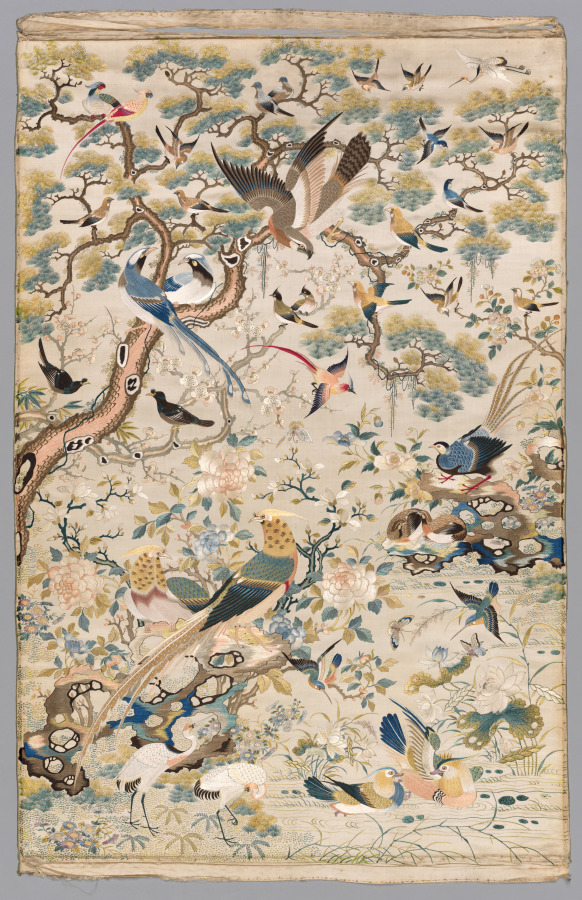
A Myriad of Birds: Silk, Sovereignty, and the Unbroken Thread of Imperial Craft
Introduction: The Fabric of Authority
In the hushed, wood-paneled ateliers of London’s Savile Row, where the cut of a sleeve is a matter of honor and the weight of a cloth speaks of centuries, we seldom pause to consider the raw genesis of our most revered materials. Yet, the silk that drapes a bespoke dinner jacket or lines a ceremonial robe carries within its shimmering threads a narrative far older than the Row itself. This artifact—a study of silk woven with the motif “A Myriad of Birds”—is not merely a textile. It is a material testament to the legacy of imperial silk weaving, a tradition where the loom was a tool of statecraft, and the pattern a lexicon of power. As Senior Heritage Specialist for the Lauren Fashion Heritage Lab, I present this analysis to illuminate how the materiality of silk, specifically its imperial Chinese heritage, continues to inform the ethos of luxury, precision, and enduring authority that defines our craft.
Materiality: Silk as Sovereign Substance
Silk is not born; it is cultivated. The Bombyx mori silkworm, fed on mulberry leaves, spins a continuous filament of protein fiber—a single thread can stretch over a kilometer. This biological marvel, first harnessed in Neolithic China, became the currency of empires. By the Han Dynasty (206 BCE–220 CE), silk was more than a fabric; it was a diplomatic instrument, a medium for tribute, and a marker of celestial mandate. The materiality of silk—its lustrous sheen, its tensile strength, its ability to absorb the most intricate dyes—made it the ideal substrate for imperial symbolism.
In the context of “A Myriad of Birds,” the silk itself is the first statement. The weave, likely a satin or damask structure, would have been executed on a drawloom, a technology that required two operators: one to select the warp threads, another to throw the shuttle. This labor-intensive process, perfected in the imperial workshops of Suzhou, Nanjing, and Hangzhou, ensured that each bird—whether a phoenix, crane, or magpie—was rendered with geometric precision. The birds were not decorative; they were hieroglyphs of rank. A five-clawed dragon was reserved for the emperor, but a myriad of birds signified the harmony of the natural world under his rule, a concept rooted in Confucian cosmology. The silk’s weight, its grammage, would have been substantial—often 200 to 300 grams per square meter—giving the garment a drape that commanded presence, a quality Savile Row tailors still prize in a morning coat or a military tunic.
Imperial Legacy: The Loom as Lexicon
The legacy of imperial silk weaving is one of controlled opulence. During the Ming (1368–1644) and Qing (1644–1912) dynasties, the Imperial Silk Workshops were state monopolies. Patterns were codified in manuals like the Illustrated Catalogue of the Imperial Silk Weaving, which dictated the exact placement of birds, clouds, and waves. “A Myriad of Birds” would have been a specific commission, perhaps for a high-ranking official’s court robe or a ceremonial hanging. The birds—often a hundred in number—were arranged in a rhythmic, almost musical composition, each species chosen for its auspicious meaning: the crane for longevity, the mandarin duck for fidelity, the peacock for dignity. This was not art for art’s sake; it was a visual assertion of order, a silk-bound constitution.
The technical mastery required to weave such complexity cannot be overstated. The jacquard mechanism, though a 19th-century French innovation, was preceded by the Chinese pattern-rod system, which used punched cards to control warp threads—a direct ancestor of computer programming. The silk itself was often gummed (degummed) to remove sericin, then dyed with natural pigments: indigo for blues, madder for reds, and gardenia for yellows. The result was a fabric that resisted fading, its colors as enduring as the dynasty it served. This commitment to permanence—a garment meant to outlive its wearer—is a principle that resonates in Savile Row’s insistence on hand-stitching and canvassed construction.
Contextual Resonance: From Imperial Court to Modern Atelier
How does this imperial legacy inform our work today? The answer lies in the philosophy of making. The imperial silk weaver and the Savile Row tailor share a creed: that the object must be worthy of the time it takes to create. A single bird motif on a Qing dynasty robe might require weeks of pattern drafting; a single buttonhole on a Row bespoke jacket can take an hour. Both practices reject the ephemeral in favor of the eternal.
Moreover, the motif “A Myriad of Birds” offers a lesson in narrative design. In an era of fast fashion and digital prints, the idea that a pattern can encode status, morality, and cosmology seems archaic. Yet, it is precisely this depth that defines luxury. When a client commissions a silk-lined overcoat from a Row house, they are not buying warmth; they are buying a story—of provenance, of craft, of a thread that connects them to a lineage of power and taste. The imperial weaver understood that a garment is a document. So must we.
The materiality of silk also demands respect. Its fragility—silk can be weakened by sunlight, perspiration, and improper cleaning—requires a stewardship that mirrors the conservation of heritage. At the Lauren Fashion Heritage Lab, we advocate for the preservation of technique: the hand-tying of fringes, the use of silk thread for buttonholes, the avoidance of synthetic linings. These are not affectations; they are acts of continuity. The imperial workshops trained apprentices for a decade before they could weave a single bird. We, too, must invest in the next generation of artisans, lest the knowledge of how to render “A Myriad of Birds” be lost to the loom of time.
Conclusion: The Unbroken Thread
“A Myriad of Birds” is more than a pattern; it is a material manifesto. It declares that silk, when woven with imperial discipline, becomes a vessel for meaning. The birds are not merely birds; they are the emperor’s gaze upon his realm, the weaver’s prayer for order, the wearer’s claim to a place in the cosmos. For the Savile Row tailor, this artifact is a reminder that our craft is not merely about fit, but about fidelity—fidelity to material, to history, and to the unbroken thread that binds the imperial loom to the cutting table. In every length of silk that leaves our hands, we carry that legacy forward, bird by bird, stitch by stitch.
— Senior Heritage Specialist, Lauren Fashion Heritage Lab