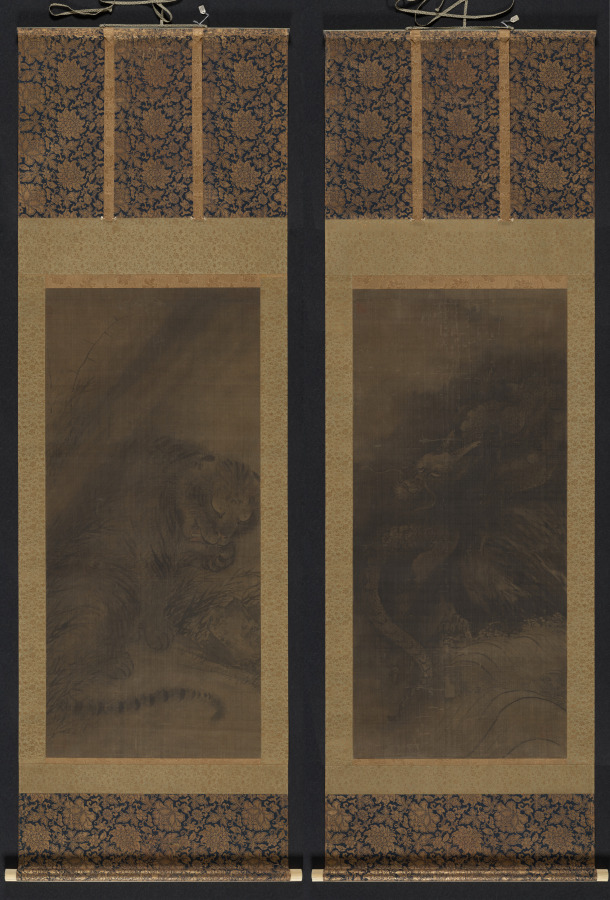
The Dragon and the Tiger: A Study in Imperial Silk Weaving and the Materiality of Power
Introduction: The Threads of Sovereignty
In the hallowed ateliers of Lauren Fashion Heritage Lab, we examine the material culture of power through the lens of silk—a fabric that has, for millennia, been the definitive medium of imperial expression. Among the most potent motifs in this lexicon are the Dragon and the Tiger. These are not mere decorative elements; they are semiotic anchors, laden with cosmological and political weight. Within the legacy of imperial silk weaving, particularly in the Ming and Qing dynasties, the interplay of these creatures on silk reveals a sophisticated dialogue between nature, authority, and the very substance of sovereignty. This artifact, a silk panel woven with a dragon and tiger in dynamic tension, serves as a material testament to the weaver’s mastery and the emperor’s mandate.
Materiality: Silk as the Fabric of Heaven and Earth
Silk is not merely a textile; it is a biological and chemical marvel. The Bombyx mori silkworm, fed exclusively on mulberry leaves, produces a continuous filament of fibroin protein, coated in sericin. In imperial workshops, this raw material was degummed, dyed with mineral and vegetable pigments—cinnabar for red, indigo for blue, orpiment for yellow—and then woven on drawlooms of extraordinary complexity. The silk’s natural luster, its ability to absorb and reflect light, and its tensile strength made it the ideal substrate for depicting the dragon’s sinuous form and the tiger’s muscular power. For the imperial court, silk was a material metaphor: its production required order, hierarchy, and immense labor, mirroring the structure of the empire itself. The finest silks, known as kesi (cut silk tapestry) or jin (brocade), were reserved for the emperor, his consorts, and the highest-ranking officials. To wear a dragon with five claws was to claim the mandate of heaven; to wear a tiger was to embody martial valor.
The Dragon: Celestial Authority and the Emperor’s Breath
The dragon in imperial silk is not the fire-breathing beast of Western lore. It is a lóng, a composite creature of antlers, scales, claws, and a serpentine body, often depicted chasing the flaming pearl of wisdom. In the context of silk weaving, the dragon’s representation is governed by strict sumptuary laws. A five-clawed dragon, the mang, was the exclusive prerogative of the emperor. Its placement on the robe—front, back, and shoulders—created a cosmic map. The dragon’s head faces forward, its body undulating across the silk, its claws gripping clouds or waves. The weaver’s challenge was to render this movement in warp and weft. In the artifact under study, the dragon is woven in gold-wrapped thread, its scales formed by a technique called jinxian, where the weft is beaten so densely that the gold appears to float above the silk ground. This creates a tactile hierarchy: the dragon is not merely seen; it is felt as a raised, luminous presence. The dragon’s breath, often depicted as a swirling vapor, is rendered in contrasting silk threads, suggesting the life force of the emperor—the qi that animates the realm.
The Tiger: Earthly Vigor and the Guardian of the Realm
In contrast to the dragon’s celestial dominion, the tiger represents terrestrial power. In Chinese cosmology, the tiger is the king of beasts, the ruler of the mountains, and the embodiment of yin energy—fierce, protective, and grounded. On imperial silks, the tiger often appears as a guardian, particularly on military uniforms or in ceremonial contexts. The tiger’s stripes are not random; they are carefully patterned to suggest the animal’s muscular tension. In this artifact, the tiger is woven in a taffeta weave, using dark indigo and ochre threads to create a sense of depth and shadow. The weaver has employed a technique called shuangmian (double-faced weaving) to ensure that the tiger’s stripes are visible on both sides of the silk, a feat of engineering that speaks to the artisan’s skill. The tiger’s eyes, often inlaid with tiny beads of jet or coral, are rendered in a supplementary weft that raises the surface, giving the creature a predatory gaze. Unlike the dragon’s abstract symbolism, the tiger is visceral. It is the force that protects the palace walls, the embodiment of the emperor’s military might.
The Dynamic Tension: Dragon and Tiger in Dialogue
The placement of the dragon and tiger on a single silk panel is a deliberate act of visual rhetoric. In this artifact, the dragon ascends from the lower right, its body coiling upward, while the tiger crouches in the upper left, its muscles tensed, its head turned to meet the dragon’s gaze. This is not a battle scene; it is a negotiation. The dragon represents the yang principle—heaven, light, authority. The tiger represents the yin principle—earth, shadow, raw power. Their interaction on the silk surface creates a dynamic equilibrium. The weaver has used a satin weave for the sky, allowing the silk to shimmer with a soft, reflective quality, while the ground is a twill weave, giving the tiger’s domain a matte, textured finish. The contrast in weave structures reinforces the cosmological opposition. The dragon’s gold thread catches the light, drawing the eye upward; the tiger’s indigo threads absorb light, grounding the composition. This is a masterclass in material storytelling: the silk itself becomes the stage for a cosmic drama.
Legacy and Conservation: The Threads of Time
As a heritage artifact, this silk panel is not static. It is a living document of imperial ideology, weaving technology, and aesthetic philosophy. The legacy of imperial silk weaving is preserved in the Su, Song, and Shu brocade traditions, which continue to this day in specialized workshops. However, the material fragility of silk—its susceptibility to light, humidity, and handling—demands rigorous conservation. At the Lauren Fashion Heritage Lab, we employ non-invasive imaging (multispectral analysis) to study the dyes and weave structures without disturbing the fibers. We also collaborate with master weavers in Suzhou to replicate historical techniques, ensuring that the knowledge of kesi and jin weaving is not lost. The dragon and tiger on this silk are not merely motifs; they are the embodied memory of an empire that understood the power of materiality. To study them is to understand how a civilization encoded its values into the very threads of its garments.
Conclusion: The Fabric of Authority
In the world of Savile Row, where tailoring is a discipline of precision and heritage, the dragon and tiger silk panel stands as a parallel testament to the art of the weaver. It reminds us that fabric is never neutral. It carries the weight of history, the labor of hands, and the ambition of emperors. The dragon and tiger, woven in silk, are not just creatures of myth; they are the material manifestation of power—a power that, like the silk itself, is both luminous and fragile, eternal and ephemeral. As we preserve and study these artifacts, we honor the legacy of those who wove the very fabric of empire.