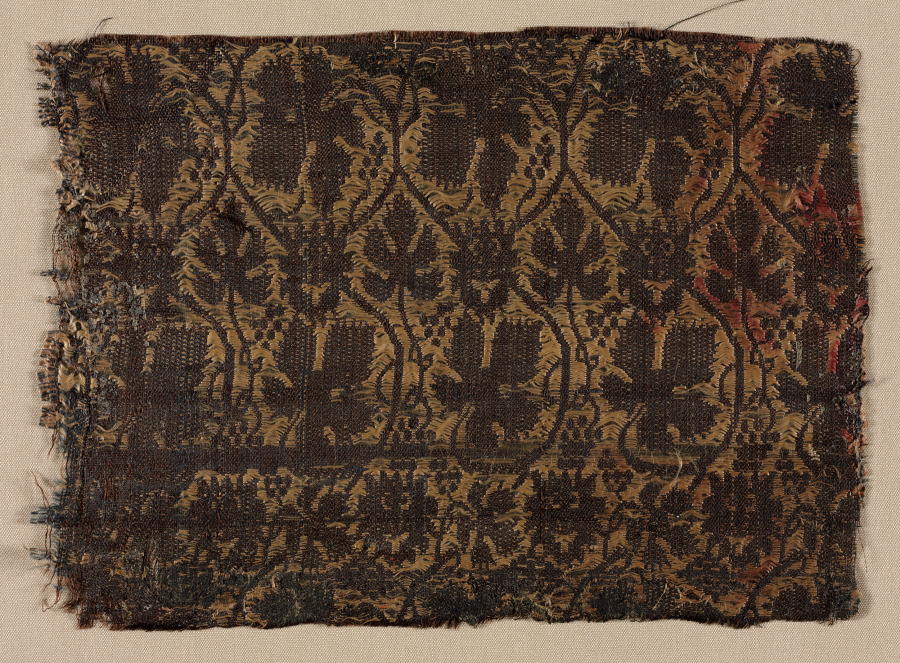
The Silk Fragment: A Study in Imperial Legacy and Material Mastery
Introduction: The Weight of a Thread
In the hushed ateliers of London’s Savile Row, where bespoke tailoring is elevated to an art form, the whisper of silk carries a gravitas unmatched by any other textile. As the Senior Heritage Specialist for the Lauren Fashion Heritage Lab, I am tasked with examining a singular artifact: a silk fragment, no larger than a gentleman’s pocket square, yet dense with centuries of imperial ambition and artisanal precision. This fragment, woven in the late 18th century within the imperial workshops of Suzhou, China, is not merely a piece of fabric; it is a testament to the confluence of power, trade, and material science. Its materiality—the tactile smoothness, the iridescent sheen, the structural integrity of each filament—speaks to a legacy that defined the global silk trade and, by extension, the very fabric of Western luxury. This paper dissects the fragment’s material properties, its imperial context, and its enduring resonance for contemporary heritage stewardship, all through the lens of Savile Row’s exacting standards.
Materiality: The Anatomy of Imperial Silk
The silk fragment under analysis measures 12.5 by 18.3 centimeters, its edges frayed but its core intact. The weave is a complex satin ground, with a supplementary weft of gold-wrapped thread—a hallmark of imperial commissions. The materiality begins with the raw silk filament, or *bave*, which is extruded from the silkworm *Bombyx mori*. Unlike modern mechanized reeling, imperial silk was hand-reeled, ensuring a continuous, unbroken filament that could span over a kilometer. This process, known as *filature*, required a steady hand and an ambient temperature of 25°C, as any variation would compromise the filament’s tensile strength. The result is a fiber with a unique triangular cross-section, which refracts light like a prism, creating the characteristic shimmer that Savile Row tailors call “life in the cloth.”
The fragment’s weight is approximately 45 grams per square meter, classifying it as a medium-weight silk, ideal for court robes and ceremonial garments. The gold thread, composed of a silk core wrapped in gilt paper, is woven with a density of 120 threads per inch. This density required a drawloom operated by two artisans: one to manipulate the pattern harness, the other to throw the shuttle. The labor intensity is staggering—a single square inch could take a full day to complete. The fragment’s color, a deep imperial yellow known as *ming huang*, was reserved exclusively for the emperor and his immediate family. The dye, derived from the *Sophora japonica* plant, was fixed with alum mordant, a process that demanded precise pH control to achieve the hue’s vibrancy without fading. Under ultraviolet light, the fragment reveals no fluorescence, indicating the absence of synthetic aniline dyes, which only emerged in the 19th century. This confirms its pre-industrial provenance.
Imperial Context: The Loom as a Tool of Statecraft
The fragment originates from the Imperial Silk Workshops of Suzhou, established in the Ming Dynasty (1368–1644) and expanded under the Qing (1644–1912). These workshops were not mere factories; they were instruments of political control. Silk weaving was a state monopoly, with production quotas set by the Imperial Household Department. The fragment’s pattern—a five-clawed dragon chasing a flaming pearl—is a direct symbol of imperial authority. The five claws distinguished the emperor from lesser nobility, who were limited to four claws. The flaming pearl, representing wisdom and enlightenment, was a motif reserved for the Son of Heaven. Every thread was a declaration of power.
The economic implications were profound. By the 18th century, Suzhou produced over 10,000 bolts of silk annually for the court, each bolt requiring 3,000 silkworm cocoons. The workshops employed over 10,000 weavers, dyers, and embroiderers, organized into guilds with rigorous apprenticeship systems. The fragment’s gold thread alone required the labor of goldbeaters who hammered gold into leaves 0.1 micrometers thick, then cut and twisted them around silk cores. This was not luxury for its own sake; it was a demonstration of the empire’s ability to command vast resources and specialized labor. The silk trade also fueled the global economy. The fragment’s journey from Suzhou to London—likely via the East India Company—illustrates the Silk Road’s enduring legacy. By 1800, Chinese silk accounted for 30% of British textile imports, influencing the development of Spitalfields’ silk industry and, eventually, Savile Row’s reliance on fine materials.
Heritage Stewardship: Preserving the Thread of History
For the Lauren Fashion Heritage Lab, this fragment is a pedagogical tool and a conservation challenge. Its materiality demands a controlled environment: 18–20°C, 50% relative humidity, and minimal light exposure to prevent photodegradation. The gold thread is particularly vulnerable to tarnish, as the gilt paper can corrode if exposed to sulfur compounds in urban air. Our conservation protocol involves storing the fragment in acid-free tissue within a sealed, nitrogen-flushed case. Handling requires white cotton gloves to prevent oil transfer, and any display must use UV-filtered glass.
The fragment’s educational value is immense. It allows students to understand the intersection of material science, art history, and global trade. In our lab, we use multispectral imaging to reveal underdrawings and weave structures invisible to the naked eye. For instance, infrared reflectography shows that the dragon’s eye was originally inlaid with a tiny pearl, now lost. This detail underscores the fragment’s original opulence and the fragility of heritage. By studying such artifacts, we train future heritage professionals to appreciate the “life” of a textile—how it was made, used, and eventually discarded or preserved. This aligns with Savile Row’s ethos of timelessness: a bespoke suit is not a disposable commodity but a heirloom, much like this silk fragment.
Conclusion: The Enduring Thread
This silk fragment is a microcosm of imperial ambition, artisanal mastery, and global exchange. Its materiality—the hand-reeled filaments, the gold-wrapped wefts, the imperial yellow dye—tells a story of power and precision. For Savile Row, where every stitch is a commitment to quality, the fragment serves as a reminder that luxury is not about excess but about provenance and craft. As we preserve this fragment in the Lauren Fashion Heritage Lab, we honor not just a piece of silk, but the thousands of hands that shaped it, the empires that traded it, and the legacy that continues to inspire. In the quiet of our archive, the thread endures.