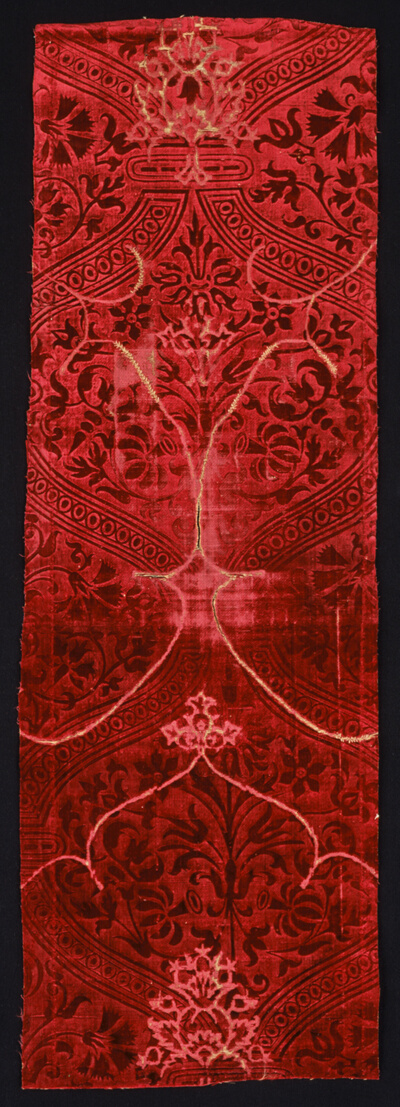
The Panel: An Anatomy of Fluid Authority
To comprehend the panel in question is to engage in a dissection of sartorial authority. It is not merely a component, but a foundational treatise. Here, we examine an artifact of deliberate and sophisticated construction: a voided velvet of the highest order, executed in pure silk. Its materiality speaks not of fleeting fashion, but of a grammar of elegance established over centuries and refined to an exacting point of principle.
Material Provenance & Technical Execution
The substrate is a satin weave, the quintessential silk foundation for achieving a luminous, unbroken surface. This is not the simple sheen of lesser cloth; it is a deep, liquid radiance—a ground of light, upon which the narrative of texture is built. Upon this ground operates a system of supplementary pile warps, raised and severed to form the velvet pile. The term ‘voided’ is crucial: it denotes not an absence, but a deliberate, strategic omission. The pile is present to define pattern and ground, retreating to reveal the luminous satin beneath in a precisely calibrated dialogue between shine and shadow, between tactility and smooth, flowing plane.
The final, definitive stroke is the stamp. This is not a crude impression, but a controlled application of heat and pressure, permanently crushing sections of the pile to create a secondary, sub-tier of pattern and lustre. The stamped areas, flattened and polished, catch the light differently from the upright velvet and the bare satin, resulting in a tripartite play of reflectance. This requires a master’s hand—an intimate knowledge of the fibre’s tolerance, the precise moment of intervention to sculpt without scorching, to define without destroying the inherent vitality of the silk.
Context: The Canons of Silk Craftsmanship
This panel exists within the unbroken lineage of classic silk craftsmanship, a realm where the East’s ancient sericultural secrets were met and translated by the European loom. The satin weave itself, derived from the Chinese ‘silk town’ of Quanzhou (Zayton), found its apotheosis in the workshops of Lyon and Spitalfields. Voided velvet techniques, historically used for ecclesiastical and regal vestments, speak of a heritage where cloth was a direct expression of status and power—the complexity of its manufacture a barrier to entry as effective as any gate.
The fluid elegance achieved is not the effortless drape of casual attire. It is, rather, a calculated fluidity. It is the heavy, whispering fall of a quality that possesses both substance and grace, a cloth that moves with the wearer while retaining its own structural intelligence. It conforms without collapsing, highlights without exaggerating. This is the elegance of the perfectly balanced blade, of the precisely tailored silhouette—an elegance that derives from absolute control over one’s materials and form.
Philosophy of Application: Beyond Ornament
In the hands of a discerning cutter—a Savile Row master—such a panel is never treated as simple ornament. It is approached as a structural and expressive element of the highest order. Its use is governed by principles of restraint and accentuation.
The Direction of Pile is the first consideration. The nap must be cut and assembled with a uniform orientation, ensuring the colour shifts from deep to light with a consistent, directional flow, much like the lay of fine fur. To do otherwise is to introduce visual chaos, a mark of the amateur.
The Placement of Pattern is next. The voided design is not scattered; it is positioned with the strategic intent of a military campaign. On a lapel, it might provide a subtle, textural definition to the roll. On a cuff or a pocket flap, it serves as a discreet but undeniable signature of bespoke consideration—a detail perceived subliminally, building an impression of consummate finish.
The stamped elements introduce a further layer of refinement. They can be used to subtly demarcate borders, to create a faint, shadowed line beside a seam, or to provide a centred motif of understated grandeur. The crushed pile offers a matte contrast, a visual pause that allows the surrounding velvet and satin to communicate with greater clarity.
The Heritage Lab Perspective: A Contemporary Articulation
For the Lauren Fashion Heritage Lab, this panel is a case study in translating immutable principles into a contemporary lexicon. The heritage is not replicated; it is re-articulated. The classic voided velvet, once the preserve of court dress and banyans, finds its modern expression in the smoking jacket of impeccable lineage, the evening waistcoat that commands a room without raising its voice, or the unique collaration on a tailored overshirt that blurs the lines between formal and avant-garde.
Our research focuses on the dialogue between this historic materiality and modern silhouettes. How does the fluid elegance of such silk comport with the sharper, architectural lines of contemporary tailoring? The answer lies in contrast and complement. The soft, luminous texture of the panel, when inset into a sharply structured jacket of worsted or cavalry twill, creates a moment of sophisticated tension—a testament to the wearer’s understanding of both tradition and modernity.
In conclusion, this silk panel—with its satin ground, voided velvet, and stamped detail—is far more than a swatch of fabric. It is a condensed history of luxury, a technical manifesto, and a philosophical statement on controlled elegance. It represents the point where peerless material meets intentional craft, resulting in an artifact that does not simply adorn the body, but articulates a silent, unequivocal authority. It is, in the final analysis, cloth cut from the very fabric of legacy.