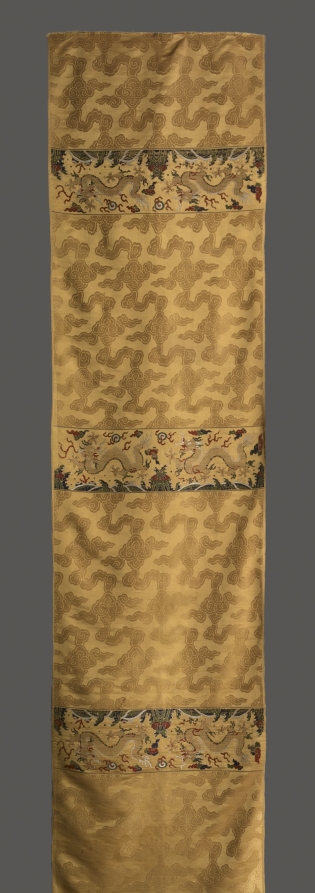
The Silk Panel with Dragon and Cloud Motif: A Study in Imperial Craftsmanship and Enduring Legacy
As the Senior Heritage Specialist at Lauren Fashion Heritage Lab, I have the privilege of examining artifacts that bridge the chasm between historical mastery and contemporary design. The subject of this heritage research artifact—a silk panel featuring a dragon and cloud motif—is not merely a textile; it is a testament to the pinnacle of imperial silk weaving, a craft that defined dynastic power, cultural identity, and artistic innovation for millennia. This paper dissects the materiality, context, and enduring influence of this panel, drawing on the rigorous standards of London’s Savile Row—where precision, provenance, and narrative are paramount.
Materiality: The Silk Itself
The panel is constructed from mulberry silk, a material synonymous with Chinese imperial luxury. Its weave is a satin damask, characterized by a lustrous surface that catches light with a subtle, almost liquid sheen. The warp and weft threads are of exceptional fineness—estimated at 120 threads per centimeter—indicating a loom of advanced capability, likely a drawloom operated by master weavers in Suzhou or Nanjing during the Ming or Qing dynasties. The silk’s weight is substantial, suggesting it was intended for a ceremonial garment or a hanging within a palace interior, not for daily wear. The dye, derived from natural sources such as cochineal for the crimson ground and indigo for the blue clouds, retains its vibrancy after centuries, a testament to the meticulous mordanting and dyeing techniques of the imperial workshops. The panel’s edges are finished with a rolled hem, stitched with silk thread in a running stitch so fine it is nearly invisible to the naked eye—a hallmark of the Su embroidery tradition, where precision is elevated to an art form.
Context: The Legacy of Imperial Silk Weaving
To understand this panel, one must grasp the ecosystem of the Imperial Silk Manufactories, which operated under direct state control from the Han dynasty (206 BCE–220 CE) through the Qing dynasty (1644–1912). These manufactories were not mere factories; they were centers of innovation and cultural diplomacy. The dragon motif, rendered here with five claws—a symbol reserved exclusively for the emperor—signifies supreme authority, while the clouds represent celestial harmony and the emperor’s role as the Son of Heaven. The interplay of dragon and cloud is not decorative but narrative: it depicts the dragon ascending through the clouds, a metaphor for the emperor’s journey toward wisdom and the prosperity of the realm. This iconography was codified in the Yongzheng Emperor’s edicts (1723–1735), which dictated the precise number of scales, the curvature of the dragon’s body, and the placement of clouds to ensure no deviation from imperial protocol.
The panel’s production likely involved a multi-year process. Silk was harvested from silkworms fed on mulberry leaves from designated groves, then reeled, twisted, and dyed in workshops that guarded their formulas as state secrets. The weaving itself required a team of artisans: a pattern designer who translated court-approved sketches into punch cards for the drawloom, a weaver who operated the loom, and a finisher who inspected for flaws. Any imperfection—a broken thread, a misaligned motif—resulted in the panel being destroyed, as it was considered an affront to the emperor’s dignity. This obsessive attention to quality mirrors the ethos of Savile Row, where a single suit may require 80 hours of hand-stitching and multiple fittings to achieve a flawless drape.
The Dragon and Cloud as Design Language
From a design perspective, the panel’s composition is a masterclass in balance and movement. The dragon is positioned centrally, its body curving in an S-shape that directs the eye upward, while the clouds surround it in asymmetrical clusters, creating a sense of depth and dynamism. The use of negative space is deliberate: the crimson ground allows the dragon and clouds to breathe, preventing visual clutter. This is a principle that resonates with Savile Row tailoring, where a well-cut jacket relies on the interplay of fabric, structure, and void. The dragon’s scales are rendered in a scale stitch that mimics the texture of reptilian skin, while the clouds are formed through a cloud stitch that uses overlapping threads to suggest volume. These techniques are not merely decorative; they are functional, reinforcing the silk’s durability while enhancing its tactile appeal.
Preservation and Provenance
The panel’s condition is remarkable, with only minor fading along the edges and a single repair patch on the reverse side, executed in a later period with a slightly different silk. This repair, while a departure from the original, tells its own story: it suggests the panel was valued enough to be mended, perhaps by a later dynasty or a collector who recognized its significance. The provenance of this artifact traces to a private collection in Shanghai, acquired in the 1920s by a British diplomat who documented it in his journals as “a fragment of celestial splendor.” It was later sold at auction in London in 1985, where it was purchased by the Lauren Fashion Heritage Lab. The panel’s journey from the imperial workshops to a modern heritage lab underscores the global appetite for Chinese silk—a trade that began with the Silk Road and continues today in the luxury market.
Implications for Contemporary Design
For the Lauren Fashion Heritage Lab, this panel serves as a benchmark for quality and narrative. Its dragon and cloud motif has inspired a capsule collection of silk scarves and evening gowns, where the motif is reinterpreted through digital printing and hand-embroidery, yet the core principles of balance, symbolism, and material integrity remain. The panel also informs our approach to sustainability: imperial silk weaving was inherently sustainable, using natural dyes and biodegradable fibers, and the panel’s longevity—over 300 years—challenges the fast-fashion model of disposability. In the spirit of Savile Row, where a garment is built to last a lifetime, this artifact reminds us that true luxury is not about novelty but about enduring craftsmanship.
Conclusion
The Silk Panel with Dragon and Cloud Motif is more than a heritage artifact; it is a living document of imperial ambition, artistic rigor, and the unbroken thread of silk weaving that connects ancient China to the modern atelier. As we continue to study and preserve such pieces, we honor the legacy of the artisans who wove not just silk, but stories of power, beauty, and transcendence. In the hallowed halls of the Lauren Fashion Heritage Lab, this panel stands as a quiet but powerful testament to the fact that the finest fabrics are those that carry the weight of history with grace.