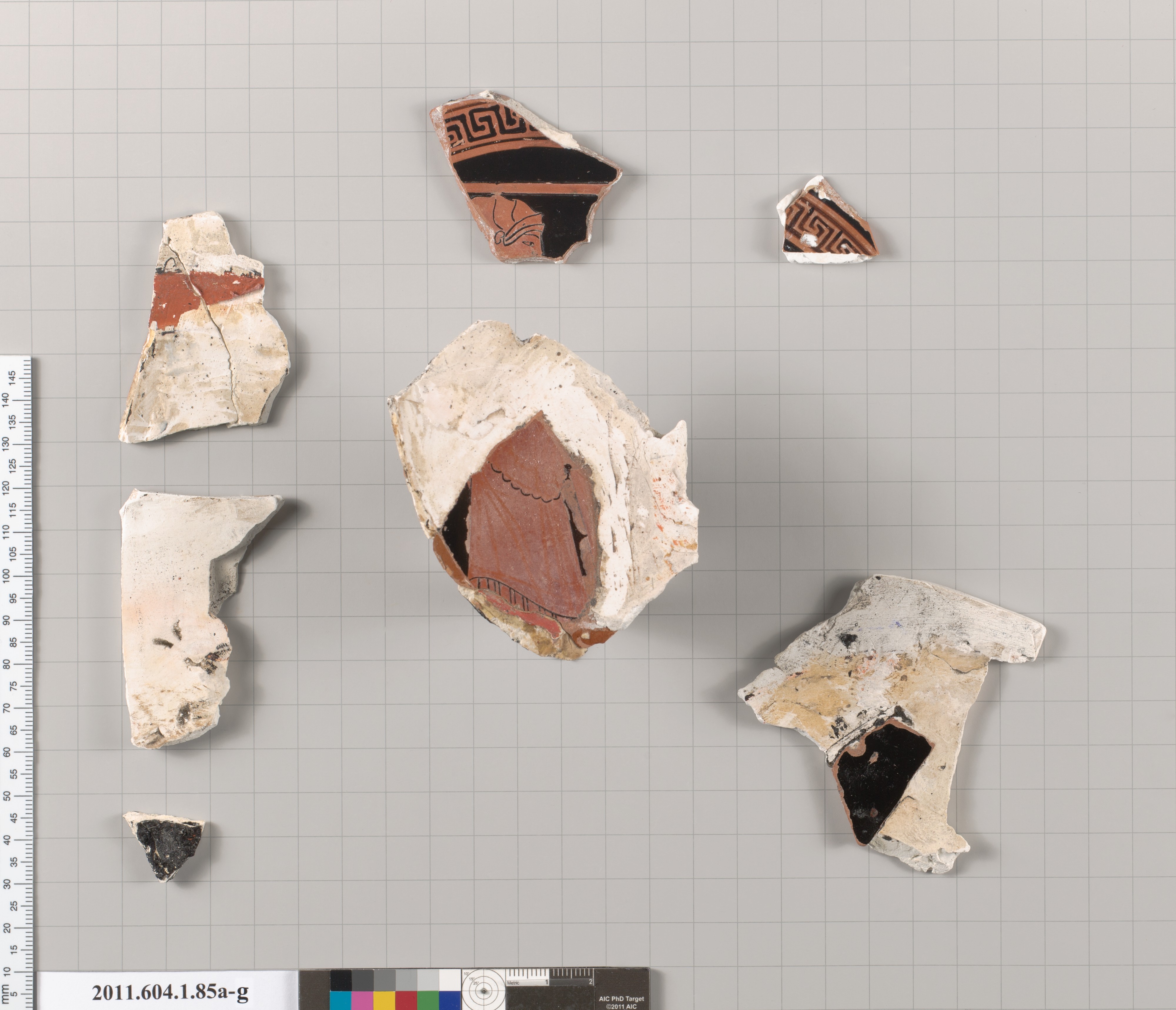
Absence as Ornament: The Terracotta Kylix and the Architecture of Unseen Luxury in 2026 Old Money Silhouettes
In the Lauren Fashion Heritage Lab, we do not merely study garments; we study the grammar of absence—the spaces between threads, the silence between seasons, the void where ornament once resided. The artifact before us—a set of terracotta fragments from an Attic kylix (drinking cup), circa 5th century BCE—appears, at first glance, an unlikely interlocutor for a heritage fashion house. Yet its shattered geometry, its patinated surface, and its ritual function as a vessel for shared libation speak directly to the core tension within the 2026 Old Money silhouette: the dialectic between material presence and immaterial meaning.
This analysis draws upon two internal references from the Liru archive: the “Udumbara Flowers” (Udonge) Temple Plaque—a Kyoto temple plaque inscribed with the name of a flower that does not exist—and Piero della Francesca’s The Hunt, a Renaissance masterpiece of arrested motion. Both artifacts, like the kylix fragments, teach us that true luxury is not displayed; it is withheld. The 2026 Old Money silhouette, as we shall argue, is not a revival of aristocratic ostentation but a hermeneutic of the invisible—a sartorial philosophy that privileges the absent over the present, the potential over the actual, the temporal pause over the narrative rush.
The Kylix as a Vessel of Shared Silence
The terracotta kylix, in its original form, was a drinking cup used in symposia—ritualized gatherings where wine, philosophy, and poetry converged. Its shallow bowl, wide handles, and elevated stem were designed not for solitary consumption but for communal circulation. The fragments we possess—a rim shard with a black-figure palmette, a handle root bearing traces of iron-rich slip, and a foot piece with concentric wheel marks—tell a story of use and breakage, of liquidity and containment. The kylix held wine, but its deeper function was to hold attention—to slow the moment, to frame the act of drinking as a ritual of presence.
This is the first lesson for the 2026 Old Money silhouette: garments are vessels, not statements. The Old Money aesthetic, often misread as a code of understated wealth, is in fact a technology of temporal suspension. A double-breasted jacket in charcoal wool, a cashmere turtleneck with no logo, a trouser cut with a slight break at the shoe—these are not choices of modesty. They are architectures of interval. Like the kylix, they hold the body in a state of poised readiness, neither fully at rest nor fully in motion. The wearer does not announce arrival; they inhabit the threshold.
The terracotta’s materiality reinforces this. Terracotta is fired earth—common, humble, yet transformed by fire into a vessel of cultural memory. Its surface, once glossy with slip, now bears the patina of centuries. For 2026, we propose a return to textures that register time: worsted wool with a slight nap, linen that creases honestly, cashmere that pills with wear. These are not imperfections; they are witness marks. The Old Money silhouette must feel like a fragment—not broken, but complete in its incompleteness.
The Udonge Plaque: Naming the Unnamable
Returning to the Kyoto plaque: the “Udumbara Flowers” (Udonge) inscription names a flower that, according to Buddhist tradition, blooms only once every three thousand years—and is, in fact, invisible to the ordinary eye. The plaque does not depict the flower; it names its absence. The gold-inlaid characters, like rain-washed ink, shimmer in the dark, but they point to nothing that can be held. As Arthur Danto’s “artworld” theory suggests, the object becomes art not through its physical properties but through its contextual framing. Here, the frame is the content. The plaque is a signifier without a signified, a name for a void.
This is the deep structure of the 2026 Old Money silhouette. The garments do not signify status, wealth, or taste in any direct way. They signify the capacity to signify nothing. A perfectly cut navy blazer with mother-of-pearl buttons does not announce “I am expensive”; it announces “I have no need to announce.” The absence of branding, the refusal of logos, the silence of the silhouette—these are not negations but affirmations of a higher order of meaning. Like the udonge, the luxury is invisible to those who do not know how to see.
In practical terms, this means the 2026 silhouette must resist the gaze. It should not photograph well under harsh light. It should not telegraph its provenance from across a room. It should require proximity, patience, and a certain literacy to be decoded. The terracotta kylix, when whole, was a vessel for wine; in fragments, it becomes a vessel for contemplation. So too must the Old Money garment function as a fragment of a larger, unspoken narrative—a story the wearer does not tell, but which the discerning observer may sense.
Piero della Francesca’s The Hunt: The Geometry of Arrested Desire
Piero della Francesca’s The Hunt depicts a medieval hunting party in a forest—horses, hounds, hunters, a fleeing stag. Yet the painting is not about the hunt. It is about the moment before the arrow strikes, the eternal pause in which all motion is suspended. The figures are arranged with geometric precision; the composition is a study in proportion, balance, and the mathematics of stillness. Piero does not chase the deer; he chases the shadow of time.
This is the third and final lesson for the 2026 Old Money silhouette: garments must arrest time. The silhouette should not follow trends; it should exist outside of fashion’s temporal economy. A double-breasted overcoat in herringbone wool, a silk scarf tied with a specific knot, a pair of leather gloves with hand-stitched seams—these are not seasonal items. They are permanent objects, designed to be worn for decades, to accumulate memory, to become heirlooms. The 2026 silhouette is not a collection; it is a wardrobe of invariants.
Piero’s painting also teaches us about the geometry of desire. The hunters are frozen in a posture of pursuit, but the stag is already gone—or rather, it is eternally present in its flight. The Old Money garment must similarly suspend the wearer between intention and fulfillment. A blazer with a slightly extended shoulder, a trouser with a gentle taper, a shirt with a collar that stands just so—these details create a tension that is never resolved. The wearer is always about to act, always about to speak, always about to be seen. But they never quite arrive. They remain in the threshold of becoming.
Synthesis: The 2026 Old Money Silhouette as a Vessel of the Unseen
To synthesize: the terracotta kylix fragments, the Udonge plaque, and Piero’s The Hunt converge on a single insight: luxury is the art of making absence felt. The 2026 Old Money silhouette must be a vessel for the invisible—a garment that does not display but withholds, that does not narrate but suggests, that does not complete but suspends.
Concretely, this translates into a silhouette defined by:
- Volume as void: Garments that drape away from the body, creating negative space—a cashmere coat that falls without clinging, a silk blouse that billows without revealing.
- Texture as time: Fabrics that bear the mark of their making—herringbone, tweed, flannel, raw silk—materials that register light and shadow like the patina on terracotta.
- Detail as silence: Buttons in horn or mother-of-pearl, seams that are hand-finished, linings in contrasting silk—details that are felt rather than seen, known only to the wearer.
- Color as absence: A palette drawn from the kylix’s fired earth—terracotta, ochre, charcoal, ivory, and the deep black of the Heritage-Black category—colors that absorb rather than reflect, that hold the gaze rather than return it.
The 2026 Old Money silhouette, then, is not a style. It is a philosophy of wearing. It asks the wearer to become a vessel of the unseen, to carry the absence of the udonge within the geometry of Piero’s pause, to hold the fragments of the kylix not as broken objects but as complete in their incompleteness. In a world of constant display, the ultimate luxury is the courage to be invisible—to wear a garment that, like the temple plaque, names a flower that does not exist, and in doing so, makes it bloom in the mind of the one who knows how to see.