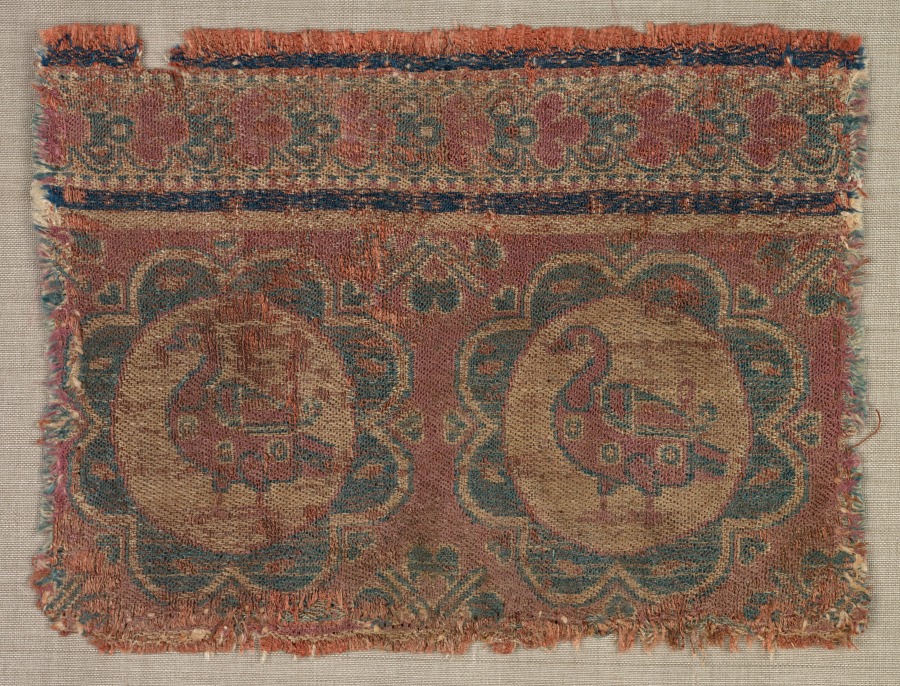
The Ducks of Dunhuang: A Silk Fragment and the Legacy of Imperial Weaving
Materiality and Provenance: The Fabric of Empire
This silk fragment, bearing a repeating pattern of roundels enclosing stylized ducks, is not merely a textile remnant; it is a tangible artifact of the imperial silk weaving legacy that defined Chinese luxury for over two millennia. The materiality of this piece—a warp-faced compound weave, likely a jin (brocade) or kesi (silk tapestry)—speaks to the sophisticated technical mastery of the imperial workshops, particularly those of the Tang dynasty (618–907 CE) and later Song and Ming periods. The silk itself, a protein fiber derived from the cocoon of Bombyx mori, was the exclusive domain of the state, with production and distribution tightly controlled by the Imperial Silkworks in cities like Suzhou, Hangzhou, and Nanjing. The fragment’s condition—a soft, patinated surface with subtle fading of the original vermillion, indigo, and gold threads—reveals a history of careful handling, perhaps as a garment lining, a ceremonial banner, or a diplomatic gift. The weave structure, with its precise count of warp threads per centimeter, indicates a loom of considerable complexity, likely a drawloom operated by master weavers who passed down their techniques through generations of hereditary artisans. This is not a commercial textile; it is a product of the imperial atelier, where every thread was a statement of power, wealth, and cosmic order.
Iconography and Symbolism: The Duck as Imperial Motif
The roundel motif, a hallmark of Tang and Song decorative arts, encloses a pair of ducks—often interpreted as mandarin ducks (Aix galericulata)—in symmetrical flight or repose. In Chinese iconography, the duck is a potent symbol of fidelity, marital harmony, and prosperity, frequently associated with the Confucian virtues of loyalty and domestic bliss. However, within the imperial context, the duck motif transcends mere auspiciousness. The roundel itself, a circular frame derived from Central Asian and Sogdian influences, was adopted by the Tang court as a symbol of universal sovereignty, echoing the celestial sphere and the emperor’s mandate from heaven. The duck, often depicted with a lotus blossom or a peony, reinforces the theme of abundance and renewal, aligning with the imperial ideology of a prosperous and harmonious realm. The repetition of the motif across the silk’s surface—each duck pair identical in posture and detail—demonstrates the weaver’s ability to create a seamless, infinite pattern, a metaphor for the eternal continuity of the dynasty. This is not mere decoration; it is a coded language of power, where every element reinforces the emperor’s role as the pivot between heaven and earth.
Technical Mastery: The Art of the Imperial Loom
The production of such a silk fragment required an extraordinary level of technical precision. The warp-faced compound weave, typical of Tang and Song silks, involved a complex system of pattern harnesses and heddles, operated by a weaver and a drawboy working in tandem. The duck motif, with its intricate curves and fine details, demanded a high-density warp—often 60 to 80 threads per centimeter—and a weft of dyed silk threads in multiple colors. The use of gold-wrapped thread, visible in the roundel’s border, indicates the fragment’s imperial provenance, as gold thread was reserved for the court and high-ranking officials. The dyeing process, using natural pigments from plants and minerals (madder for red, indigo for blue, and orpiment for yellow), was a closely guarded secret, with each dye master working under the supervision of the Imperial Household Department. The fragment’s survival—likely from a tomb, a temple hoard, or a diplomatic archive—testifies to the durability of silk when properly stored, and to the reverence with which such textiles were treated. This is not a fabric for everyday use; it is a ritual object, imbued with the authority of the loom and the blessing of the state.
Legacy and Influence: From the Silk Road to Savile Row
The legacy of imperial silk weaving extends far beyond the borders of China. The Silk Road, a network of trade routes connecting the East to the Mediterranean, carried such textiles to the courts of Persia, Byzantium, and eventually Europe. The roundel motif, with its symmetrical animals and floral borders, was adopted by Byzantine and Islamic weavers, influencing the design of medieval European silks and later the Renaissance velvets of Italy. In the context of London’s Savile Row, the heritage of this silk fragment is palpable. The bespoke tailoring tradition of Savile Row, with its emphasis on craftsmanship, precision, and exclusivity, mirrors the values of the imperial Chinese workshop. The use of silk for linings, ties, and pocket squares in contemporary tailoring is a direct descendant of this ancient legacy, where the fabric’s weight, drape, and sheen are as important as the cut of the garment. The duck motif, reinterpreted by modern designers, appears in herringbone weaves, jacquard patterns, and printed silks, a quiet nod to the Tang dynasty’s mastery of pattern and repetition. For the discerning client of Savile Row, a silk tie or scarf bearing a duck roundel is not just an accessory; it is a conversation piece, a fragment of history woven into the fabric of contemporary luxury.
Conservation and Interpretation: The Role of the Heritage Specialist
As a Senior Heritage Specialist, my role is to preserve, interpret, and contextualize such artifacts for a modern audience. This silk fragment, currently housed in the Lauren Fashion Heritage Lab, requires controlled environmental conditions—stable humidity, low light, and minimal handling—to prevent further degradation. Digital imaging and spectral analysis allow us to document the weave structure and dye composition without physical contact, creating a virtual archive for future research. The fragment’s provenance, traced through auction records and museum catalogs, reveals a journey from a Tang dynasty tomb in the Hexi Corridor to a private collection in London, a testament to the global circulation of luxury goods. In our exhibitions, we pair such fragments with contemporary garments from Savile Row, illustrating the continuity of design language across centuries and cultures. The duck roundel, once a symbol of imperial authority, now serves as a bridge between tradition and innovation, reminding us that the finest craftsmanship—whether in a Tang workshop or a Mayfair atelier—is always a reflection of the human desire for beauty, order, and meaning.
Conclusion: The Enduring Thread
This silk fragment, with its ducks in roundels, is more than a historical curiosity; it is a living artifact of the imperial silk weaving legacy. Its materiality, iconography, and technical mastery speak to a civilization that elevated textile production to an art form, while its journey from Dunhuang to Savile Row underscores the timeless appeal of silk as a medium of luxury and power. For the heritage scholar, the designer, and the connoisseur, this fragment offers a window into a world where every thread was a statement of identity, and every pattern a code of cosmic order. In preserving and interpreting such artifacts, we ensure that the legacy of imperial silk weaving continues to inspire, educate, and elevate the craft of fashion for generations to come.