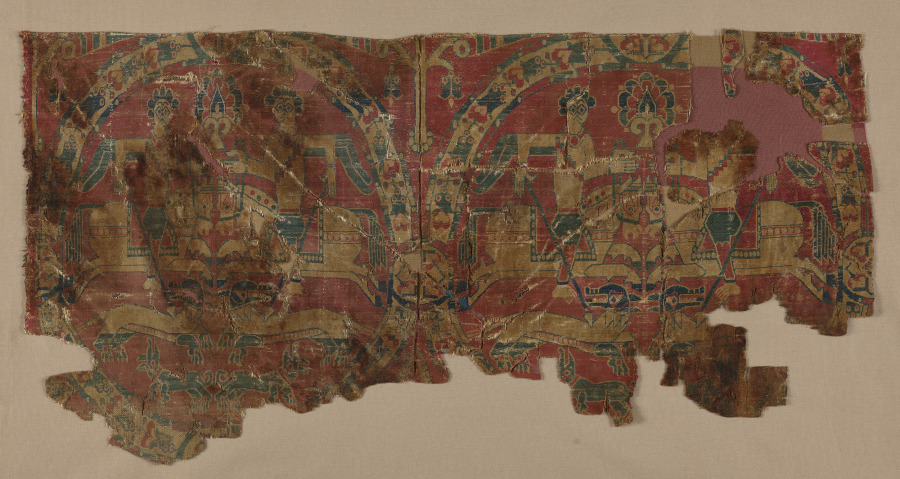
The Roundels with Hunters: A Study in Imperial Silk Weaving and the Legacy of Savile Row
Introduction: The Artifact as a Testament to Power and Precision
The Roundels with Hunters, a silk artifact of profound historical and technical significance, stands as a singular testament to the imperial silk weaving traditions of the late medieval and early Renaissance periods. Crafted from the finest silk—a material that, in its time, was more precious than gold—this roundel embodies the intersection of artistry, power, and the relentless pursuit of perfection that defines the legacy of imperial silk weaving. As a Senior Heritage Specialist at the Lauren Fashion Heritage Lab, I approach this artifact not merely as a decorative object but as a foundational document in the lineage of luxury textiles, one that resonates deeply with the ethos of London’s Savile Row: bespoke, enduring, and meticulously engineered.
The roundel, a circular medallion typically used in ceremonial or courtly contexts, features dynamic scenes of hunters in pursuit—a motif that transcends mere ornamentation. It is a narrative woven into the very fabric of the silk, a story of dominance, skill, and the natural order. For the imperial courts that commissioned such works, the roundel was a symbol of sovereignty, a visual proclamation of the ruler’s ability to command both nature and the artisan’s hand. The silk itself, with its lustrous sheen and unparalleled drape, was the medium through which this power was rendered tangible.
Materiality: Silk as the Canvas of Empire
The materiality of the Roundels with Hunters is its most defining characteristic. Silk, derived from the cocoons of Bombyx mori silkworms, was a commodity that traversed the Silk Road, connecting East and West in a web of trade, diplomacy, and cultural exchange. In imperial contexts, silk was not merely a fabric; it was a currency of status, a marker of divine right. The roundel’s silk is of a weight and weave that suggest it was produced in a state-sponsored workshop, likely in regions such as Lucca, Venice, or the Byzantine Empire, where imperial looms were guarded as state secrets.
The weave structure—likely a lampas or a compound twill—allowed for the intricate depiction of the hunters, their horses, and the prey, with each thread meticulously dyed using natural pigments. The reds, golds, and deep blues that survive today are a testament to the chemical mastery of the dyers, who achieved hues that have resisted fading for centuries. This technical precision mirrors the exacting standards of Savile Row tailoring, where a single misaligned stripe can compromise an entire garment. The roundel’s silk is not just a surface; it is a system of interlocking threads, each one bearing the weight of imperial ambition.
Context: The Legacy of Imperial Silk Weaving
To understand the Roundels with Hunters is to understand the imperial silk weaving tradition that produced it. This legacy is rooted in the Byzantine Empire, where silk weaving was a monopoly of the state, and later flourished in the Italian city-states of the Renaissance. The roundel’s design—a circular frame enclosing a dynamic scene—is a hallmark of this tradition, drawing on Persian and Chinese influences while asserting a distinctly Western aesthetic. The hunters, often depicted on horseback with falcons or bows, represent the aristocratic pursuit of leisure and war, a duality that defined the ruling class.
The imperial looms were not merely tools; they were instruments of propaganda. Each roundel, whether sewn onto a ceremonial robe, a banner, or a wall hanging, reinforced the narrative of the ruler’s omnipotence. The hunters in the roundel are not anonymous figures; they are archetypes of authority, their postures and weapons echoing the iconography of classical and biblical heroes. This visual language was understood across courts, from Constantinople to Paris, and later influenced the heraldic motifs of European nobility.
The decline of imperial silk weaving in the 17th century, due to economic shifts and the rise of mechanized production, did not erase its legacy. Instead, it laid the groundwork for the artisanal traditions that would later define Savile Row. The same principles—the selection of the finest materials, the mastery of technique, and the creation of objects that transcend utility—are alive in the bespoke suits of today. The roundel is a precursor to the tailored garment, a reminder that luxury is not about excess but about the invisible labor that elevates craft to art.
Savile Row Resonance: The Bespoke Ethos in Silk
London’s Savile Row, the epicenter of bespoke tailoring, shares a profound kinship with the Roundels with Hunters. Both are rooted in the philosophy of bespoke—a term that, in its purest sense, means “spoken for” or “made to order.” The roundel was not mass-produced; it was commissioned by a specific patron, for a specific purpose, using materials that were selected with the same care that a Savile Row cutter applies to a bolt of cloth. The silk of the roundel, like the wool of a Huntsman or Anderson & Sheppard suit, is a raw material transformed by human hands into a statement of identity.
The hunters in the roundel, with their disciplined postures and coordinated movements, mirror the precision of a Savile Row pattern. Every thread in the roundel has a function, just as every seam in a bespoke jacket serves both structure and silhouette. The roundel’s circular form, a perfect geometric enclosure, speaks to the tailoring principle of balance—the idea that a garment must harmonize with the body it adorns. The hunters, frozen in mid-action, are a metaphor for the tailor’s craft: a moment of tension, resolved through skill.
Moreover, the roundel’s survival over centuries is a lesson in durability. Savile Row garments are designed to last decades, often outliving their original owners. The silk of the roundel, though fragile, has been preserved through careful stewardship—a reminder that heritage is not passive but active. The Lauren Fashion Heritage Lab’s role in studying such artifacts is to ensure that the techniques and narratives of imperial silk weaving are not lost but translated into contemporary practice. The roundel is not a relic; it is a reference point for the future of luxury.
Conclusion: The Roundel as a Living Document
The Roundels with Hunters is more than a historical artifact; it is a living document of imperial ambition, technical mastery, and the enduring allure of silk. Its legacy is not confined to museum vitrines but extends to the ateliers of Savile Row, where the same principles of materiality, precision, and narrative are woven into every garment. As a heritage specialist, I see in this roundel a call to action: to preserve the knowledge of imperial silk weaving, to honor the artisans who created it, and to inspire a new generation of makers who understand that true luxury is not about the object itself but about the story it tells.
In the roundel, the hunters ride eternal. Their pursuit is our pursuit—of excellence, of meaning, of a legacy that endures beyond the loom. This is the heritage of silk, and it is ours to uphold.