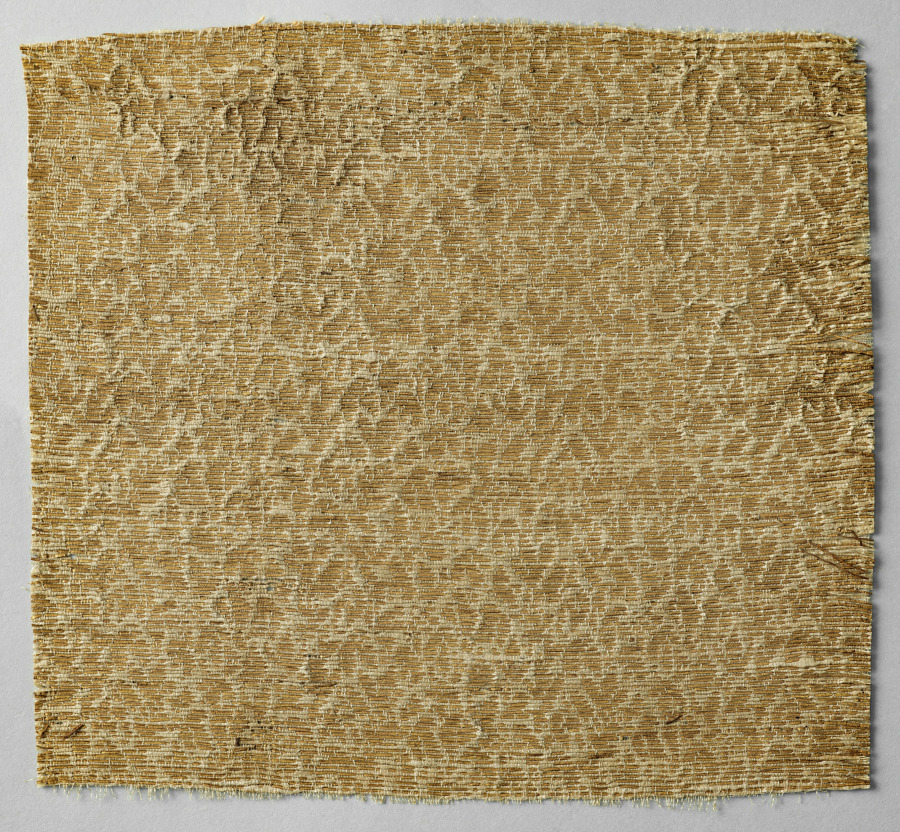
A Treatise on the Imperial Silk Weave: The Specimen of the Diminutive Foliate Motif
To engage with this particular textile—a silk of a most particular character, bearing the repeated motif of tiny, precisely rendered leaves—is to engage not merely with a fabric, but with a continuum of imperial ambition. One must approach it not as a simple decorative article, but as a crystallised moment of administrative genius, aesthetic dogma, and technical supremacy. The materiality, silk itself, is the non-negotiable premise; the very substrate of power in the contexts we must consider. Its handle, its luminosity, its capacity to hold colour and form: these are the foundational truths upon which empires built a visual language of authority.
The Loom as an Instrument of State
The legacy of imperial silk weaving, whether in the Byzantine gynaecea, the vast Ming dynasty workshops of Suzhou and Nanjing, or the regimented manufactures royales of Louis XIV, was fundamentally an exercise in controlled splendour. The imperial loom was never a solitary instrument; it was the nexus of a vast, state-sanctioned ecosystem. It demanded sericulture of a flawless standard, the procurement and formulation of dyes from the farthest reaches of the known world—the crimson of cochineal, the gold of saffron, the elusive purple—and the subjugation of prodigious skill to the service of a singular, approved aesthetic. The weave was, in its essence, a legislated object. To produce silk of this calibre outside of imperial sanction was often not merely illegal, but an act of lèse-majesté.
Within this rigid framework, the motif—our subject’s field of tiny leaves—becomes profoundly significant. It is rarely the grandest statement. It is not the confronting dragon or the expansive phoenix, motifs reserved for the sovereign alone. Rather, it belongs to a sophisticated grammar of subsidiary patterns. These leaves, perhaps of ginkgo, mulberry, or a stylised vine, speak of a natural world ordered, miniaturised, and rendered eternally obedient upon the plane of the cloth. Their repetition is not mere decoration; it is a demonstration of flawless technical execution, a rhythmic assertion of control over every thread, every intersection of warp and weft. The consistency of the motif across the expanse of the textile is the true testament to its imperial provenance, betraying the work of master weavers operating within a system that tolerated no deviation.
The Specimen: A Discourse on Refined Allusion
Observe our specific artifact. The leaves are tiny. This is a point of the utmost consequence. The scale implies intimacy, a design meant not to shout across a throne room, but to whisper of cultivated taste during the closer proximities of courtly life. It suggests a garment for a high-ranking official, a scholar-mandarin, or a member of the imperial household whose status required distinction but not the paramount symbols. The silk likely possesses a sublime weight and a characterful, subdued lustre—what the Chinese connoisseur would term neither too flashy nor too dull.
Consider the possible contexts. In the Chinese tradition, the leaf, while seemingly generic, is never innocent. The mulberry leaf references the very origin of silk itself, a nod to the foundational industry of the state. A ginkgo leaf, with its ancient lineage, whispers of longevity and resilience. A vine suggests interconnectedness and perpetual growth. Wearing such a pattern was to align oneself with these virtuous, state-approved principles. In the Western imperial context, perhaps that of Byzantium or later Baroque Europe, the tiny leaf could evolve into the acanthus or the laurel, symbols of Apollo, of victory, and of classical learning appropriated for Christian or absolutist monarchies. The silk becomes a canvas for heraldry of the natural world, a second skin imbued with allegory.
The colour, now perhaps faded to a gentleman’s dignified patina, would have been originally of deep import. A leaf in sombre blue upon an ivory ground speaks a different dialect than one in gold upon a deep crimson. Each combination was a carefully chosen phrase in the language of courtly hierarchy, dictating season, occasion, and rank with the precision of a legal document.
Enduring Legacy: The Echo in Modern Cloth
The cessation of an empire does not halt the resonance of its artefacts. The legacy of this imperial weaving discipline echoes in the most refined ateliers of the modern age. The Savile Row cutter, for instance, understands the imperative of flawless, consistent repetition—the precise stitch, the symmetrical lapel, the unvarying line of pick-stitching. It is a different application of the same principle: the subjugation of technique to a timeless, governing aesthetic.
More directly, the very existence of this textile specimen, with its tiny leaves, challenges contemporary design. It posits that true luxury lies not in ostentation, but in the depth of allusion and the perfection of execution on a miniature scale. It argues for a heritage of considered subtlety over brute display. To incorporate such a narrative into a modern collection is not to replicate the pattern literally, but to understand and translate its ethos: the weight and fall of such a silk, the dignity of a restrained, all-over pattern, the intelligence of a motif that rewards closer inspection.
In conclusion, this textile is a document. Its silk is the page, its weave the script, and its tiny leaves the carefully chosen vocabulary. It chronicles a world where the production of beauty was an arm of governance, where the wearer was a walking manifesto of state ideology, and where the highest art was to render profound meaning with such exquisite subtlety that it appeared, to the undiscerning eye, as mere decoration. It is, in the final analysis, a masterclass in the power of the minute, a testament to the fact that in the most rarefied circles of heritage, authority has often spoken in a whisper, woven in silk.