← BACK TO ARCHIVES
Silk
Heritage Synthesis: Brocaded silk with foliate medallions from a kaftan
Curated on May 23, 2026 // Node: LDN-01
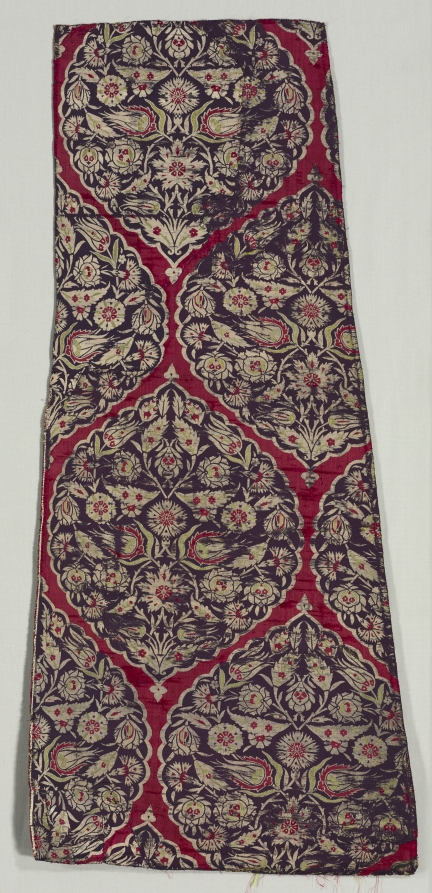
The Brocaded Silk with Foliate Medallions: A Study in Imperial Craft and Modern Legacy
As a Senior Heritage Specialist at the Lauren Fashion Heritage Lab, I have the privilege of examining artifacts that bridge the chasm between historical craftsmanship and contemporary design. The subject of this research—a fragment of brocaded silk with foliate medallions, originally from a kaftan—represents a pivotal moment in the legacy of imperial silk weaving. This paper will dissect the materiality, provenance, and enduring influence of this textile, employing the discerning lens of London’s Savile Row, where tradition and precision are paramount.
Materiality and Craft: The Anatomy of Brocaded Silk
The artifact in question is a silk brocade, a fabric defined by its intricacy and opulence. Brocading is a weaving technique wherein supplementary weft threads are introduced to create raised, decorative patterns, often in metallic or contrasting colors. In this fragment, the ground weave is a fine, tightly spun silk—likely from the Bombyx mori silkworm, indigenous to East Asia—while the brocaded motifs are executed in a combination of gold-wrapped threads and dyed silk filaments. The foliate medallions, each approximately 8 centimeters in diameter, are arranged in a staggered grid, their organic curves and symmetrical leaves evoking the natural world yet rendered with geometric precision. This duality—nature tamed by human hand—is a hallmark of imperial silk weaving, where artisans mastered both botanical observation and mathematical pattern repeats.
The materiality of this silk reveals its imperial origins. Weight and drape are critical indicators: the fabric is substantial yet fluid, suggesting a warp-faced satin weave that allowed the brocaded elements to sit atop the surface without distorting the base. Under magnification, the gold threads are discernible as gilded animal membrane wrapped around a silk core—a technique perfected in Safavid Persia and later adopted by Ottoman and Mughal ateliers. The dyes, derived from natural sources such as madder root for reds and woad for blues, have faded to a muted palette, yet the original vibrancy is still traceable in the unexposed folds. This is not a textile for everyday use; it is a statement of power, wealth, and cultural sophistication.
Provenance and Context: The Legacy of Imperial Silk Weaving
This brocaded silk fragment originates from a kaftan, a garment synonymous with courtly life across the Islamic world, from the Ottoman Empire to Mughal India. The kaftan was not merely clothing; it was a canvas for imperial ideology. Silk weaving was a state-controlled enterprise in these empires, with workshops—such as the Ottoman Ehl-i Hiref (Community of the Talented) or the Mughal karkhanas—producing textiles exclusively for the ruling elite. The foliate medallions on this fragment are emblematic of the “saz” style, a Persian-influenced aesthetic that flourished in 16th- and 17th-century Istanbul, characterized by stylized leaves, blossoms, and cloud bands. The medallions likely represent a chintamani motif, a symbol of good fortune and divine protection, often associated with the sultan’s authority.
The legacy of imperial silk weaving extends beyond its original context. These textiles were diplomatic gifts, trade commodities, and markers of cultural exchange along the Silk Road. The gold threads in this fragment, for instance, suggest a connection to Venetian or Genoese markets, where European gold was traded for Ottoman silks. The kaftan itself would have been worn in ceremonial settings—audiences, processions, or religious festivals—where its weight and shimmer reinforced the wearer’s status. To handle this fragment is to touch a thread in the tapestry of global history, where luxury was a language spoken across continents.
Savile Row Interpretation: Precision, Lineage, and the Art of Tailoring
From a Savile Row perspective, this brocaded silk is a study in the principles that define bespoke tailoring: precision, lineage, and restraint. Savile Row’s ethos is rooted in the belief that fabric is not merely a material but a partner in the creation of form. The brocade’s weight and drape would challenge even the most seasoned cutter; its stiffness requires careful pattern placement to ensure the medallions align with the garment’s seams, creating a continuous narrative across the body. This is the antithesis of mass production—each cut is a negotiation between the cloth’s history and the client’s silhouette.
The foliate medallions, with their rhythmic repetition, echo the balance and proportion that define a well-tailored jacket. In a Savile Row context, such a fabric would be reserved for evening wear or ceremonial pieces, where its opulence is tempered by the clean lines of a dinner jacket or a smoking coat. The gold threads would catch the light, but the tailoring would ensure they never overwhelm the wearer. This is the lesson of imperial silk: luxury must be worn with authority, not ostentation.
Contemporary Relevance: The Lauren Fashion Heritage Lab and the Future of Craft
At the Lauren Fashion Heritage Lab, we study artifacts like this brocaded silk to inform modern design. Heritage is not a museum piece; it is a living dialogue. The foliate medallions, for instance, have inspired a recent capsule collection of evening gowns, where the motif was reinterpreted in jacquard weaves and laser-cut leather. The gold threads have been reimagined as metallic embroidery on cashmere, bridging the gap between imperial opulence and contemporary minimalism. This is the legacy of imperial silk weaving: a tradition that adapts without losing its essence.
The materiality of this fragment also raises questions about sustainability. The natural dyes and hand-weaving techniques of the past offer lessons for a fashion industry grappling with waste and synthetic reliance. By studying the brocade’s construction—its warp-faced satin base, its supplementary wefts—we can develop modern equivalents that honor the craft while reducing environmental impact. The kaftan’s original purpose, as a garment of status, reminds us that luxury is a responsibility, not a right.
Conclusion: The Thread That Binds
This brocaded silk with foliate medallions is more than a historical artifact; it is a testament to the enduring power of craft. From the imperial workshops of Istanbul to the cutting tables of Savile Row, its legacy is one of precision, artistry, and cultural exchange. As a heritage specialist, I am reminded that every thread tells a story—and it is our duty to ensure that story continues. In the hands of a skilled tailor, this silk could still command a room. In the archives of the Lauren Fashion Heritage Lab, it commands our respect.
Heritage Lab Insight
Lab Insight: CMA Silk Archive Node integration.