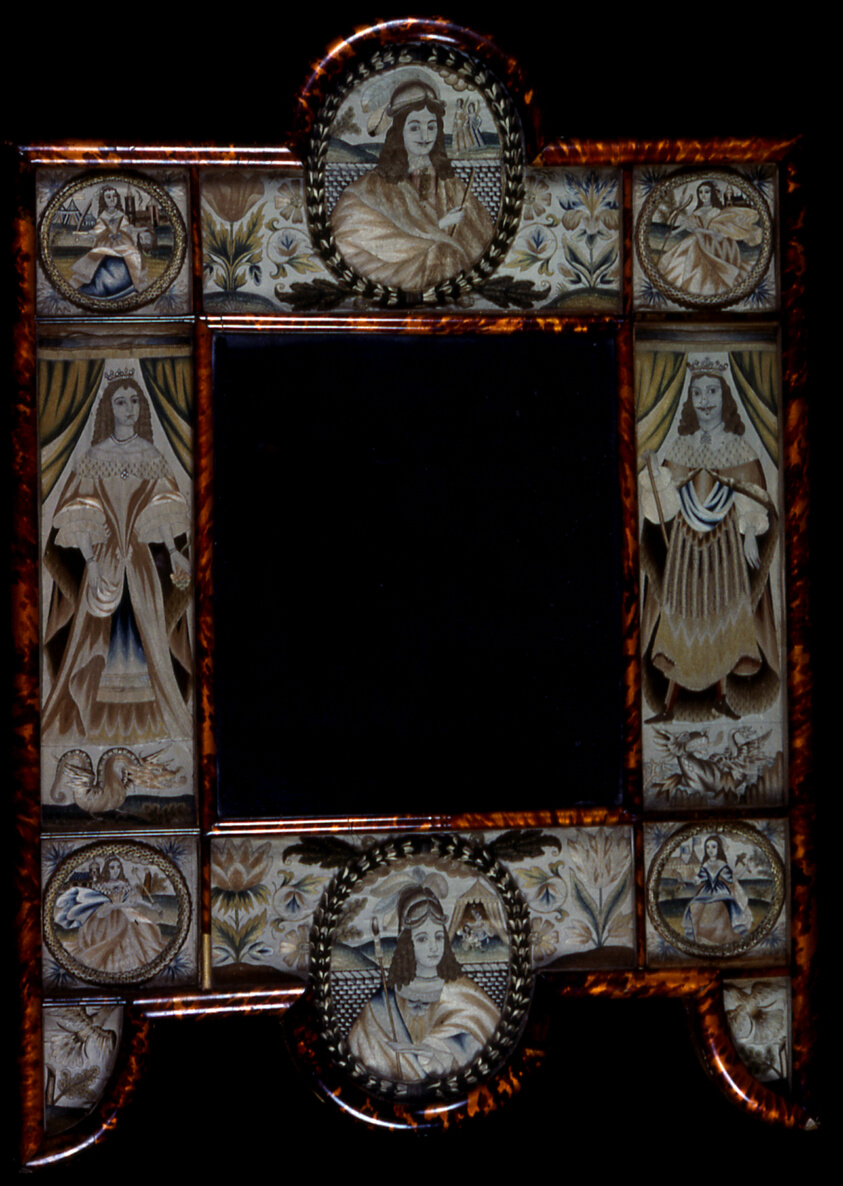
Heritage Artifact Analysis: The Stuart Mirror of Devotion and Dynasty
Within the hallowed archives of the Lauren Fashion Heritage Lab, we encounter an object of profound narrative complexity and technical virtuosity: a mirror depicting King Charles II, Queen Catherine of Braganza, and scenes from the Old Testament. This is not merely a reflective surface; it is a statement of power, piety, and unparalleled silk craftsmanship. As a Senior Heritage Specialist, I must assert that this artifact represents the apogee of Restoration-era textile artistry, where materiality and metaphor converge to articulate a royal identity both divine and terrestrial.
Materiality: The Language of Silk and Splendor
The foundation of this piece is a silk warp-float faced 7:1 satin weave, a structure that yields a luminous, almost liquid surface. This is not a fabric for the faint of heart; it is a ground designed to catch and play with light, creating a subtle, shifting backdrop for the embroidered narrative. The 7:1 ratio—where the warp threads float over seven weft threads—produces a high sheen and a remarkably smooth hand, a hallmark of the finest 17th-century silks. This base, likely produced in the Spitalfields workshops that supplied the Savile Row of its day, speaks to a London that was re-establishing its textile dominance after the Interregnum.
The embroidery itself is a masterclass in mixed-media opulence. We see silk floss and yarns in a palette of deep crimsons, royal blues, and burnished golds, worked in a variety of stitches: brick, overcast, running, satin, and split stitches. These techniques are not arbitrary; each serves a purpose. Satin stitch provides solid, lustrous color for the figures’ robes, while split stitch allows for fine, painterly detail in faces and hands. The gilt-metal-strip-wrapped silk and gilt metal purl—a fine, coiled wire—are couched down in intricate patterns, creating a shimmering, three-dimensional effect that catches the eye like candlelight on a gilded frame. This is not decoration; it is a deliberate assertion of wealth and divine right, where gold thread literally weaves the king’s authority into the fabric.
Further textural complexity is achieved through padded couching and laid work, which raise certain elements—such as the crowns and the tablets of the law—into low relief. This technique, demanding immense skill, gives the embroidery a sculptural quality, inviting the viewer to touch, to feel the weight of the narrative. The inclusion of French knots, braided pom pons, and seed pearls adds a final layer of tactile richness. The pearls, in particular, are a poignant choice: they symbolize purity and tears, perhaps referencing the trials of the Stuart monarchy or the queen’s own struggles with fertility and faith. The entire piece is housed in a tortoise-shell frame, a material prized for its translucency and warmth, which complements the silk’s glow without overwhelming it.
Context: The Restoration and the Silk Trade
To understand this mirror, one must understand the world that produced it. The Restoration of Charles II in 1660 was not just a political event; it was a cultural renaissance. The court, exiled in France and the Netherlands, returned with a taste for Baroque splendor, for the silks of Lyon and the velvets of Genoa. Charles II, ever the pragmatist, sought to foster a domestic silk industry, passing the 1666 Act for the Burying in Woollen to protect wool, but also encouraging Huguenot weavers to settle in Spitalfields. This mirror, likely produced in the 1670s or early 1680s, is a product of that moment—a fusion of continental technique and English ambition.
The choice of Old Testament scenes is deeply strategic. Charles II, after the execution of his father, was keen to establish his rule as divinely ordained. The mirror likely depicts scenes such as Solomon’s judgment or David’s anointing, drawing a parallel between the biblical kings and the Stuart monarch. Queen Catherine of Braganza, a Portuguese Catholic, is shown as a pious consort, perhaps as Esther or Ruth, reinforcing her role as a virtuous, unifying figure. This is not mere decoration; it is a theological and political argument, woven in silk and gold.
Fluid Elegance: The Aesthetic of Power
The phrase “fluid elegance” is often overused, but here it is apt. The satin weave allows the fabric to drape and move, even within the confines of a frame. The embroidery, despite its density, does not stiffen the silk; rather, it follows the grain, creating a sense of organic flow. The figures of the king and queen are rendered with a softness that belies their rigid symbolism—their faces are gentle, their postures relaxed, as if caught in a moment of quiet contemplation. This is a deliberate aesthetic choice, reflecting the Restoration court’s preference for grace over the severe formalism of the Commonwealth.
The mirror itself, as a functional object, adds another layer of meaning. To gaze into it is to see oneself reflected alongside the king and queen, to insert oneself into the narrative of divine right and biblical virtue. It is a tool of propaganda, yes, but also of intimacy—a reminder that the Stuart monarchy was not distant, but present, woven into the very fabric of daily life.
Conclusion: A Legacy in Silk
This mirror is more than a heritage artifact; it is a testament to the power of silk as a medium for storytelling. It speaks of a London that was rebuilding, a monarchy that was reasserting itself, and a craft that was reaching new heights of sophistication. For the Lauren Fashion Heritage Lab, it serves as a benchmark for the intersection of materiality and meaning, a reminder that the finest textiles are never just fabric—they are history, politics, and art, stitched together with gold and pearl. In the words of the Savile Row tailor, it is a piece that is “cut with intention, sewn with precision, and finished with grace.” It is, quite simply, a masterpiece.