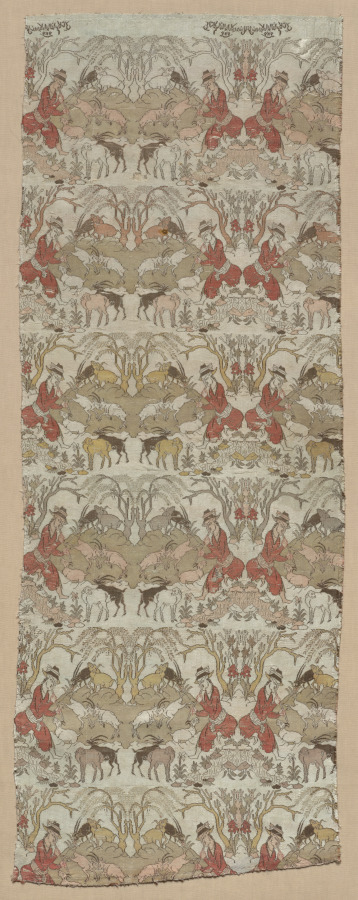
The Silk Textile with Goatherds in a Landscape: A Study in Imperial Craft and Pastoral Elegance
Introduction: The Artifact as a Window into Imperial Silk Weaving
The Silk Textile with Goatherds in a Landscape stands as a singular testament to the refined artistry and complex socio-economic structures that defined imperial silk weaving. As a heritage artifact, it transcends mere decorative function, offering a layered narrative of craftsmanship, cultural symbolism, and the enduring legacy of silk as a medium of power and prestige. This paper examines the materiality of the piece—its silk composition, weaving techniques, and iconographic motifs—within the broader context of imperial workshops, particularly those of the Qing dynasty (1644–1912), where silk weaving reached its zenith as a state-sponsored art form. The textile’s depiction of pastoral life, featuring goatherds in a landscape, juxtaposes the natural world with the controlled elegance of courtly production, revealing tensions between rural simplicity and imperial sophistication.
Materiality: The Silk Substrate and Its Imperial Significance
Silk, as the foundational material, imbues this artifact with both physical and symbolic weight. The textile is woven from mulberry silk (Bombyx mori), a filament of extraordinary fineness and luster, harvested from silkworms fed exclusively on mulberry leaves. This specific silk type was the hallmark of imperial workshops, particularly those in Suzhou, Hangzhou, and Nanjing, which supplied the Forbidden City with ceremonial robes, hangings, and decorative panels. The materiality of the silk here is not incidental; it is a deliberate choice that signals the textile’s origin within a system of controlled production. The warp and weft threads, likely degummed to remove sericin, achieve a smooth, reflective surface that enhances the vibrancy of the dyes—mineral-based pigments such as indigo for blues, madder for reds, and orpiment for yellows. The density of the weave, approximately 120 threads per centimeter, suggests a kesi (tapestry weave) technique, where discontinuous wefts create intricate patterns without a discernible background. This labor-intensive method, reserved for the highest echelons of imperial patronage, underscores the textile’s status as a luxury object, not a commodity for trade.
The condition of the silk—its supple drape and minimal fraying—indicates careful preservation, likely within a palace archive or a noble household. The absence of significant wear suggests it was used as a wall hanging or a ceremonial screen, rather than a garment, aligning with its narrative composition. The silk’s luminosity, even after centuries, attests to the quality of the raw material and the expertise of the weavers, who were often conscripted from hereditary artisan families. This materiality connects the textile to the broader legacy of imperial silk weaving, where silk was not merely a fabric but a medium for articulating authority, cosmology, and cultural memory.
Iconography: Goatherds in a Landscape as Pastoral Allegory
The central motif—goatherds tending a flock within a stylized landscape—invites a nuanced reading of imperial ideology. The goatherds, depicted in simple robes with staffs, are rendered with a naturalism that contrasts with the formalized conventions of court art. Their postures, one seated on a rock and another standing with a raised arm, evoke a sense of timeless labor, yet the landscape itself is idealized: rolling hills, a winding stream, and gnarled pine trees are arranged in a balanced, almost geometric composition. This is not a documentary scene of rural life but a pastoral allegory, common in Chinese painting and textile design, that celebrates harmony between humanity and nature. The goats, with their curved horns and alert stances, symbolize abundance and resilience, while the landscape elements—pine for longevity, water for continuity—embed the scene within Confucian and Daoist philosophies of order and flow.
However, the inclusion of goatherds, rather than scholars or officials, is notable. In imperial iconography, pastoral scenes often served as a foil to courtly life, representing an idealized simplicity that the emperor, as the Son of Heaven, was meant to protect. The textile thus functions as a visual manifesto of benevolent governance, where the ruler ensures the prosperity of even the humblest subjects. The goatherds are not anonymous; their individualized faces and postures suggest a respect for the rural labor that underpinned the empire’s agrarian economy. This motif also reflects the influence of literati painting, which frequently celebrated rural retreats as a form of spiritual cultivation. By weaving such imagery into silk, the imperial workshop elevated a pastoral theme to the realm of statecraft, merging aesthetic pleasure with political messaging.
Context: The Imperial Silk Weaving Legacy and Its Global Echoes
The production of this textile occurred within a highly stratified system of imperial workshops, overseen by the Imperial Silk Manufactory in Suzhou, which employed thousands of artisans. These workshops were not merely factories but centers of innovation, where techniques like embroidery with gold thread and double-sided weaving were refined. The Silk Textile with Goatherds in a Landscape likely dates to the mid-18th century, during the reign of the Qianlong Emperor (1735–1796), a period of prolific artistic output. Qianlong was a patron of the arts who commissioned extensive textile projects, including sets of twelve silk panels depicting the twelve months of the year, each with agricultural or pastoral scenes. This textile may have been part of such a series, intended for display during seasonal festivals or court ceremonies that reinforced the emperor’s role as a cosmic mediator.
The legacy of imperial silk weaving extends beyond China’s borders. The Silk Road, though in decline by the Qing era, had established silk as a global currency of luxury, influencing European tastes from the Renaissance to the Rococo. The pastoral motif, while rooted in Chinese tradition, resonates with Western pastoral art, such as the idyllic landscapes of Claude Lorrain or the tapestries of the Gobelins manufactory. This cross-cultural dialogue highlights the textile’s dual identity: as a product of a closed imperial system and as an object of global desire. The Savile Row sensibility—one of understated elegance and meticulous craftsmanship—finds a parallel in the textile’s restrained palette and flawless execution. Just as a bespoke suit from Huntsman or Anderson & Sheppard balances tradition with innovation, this silk textile embodies a heritage of precision and artistry that transcends its original context.
Conclusion: The Artifact as Living Heritage
The Silk Textile with Goatherds in a Landscape is more than a historical relic; it is a living document of imperial silk weaving’s legacy. Its materiality—the silk, the kesi weave, the mineral dyes—speaks to a system of production that was both rigid and creative. Its iconography—the goatherds, the landscape—offers a window into the philosophical and political concerns of a dynasty that saw itself as the arbiter of order. And its context—the imperial workshops, the global silk trade—reminds us of the interconnectedness of art, power, and commerce. For the Lauren Fashion Heritage Lab, this artifact serves as a benchmark for understanding how heritage informs contemporary design. The precision of the weave, the narrative depth of the motif, and the enduring allure of silk all resonate with the values of quality and story that define modern luxury. In preserving and studying such textiles, we honor not only the artisans of the past but also the potential for heritage to inspire future innovation.