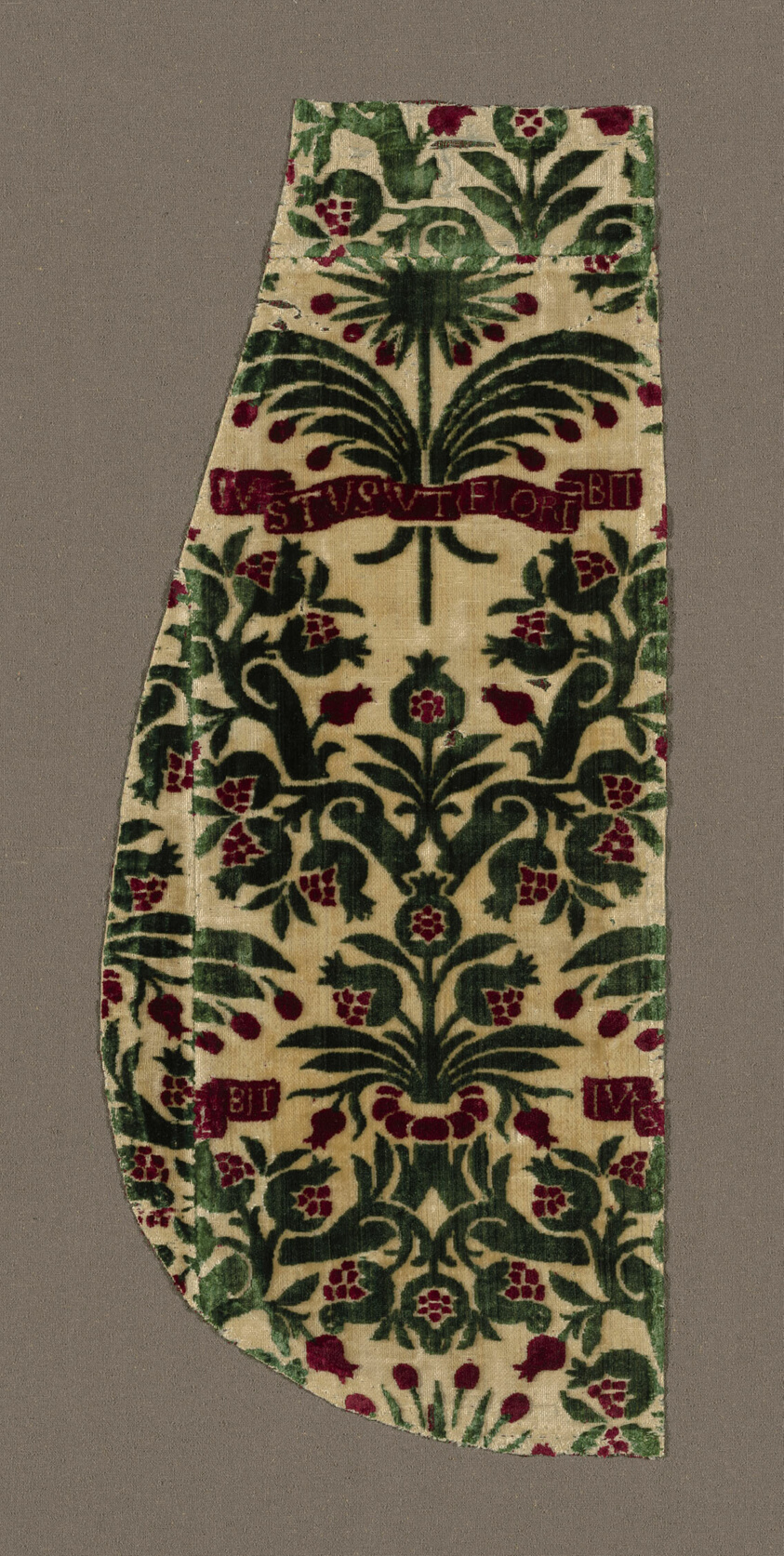
An Examination of Material Authority: The Silk Velvet Chasuble Fragment
To engage with this artifact—a portion of a chasuble in silk, satin weave, cut solid velvet—is to conduct an audit of material supremacy. One does not merely observe it; one assesses its inherent credentials. In the lexicon of cloth, where wool commands respect and cotton offers utility, silk occupies the boardroom. It is the chief executive of fibres, a natural polymer of such formidable reputation that its very name has become shorthand for unassailable luxury and technical accomplishment. This particular specimen, however, represents not merely silk in its basic state, but silk elevated through a series of deliberate, complex interventions: the satin weave foundation, the velvet pile, the precise act of cutting. The result is a material of profound depth, both literal and figurative, whose context of "classic silk craftsmanship and fluid elegance" is not a mere description, but a statement of first principles.
The Foundation: Satin Weave as Strategic Architecture
Any superior garment, from a double-breasted overcoat to a liturgical vestment, relies fundamentally on the integrity of its ground. Here, that ground is a satin weave. This is not a casual selection. The satin weave is a specific, calculated construction wherein the warp threads dominate the surface, floating over multiple weft threads before passing under one. This engineering produces a plane of exceptional smoothness, a flawless, uninterrupted bed of filament silk that possesses a characteristically subdued lustre. It is not glossy in the vulgar sense; it is luminous. This foundation provides the essential, stable substrate—the canvas, as it were—upon which the more theatrical element of velvet will be built. In sartorial terms, think of it as the perfect canvassing and inner structure of a jacket: unseen by the client, but absolutely responsible for the garment’s enduring form and drape. The satin ground ensures the fabric possesses the requisite fluid elegance, allowing it to move with a dignified, weighted grace, rather than a frivolous flutter.
The Pinnacle Achievement: The Velvet Pile
Upon this impeccable ground, the velvet is formed. Cut solid velvet represents one of the textile arts' most resource-intensive and risk-laden endeavours. It involves the creation of an additional set of warp threads—the pile warps—raised over wires during the weaving process to form loops. The critical moment, the *coup de maître*, is the cutting of these loops. Executed with a blade of singular sharpness and steadiness, this action transforms uniform loops into a standing forest of individual silk filaments. The margin for error is nil; a single tremor renders a flaw that cannot be concealed. The "solid" nature of this velvet indicates a pile of a single, intense colour, a commitment to depth rather than pattern. The consequence is a surface that engages light and touch in a manner no flat weave can emulate. Light does not reflect off it; it is absorbed, pooled, and re-emitted from the depths of the pile, creating a chromatic richness that appears almost liquid. To the hand, it offers a resistance, a plush density that speaks of immense material investment. This is the fabric’s authoritative presence.
Context and Consequence: Liturgical Sartorialism
The application of this superlative cloth to a chasuble is a matter of profound symbolic and practical congruence. The chasuble, the outermost vestment of the Eucharistic celebrant, is a garment of singular purpose and visibility. It must communicate sanctity, solemnity, and the glory of the occasion through its very substance. The use of silk velvet achieves this not through logo or label, but through innate material virtue. The fluid drape of the satin-backed velvet ensures the garment moves with the officiant’s gestures in a manner both majestic and supple. The depth of colour and the luxurious handle of the pile speak to the worthiness of the rite, an offering of the finest earthly materials in a sacred context. This is sartorial theology: the craft is an act of devotion, the material a testament to belief. In the rarefied world of Savile Row, we understand this implicitly. The selection of a fourteen-ounce West of England wool for a commission is not merely a practical choice; it is an alignment of values—heritage, performance, understatement. So too with this chasuble fragment. The silk velvet is the absolute appropriate cloth for its office.
A Legacy in the Hand
To hold this fragment is to appreciate a chain of expertise that spans continents and centuries: the cultivation of the silkworm, the reeling of the filament, the dyeing with likely mineral or insect-based dyes to achieve a profound, fast colour, the mastery of the complex loom, and the steady nerve of the cutter. Each step is a point of potential failure, demanding knowledge that is accrued, not invented. The "classic craftsmanship" referenced is this very continuum of skilled execution. The artifact in question, though now a fragment, retains its essential character. Its edges may be silent, but its surface speaks volumes. It asserts that true luxury is not about novelty, but about excellence sustained. It argues for a world where materials are understood, respected, and deployed with intentionality. In an age of noise and ephemera, this swatch of silk velvet stands as a quiet, unimpeachable rebuttal—a testament to the enduring power of material integrity, technical mastery, and purposeful elegance.
In conclusion, this portion of a chasuble is far more than a relic of ecclesiastical tailoring. It is a benchmark. It represents the pinnacle of a specific material science, where the inherent properties of silk are amplified through architectural weave and transformative finish to create a cloth of sovereign dignity. Its context is its justification. Its materiality is its argument. And in that, it shares the fundamental ethos of the finest bespoke suiting: an unwavering commitment to the supremacy of the right material, executed with peerless craft, for a purpose beyond the merely ornamental. It is, in every sense, a canonical piece.