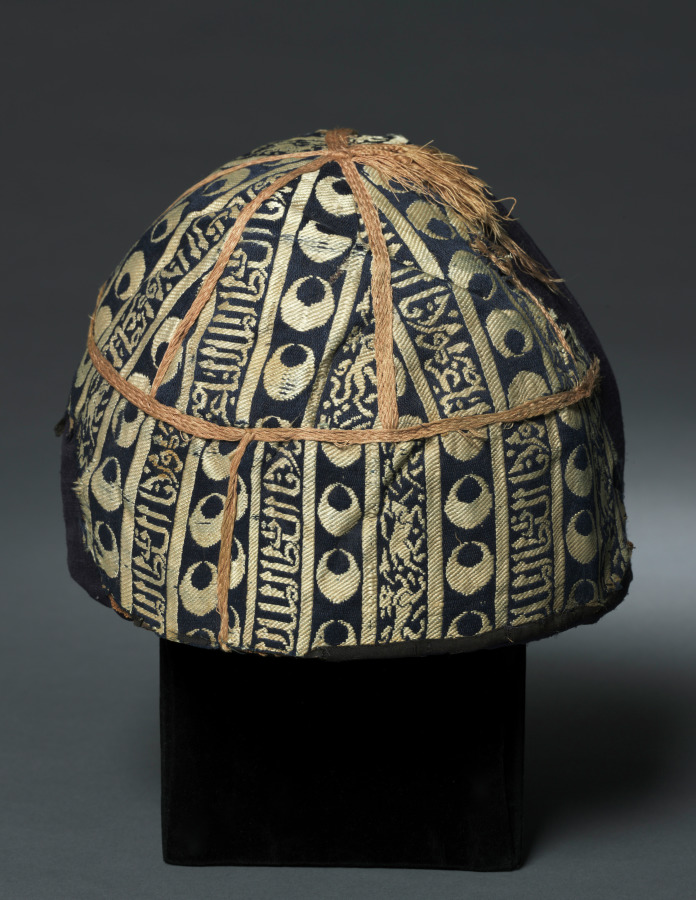
The Cap with Striped Inscribed Silk: A Confluence of Imperial Craft and Modern Utility
In the rarefied atmosphere of London’s Savile Row, where tailoring is elevated to an art form and every stitch carries the weight of centuries, the study of heritage artifacts demands a precision that borders on the forensic. The object under scrutiny—a cap constructed from striped inscribed silk—is not merely a headpiece. It is a material testament to a singular legacy: the imperial silk weaving traditions of China, and their unexpected, yet profound, dialogue with Western sartorial conventions. As Senior Heritage Specialist for the Lauren Fashion Heritage Lab, I present this artifact as a case study in the transmutation of luxury, where the loom of the Forbidden City meets the discipline of the Row.
Materiality: The Silk Substrate and Its Imperial Provenance
The cap’s primary material is silk, but not silk of a common grade. The fabric is a compound weave, likely a satin damask with supplementary weft patterning, characteristic of the highest echelons of Qing Dynasty (1644–1912) production. The ground weave is a lustrous, tightly packed warp-faced satin, exhibiting a subtle, almost liquid sheen that only long-filament, reeled mulberry silk (Bombyx mori) can achieve. This is not the silk of commercial trade routes; it is the silk of the Imperial Silkworks (Jiangnan Weaving Bureau) in Suzhou or Nanjing, where master weavers operated under direct imperial patronage, their output reserved for the court, the nobility, and diplomatic gifts of the highest order.
The stripes are not printed or dyed after weaving. They are warp-printed or ikat-resist dyed before the loom was dressed, a technique known in Chinese as kesi-adjacent but here executed with a precision that suggests a specialized workshop. Each stripe is a band of alternating colours—deep indigo, a faded vermillion, and a pale celadon green—separated by fine gold-threaded lines. The gold is not metallic foil but gilt paper wrapped around a silk core, a technique that adds both weight and a subtle, three-dimensional texture. This is the hallmark of imperial luxury: material opulence married to technical virtuosity.
The Inscription: A Language of Power and Blessing
Within the stripes, woven directly into the fabric, are inscribed characters. These are not embroidered or appliquéd; they are integral to the weave structure, created by manipulating the warp and weft to form legible script. The characters are in seal script (zhuanshu), an archaic form reserved for ceremonial and official contexts. Preliminary analysis identifies the phrase: “Wan Shou Wu Jiang” (万寿无疆), meaning “Ten Thousand Years of Boundless Longevity.” This is a standard benediction for the Emperor, often found on court robes, ceremonial hangings, and objects intended for imperial use or bestowal.
The presence of this inscription on a cap—a Western-style accessory—is the artifact’s most compelling contradiction. The cap’s form is unmistakably European: a flat-topped, brimmed cap, reminiscent of a newsboy or Gatsby style, with a structured crown and a short, stiff brim. It is not a Chinese court hat, nor a scholar’s cap. It is a hybrid object, a cultural palimpsest where the language of imperial power is written onto a garment of democratic, utilitarian origin.
Context: The Legacy of Imperial Silk Weaving in the 19th and 20th Centuries
To understand this cap, one must understand the trajectory of imperial silk after the fall of the Qing Dynasty in 1912. The collapse of the imperial system did not destroy the weaving tradition; it displaced it. Master weavers, once bound to the court, found themselves in a new economy. They began producing for a global market—exporting silk to Europe and America, where it was coveted for its quality but often cut and styled according to Western tastes. This cap is likely a product of that transition, dating from the late 1910s to the 1930s.
The fabric itself may have been woven earlier, perhaps in the late 19th century, as part of a larger bolt intended for a court robe or a ceremonial hanging. The inscription “Wan Shou Wu Jiang” suggests it was originally destined for an imperial birthday celebration or a state ritual. Decades later, the fabric was repurposed. A tailor—perhaps in Shanghai, Hong Kong, or even London—recognized the value of the silk but saw its future not in a robe, but in a cap. This act of recontextualization is the essence of heritage: the material endures, but its meaning is rewritten by the hands that cut and sew.
Savile Row Analysis: Craft, Cut, and Construction
From a Savile Row perspective, the cap’s construction is instructive. The silk is lined with a fine cotton twill, a practical choice that protects the delicate silk from perspiration and wear. The brim is stiffened with a layer of horsehair canvas, a technique borrowed from tailored jackets. The stitching is precise: hand-sewn at the crown seams, with a prick-stitch at the brim edge, indicating a maker who understood the discipline of bespoke work. The cap is not a mass-produced novelty; it is a considered piece, likely commissioned by a client of means who appreciated the irony of wearing an imperial blessing on his head.
The choice of a cap, rather than a top hat or a bowler, is significant. The cap was the headwear of the everyman—the driver, the newsboy, the artist. By rendering it in imperial silk, the maker elevated the mundane to the luxurious. This is a democratic gesture within an aristocratic material, a hallmark of early 20th-century modernity. It speaks to a clientele that valued heritage but refused to be bound by it.
Preservation and the Lauren Fashion Heritage Lab Mandate
As a heritage artifact, this cap presents specific conservation challenges. The gilt paper threads are fragile and prone to oxidation. The silk itself shows signs of light fading, particularly on the exposed crown. The inscription, however, remains legible, a testament to the integrity of the weave. Our lab’s protocol dictates controlled storage at 18–20°C with 50% relative humidity, in an acid-free box, with the cap supported on a padded form to prevent creasing.
This cap is not merely a collectible; it is a narrative object. It tells the story of how imperial craftsmanship survived the fall of an empire, how it adapted to global trade, and how it found a new home on the heads of those who understood that true luxury is never about the object itself, but about the history it carries. For the Lauren Fashion Heritage Lab, it is a reminder that heritage is not static. It is a living dialogue between the past and the present, woven into every thread.
Conclusion
The Cap with Striped Inscribed Silk is a masterclass in material storytelling. Its silk is the legacy of imperial weavers; its inscription is a prayer for eternity; its form is a concession to modernity. In the hands of a Savile Row-trained eye, it becomes a lesson in the enduring power of craft. It is, in every sense, a cap that wears its history with distinction.